

8. Ceramic Development in China
| 769 Page: 109 of 418 Go To Page: |  |
◁◁ First | ◁ Previous | Next ▷ | Last ▷▷ |
The input of Liao ceramic culture to the Chinese melting pot cannot be ignored. They inherited the tradition of polychrome lead glazing from the Tang, but now they had mastered the techniques of lead glazing in which the running together of glazes, which had imparted so much charm to Tang grave goods, could now be kept well within limits.
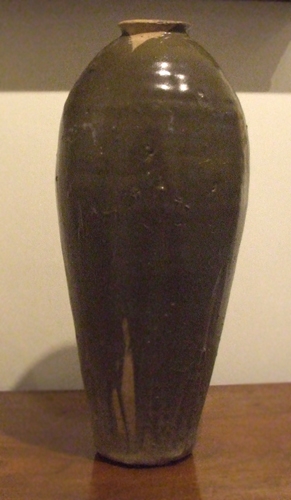
Liao massive stoneware jar with opaque
green glaze - courtesy R&G
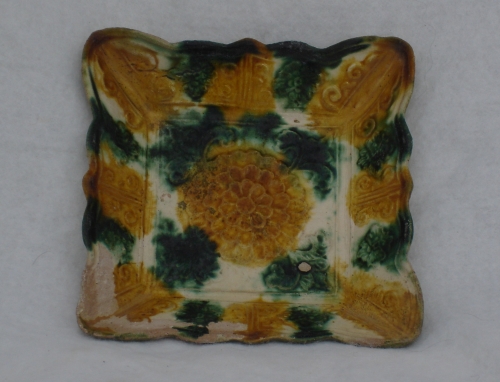
Liao sancai painted dish with central
chrysanthemum - courtesy Glade Antiques
These improvements were absorbed into general Chinese ceramic culture. The Liao produced lead-glazed earthenware, stoneware and porcelaneous ware. Also monochrome ware was produced, that was white-slipped to hide the body colour.
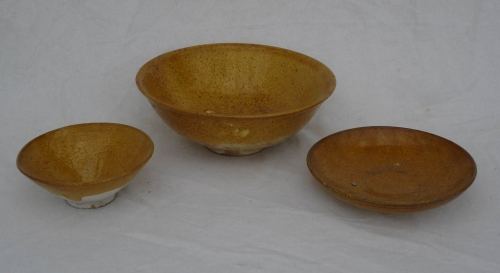
Liao yellow glazed bowls - courtesy Glade
The reddish-brown earthenware was fired high enough to be hard and resonant (rings when struck). Stoneware varied from reddish to pale grey, the latter being denser.
The porcelaneous body was hard, thin and almost white. Some very thin, exceptionally white bowls made for the Liao ruling house may have been produced in the Ding kilns that had started production in the late Tang Period but were controlled by the Liao for a short time in the 11th century.
Glazes were green, yellow or white and shapes often distinctive, particularly wine flasks and tall vases. Other shapes were based on Tang pottery or metalwork traditions of the North. Simpler shapes were thrown on a wheel, but more eccentric shapes were constructed over moulds.
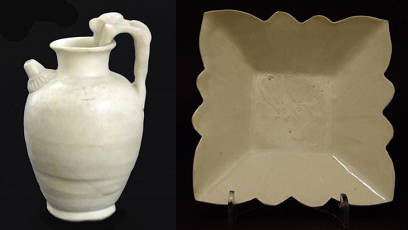
Liao miniature ewer with lion handle &
Ding dish with butterflies - courtesy
R&G McPherson Antiques
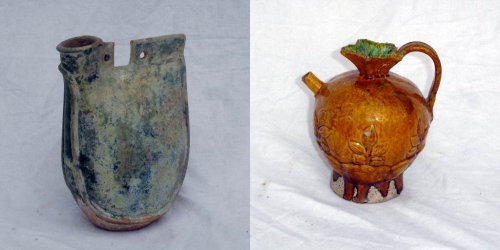
Jar copying leather water bottle and
yellow glazed jug - courtesy Glade
Antiques
This technique of using moulds with decorative motifs was a most important innovation and was to have a significant influence in the early 12th century in fostering industrialisation in China far ahead of other countries.
The Liao abandoned their Shamanic religion and turned to Buddhism. Many large Temples were built at this time in North China. Emperor Xingzong ordered a great pagoda to be built in his Capital, and it was completed in 1056. His wooden pagoda has nine storeys and at 67m high is the tallest well-preserved wooden building in China.
| Page: 109 of 418 Go To Page: | |
◁◁ First | ◁ Previous | Next ▷ | Last ▷▷ |
Author: Dr. Stan Jones © Copyright 2010 -