

1. The Beginning
| 823 Page: 12 of 418 Go To Page: |  |
◁◁ First | ◁ Previous | Next ▷ | Last ▷▷ |
Another wave of descendants of Homo Erectus, called Homo Heidelbergensis, after the German city where an early fossil was found, spread widely throughout Africa and Eurasia about 800,000 years ago. They were again further developed, had a brain capacity of about 1200cc and had greater use and quality of tools. Their remains have been found as far north as Britain, dated 500,000 years ago. In Spain there are remains dated 400,000 years ago of butchery sites for elephants estimated to need as many as 100 co-operating people, and sites in Southern France of a similar date with evidence of round huts housing 20 people.
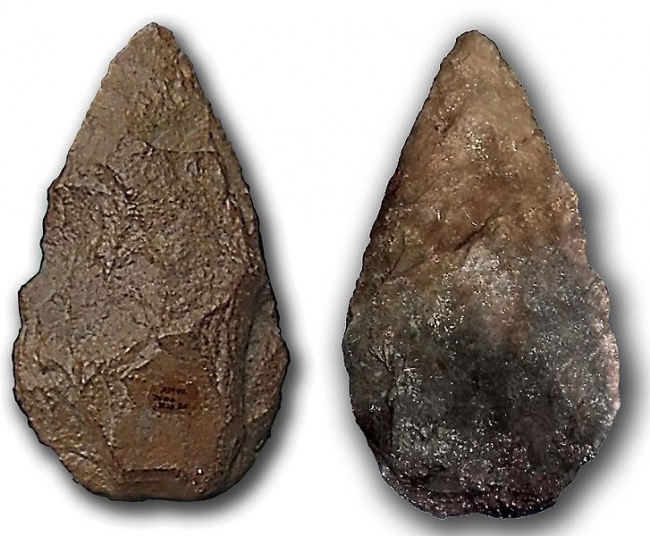
Quartzite Hand Axe, Spain 350,000 years ago
In due course, this exodus of Homo Heidelbergensis, and possibly later ones, from Africa gave rise to dispersed populations, sometimes collectively called Archaic Homo Sapiens (or Ancient humans). These gradually evolved into Neanderthals by 300,000 years ago in Europe and West Asia and the branch remaining in Africa that most probably became Modern Man or Homo Sapiens. A different strain, the “Mapas” was first identified in China. Recent DNA analysis of bones in Siberia has confirmed the eastern strain, which is now called “Denisovan”. However, it appears that Homo Erectus might have developed independently of Heidelbergensis in East Asia so the ancestry of these people is not yet clear. Traces of Denisovan DNA still exist in present day people in Australasia, so there was some interbreeding between them and early Homo Sapiens settlers there. These discrete populations were continually evolving and developing Regional characteristics.
Adding to the confusion are the recent fossil hominid remains found in Java, called Floresiensis and living only 18,000 years ago that, if confirmed, could be descendants of Homo Erectus. However, significant doubt has been cast recently on this discovery, emphasising the difficulty in interpreting the little existing evidence.
Neanderthals were at their peak around 135,000 years ago. They were thick set and heavy, which made them more suited to the colder weather in Ice Age Europe. Their brain size was about as large or even larger than modern humans. They developed communal dwelling areas outdoors or in caves, used tools and by 100,000 years ago carried out various funeral rites, including burials, and from about 50,000 years ago they buried ritual objects along with the dead. At this time Neanderthals were the most abundant hominid in the European/West Asian area. Fossils show that many Neanderthals suffered significant physical damage, presumably from hunting accidents, but were cared for by their colleagues as fossils indicate healed damage.
| Page: 12 of 418 Go To Page: | |
◁◁ First | ◁ Previous | Next ▷ | Last ▷▷ |
Author: Dr. Stan Jones © Copyright 2010 -