

8. Ceramic Development in China
| 780 Page: 121 of 418 Go To Page: |  |
◁◁ First | ◁ Previous | Next ▷ | Last ▷▷ |
However, further pottery innovation and development no longer progressed as rapidly in the North, and from this period more dramatic innovation moved permanently to the South. Although the Mongol invasion destroyed much, it freed China from the static traditions of the late Southern Sung. Northern traditions of Chun and Cizhou wares continued through the Yuan Dynasty, bolder but coarser than before.
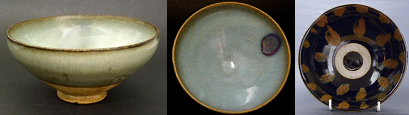
Yuan Chun ware bowls with purple splash and
Cizhou black bowl with iron oxide markings,
centre ring wiped for stacking in kiln - courtesy
R&G McPherson Antiques
In the 14th century the Chun kilns produced massive flowerpots and basins in a dark grey, very fine grained, dense body that continued into the Ming Dynasty, but it was quite different from the earlier Chun. New shapes included heavy, wide-mouthed jars, sometimes with decoration boldly carved through black or brown slip or painted in two or three colours. Turquoise was introduced as an additional colour in the 13th century. Some items were made using two moulds, one inside the other. A large wedge of clay was placed inside the larger, outer mould and the other pressed down until the excess clay was pressed out and cut off. These items could be made very uniform in size and wall thickness using much lesser skilled workmen. They were also made in standard sizes so customers could order easily. Such production methods increased industrialisation, which was a priority in the 14th century. The overglaze painting developed in the Chin dynasty was, in the 13th century, used to brightly colour items, such as the robes of small figures. By the late 14th century it was used on large wine jars in panels with landscapes containing figures and illustrations of popular stories. These techniques took until the 15th century to reach the South, when they were used not on slipped stoneware but on the fine porcelain of the Ming three and five coloured wares.
While no Yuan celadon has the perfection of colour of Sung Guan and Longquan wares, being more olive green in tone, the quality is high and the variety of decorative techniques is far greater than with the Sung.
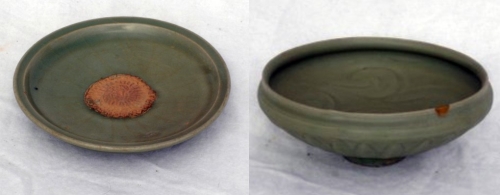
Yuan celadon dish with unglazed
chrysanthemum and Longquan bowl - courtesy
Glade Antiques
In the 14th century these included bold dragons sprigged directly onto the body under the thick glaze.
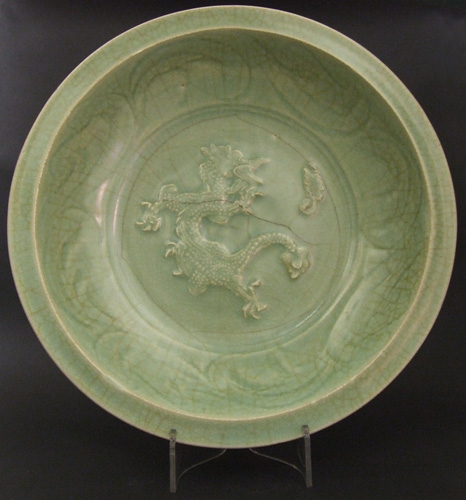
Yuan Longquan celadon dish with dragon
chasing flaming pearl - courtesy R&G
McPherson Antiques
This developed into sprigging onto glazed pieces so the unglazed reddish-brown decoration contrasted well after firing. Another technique spontaneously re-introduced from proto-Yueh in the 5th century was to add spots of high-iron slip before glazing, giving dark brown spots called “spotted celadon” or “flying celadon” by the Japanese.
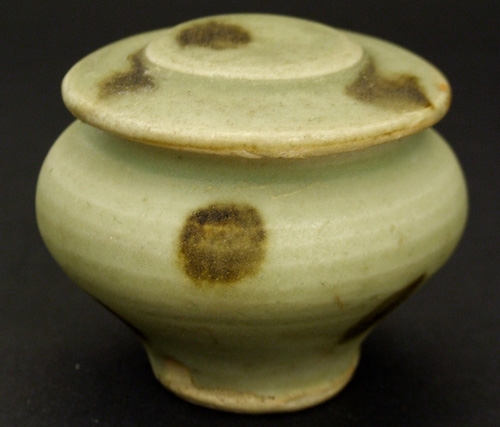
Yuan Longquan iron spot celadon - courtesy
R&G McPherson Antiques
Sometimes red spots were achieved using copper oxide. Southern kilns were also satisfying foreign tastes, producing large dishes, plates and wine jars in increasing quantities by the end of the 13th century. The wheel was used with large vases thrown in several parts, stacked and luted together. Other vases and dishes were sturdily potted in porcelain, often mould made and could also be of considerable size. The “North East” had considerable influence, as so much was exported there. Guan ware appeared to stop at the end of the 14th century, but it was revived in the 17th and 18th centuries when many good copies were made, some indistinguishable from the Sung and Yuan originals.
| Page: 121 of 418 Go To Page: | |
◁◁ First | ◁ Previous | Next ▷ | Last ▷▷ |
Author: Dr. Stan Jones © Copyright 2010 -