

8. Ceramic Development in China
| 782 Page: 123 of 418 Go To Page: |  |
◁◁ First | ◁ Previous | Next ▷ | Last ▷▷ |
Initially the main product remained Ch’ing-pai white porcelain, including richly modelled figures of Buddhist Deities, such as Bodhisattvas, up to 50 cm high, although it also produced some celadons. Ch’ing-pai from Jingdezhen and Fujian was now decorated with floral motifs and beading in raised relief or incised under the glaze. The most elaborate pieces combined flowers and vines in appliqué relief with openwork panels. Ch’ing-pai continued into the 14th century in its own right, but at the end of the 13th century it gave birth to a number of variants, ultimately taking ceramics into the modern age.
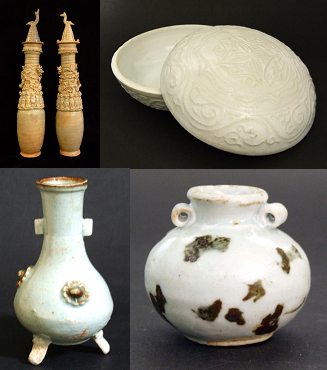
Yuan tomb offering vases with moulded
appliqués, Fujian box, jar with
iron oxide splashes widely exported to S E
Asia and qingbai porcelain tripod vase
with applied bosses - courtesy R&G
McPherson Antiques
Glazes changed from the early 14th century, to become thicker and somewhat more opaque, but still slightly bluish. A stronger, less sugar-white porcelain called “Shu-fu” ware was developed, using a glaze with reduced ash content.
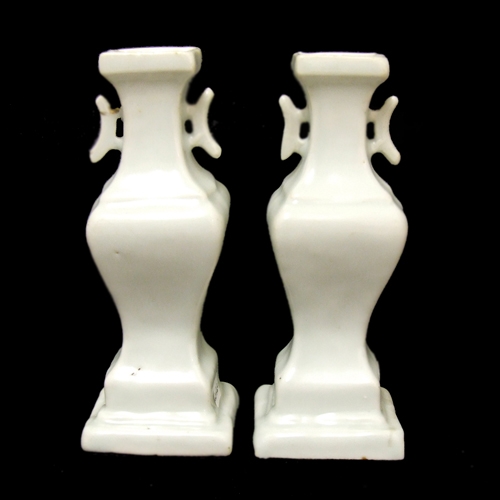
Yuan Shufu porcelain bronze form vases -
courtesy R&G McPherson Antiques
Products using this body had moulded or incised decoration, and also had the characters “shu” and “fu” under the thick glaze, meaning Privy Council so possibly referring to a Government agency. The Shu-fu white porcelain was found to be the ideal body for underglaze blue and white wares, so the factories at Jingdezhen rapidly became the centre of blue and white porcelain production. Other bodies were not so suitable for underglaze decoration using cobalt shades because of their constitution or they did not provide sufficient contrast. Jingdezhen was also an ideal site because of the abundance of the raw materials used for porcelain production – kaolin and petuntse - together with wood fuel and good routes down rivers to harbours for export. Factories at Jingdezhen also experimented with underglaze copper to produce a red colour, but this was too difficult to control and was abandoned.
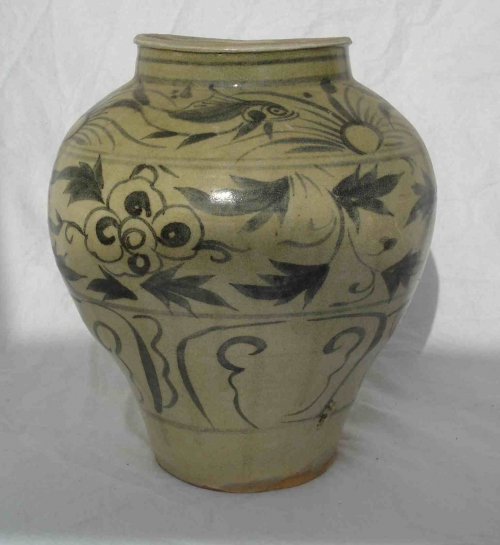
Yuan blue and white ware using local
cobalt - courtesy Glade Antiques
Dating Yuan blue and white ceramics was particularly difficult. For some time the only guaranteed Yuan pieces were a pair of exceptional, ornate temple vases, known as the Percival David Vases, which had inscriptions dating them to 1351 AD. Detailed studies in the 1980’s and 90’s expanded the knowledge base, which makes dating somewhat easier nowadays. Pieces such as the Percival David Vases ushered in the great age of Chinese blue and white porcelain. A Court patron would have commissioned such high-quality hand-decorated items, as all the finest pieces were reserved for the Court. Exports to South East Asia and the Middle East were usually mass-produced and of much lower quality. During the Yuan period the cobalt was still being imported, probably by land and sea from the area around Kashan in today’s Iran (Persia) where it had been used for decorating earthenware tiles under an alkali glaze since the 13th Century. However, local cobalt was used in provincial wares giving a rather muddy grey/blue colour, due to contamination from iron and manganese.
| Page: 123 of 418 Go To Page: | |
◁◁ First | ◁ Previous | Next ▷ | Last ▷▷ |
Author: Dr. Stan Jones © Copyright 2010 -