

1. The Beginning
| 821 Page: 14 of 418 Go To Page: |  |
◁◁ First | ◁ Previous | Next ▷ | Last ▷▷ |
In China earlier strains of Homo Erectus were apparently living until at least 150,000 years ago, in parallel with the more developed Mapas who were thought to live there until at least 120,000 years ago, although Denisovans were living 30,000 years ago in Siberia so could also have been living in China at a similar date. It appears that Eastern Homo Sapiens, arriving perhaps 60-70,000 years ago, found the coastal areas of East and South East Asia very hospitable and they thrived by adapting to the most abundant and valuable food supply available. They then moved up rivers spreading inland, displacing any remaining earlier inhabitants. There is a theory held by some in China that present day Chinese descended from the earlier strains of Homo Erectus, also that this could be used to explain their facial differences, but recent DNA evidence on 12,000 Chinese confirmed every one came from the “out of Africa” Homo Sapiens.
All varieties of Homo Erectus and Archaic Homo Sapiens, apart from Homo Sapiens himself eventually became extinct, leaving the world to Modern Man. However there was a significant cost to pay for the growth in brain size as Homo Sapiens has evolved over the millions of years. In comparison with other primates, the gestation period for humans should be about 21 months, rather than 9 months. However as mothers will agree, the size of a baby’s head at 9 months is quite large enough. The female pelvis dictates the maximum size, so human babies are born very, very early and are consequently helpless for a considerable period. This cost has obviously been worth the extra care parents have had to invest, as humans have become so successful.
Around 60,000 years ago, during the period when Homo Sapiens was spreading round the world, there was a severe cold spell, part of the last glacial period from about 115,000 to 18,000 years ago, which significantly lowered sea levels.
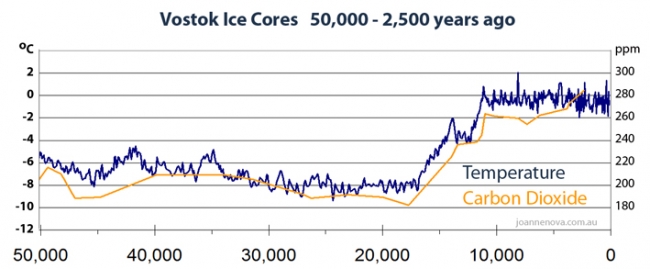
Vostok Ice Cores for last 40,000 years
- source Summit Post
This would again provide land bridges giving access to large areas of South East Asia. There is evidence of Homo Sapiens in Australia from about 55,000 years ago, which would have required a boat/raft trip of only about 60km at that time. Many South Pacific Islands were colonised around 30-40,000 years ago. However, with subsequent warm periods and the consequential rise in sea level they could have been cut off for very long periods. Similarly, in China it is possible that some Homo Sapiens became isolated in Manchuria during one of the extended cold periods perhaps around 40,000 years ago, and adapted to the cold weather by becoming stockier and developing the heat-saving and glare-resisting facial features we recognise as Mongoloid. Skulls found from 40,000 years ago in China did not exhibit such marked characteristics. This Mongol type of Modern Man expanded rapidly over the last 17,000 years, penetrating all of China. Apparently the Japanese retain more of their original Eastern Homo Sapiens ancestry than the Chinese.
| Page: 14 of 418 Go To Page: | |
◁◁ First | ◁ Previous | Next ▷ | Last ▷▷ |
Author: Dr. Stan Jones © Copyright 2010 -