

9. Ceramic Development in the Middle East
| 890 Page: 143 of 418 Go To Page: |  |
◁◁ First | ◁ Previous | Next ▷ | Last ▷▷ |
Outside in an “industrial area” there were dome-shaped, high-temperature reduction kilns, with a firing chamber separated from the items to be fired (two-stage), possibly developed from the bread ovens, but it is not yet known whether these were used from the very beginning of the settlement. The earliest, rather soft, black/red earthenware pottery is dated from about 7,500 BC, typically sack-shaped cooking pots with two small lug handles and what appear to be stands.
A more advanced form of hand-made, hard-fired pottery was made about 500 years later, becoming more elaborate in style and having a thinner body. It was coil built on a circular base, then paddled smooth and some were incised with horizontal lines. Moulded ornamentation was also used. Some of these vessels were polished or burnished, particularly if the clay used was exceptionally fine. An example of this period is a sizeable vessel in the remarkably realistic shape of a pig with four perforated lugs to suspend it.
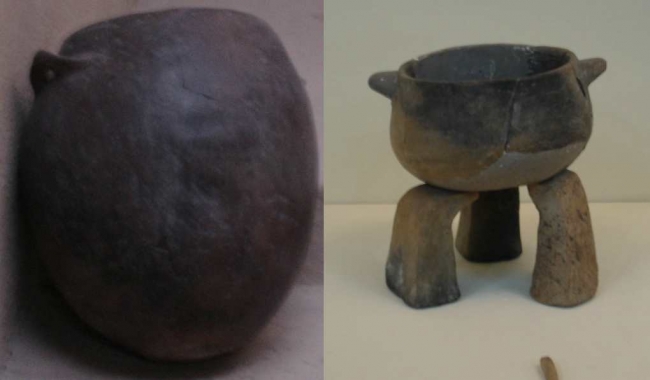
Bag shaped pots and stand 7,400-6,000 BC -
source, Museum of Anatolian Civilisations,
Ankara
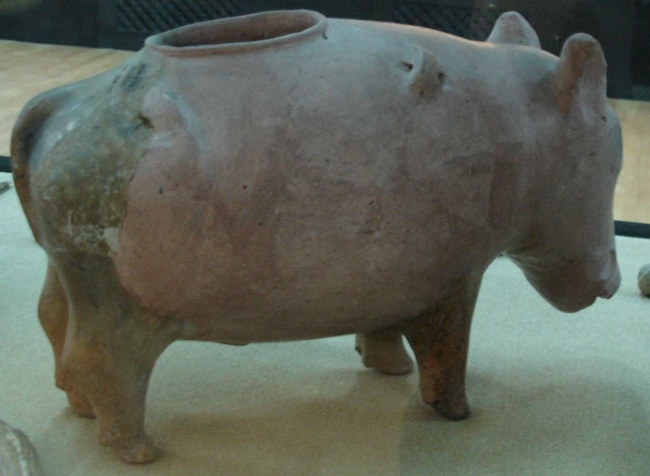
Vessel shaped as pig 7,400-6,000 BC -
source Museum of Anatolian Civilisations,
Ankara
A little later vessels had an overall red slip, followed by a cream slip over-painted in red ochre. Other pottery was monochrome – buff, light grey or brick red. Interestingly, some fingerprints have been identified on the pottery that is separable into male, female and youngsters. Pottery and stone figures have been found, many depicting females, but others depicting animals. Some items were based on bull’s heads using real horns, possibly for mounting on the walls. The female figures probably representing fertility are a particular feature of Catal Huyuk ritual objects, usually associated with the household “shrines”. A 6” high bulbous female figure, now in the Museum of Anatolian Civilisations, Ankara, dated 7,400 to 6,000 BC, is a particularly notable find. Some of the pottery statuettes were also painted. Ritual house fittings and skull cults show the increasing importance of family, ancestors and property.
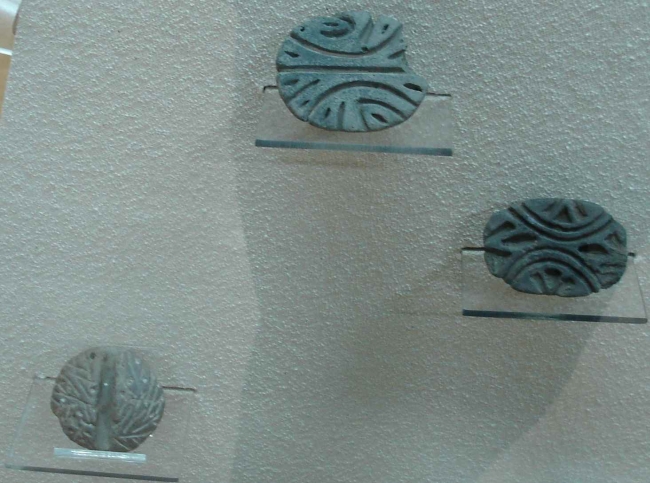
Seal stamps 7,400-6,000 BC - source Museum
of Anatolian Civilisations, Ankara
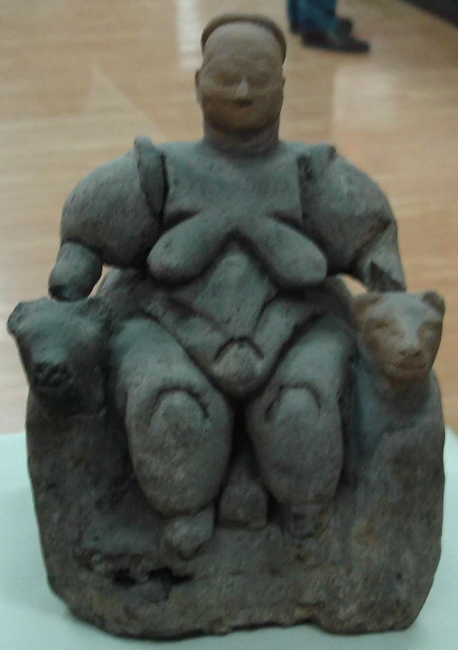
Female figurine 7,400-6,000 BC
- source Museum of Anatolian
Civilisation, Ankara
There were also fired clay stamp seals possibly used to apply colouring to their textiles or for body marking. They were inscribed with geometric patterns including spirals. Later they would be used to make impressions onto clay blobs for identifying produce and sealing containers. Such simple methods of confirming social transactions formed the basis of later, more advanced, urban recording systems. The original city was abandoned around 6,250 BC and relocated a few hundred yards away, but even this was finally abandoned around 5,500 BC. Sun-dried bricks were used for all the buildings as fired bricks were probably not used in Anatolia until about 4,000 BC.
There were many other individual settlements in the Middle East that developed early on, such as Ain Mallaha, a Natufian site near Lake Galilee and Quermez Dere in Northern Iraq and the Pendik settlement in Istanbul, but there is no evidence at present that any of them developed the social organization and technology to create the “First Civilisation” in the way the Sumerians did subsequently in South Mesopotamia. Two further settlements worthy of note were in North Syria. The people of Tell Murybet, which was inhabited before 9,000 BC by late Natufians, subsequently used clay for containers and for tokens that were used as a system of record taking or information transfer. They were discs, cones and spheres with inscribed lines as numbers, but may have contained additional information from their shape. These tokens have been found as far away as Khartum and Harappa. The houses of the inhabitants were at first circular, but changed to rectangular when they started building them of limestone blocks with clay mortar. The second settlement that was inhabited from about 6,000 BC is Tell Hamoukar in Northern Mesopotamia near the Turkish border with Iraq. Around the time of the Uruk Culture in South Mesopotamia (around 4,000 BC) the population may have been as high as 25,000 people, so it was a very large urban settlement. It seems that it was destroyed by warfare not long after 4,000 BC, the invaders hurling 4-inch diameter clay balls, perhaps from large slings. Uruk style pottery took over subsequently, but they may not have been the invaders.
| Page: 143 of 418 Go To Page: | |
◁◁ First | ◁ Previous | Next ▷ | Last ▷▷ |
Author: Dr. Stan Jones © Copyright 2010 -