

9. Ceramic Development in the Middle East
| 912 Page: 165 of 418 Go To Page: |  |
◁◁ First | ◁ Previous | Next ▷ | Last ▷▷ |
Other pots would be coated in ochre wash and fired in a way to produce a deep red or brown body with blackened upper parts and insides.
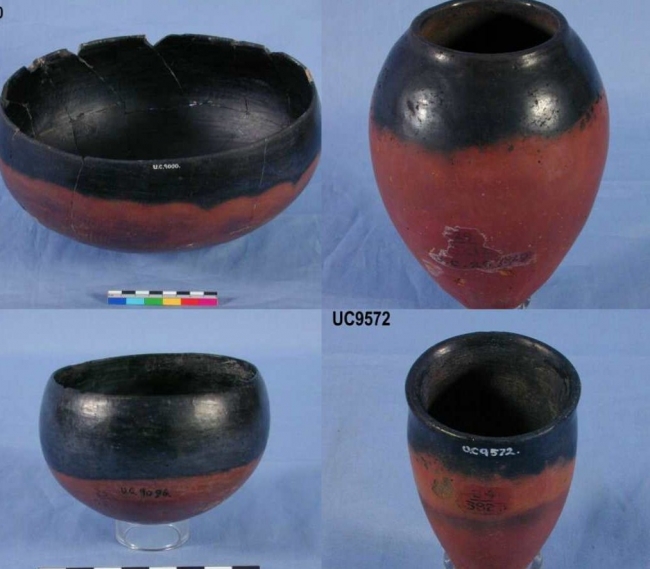
Badarian black topped red ware, rippled bowl,
burnished vessel, “canopic” jar and bowl,
UC9000, 25779, 9572, 9096
- Copyright of the Petrie Museum of
Egyptian Archaeology, UCL
Shallow bowls were the commonest form and white gypsum paint was also used after firing. How they achieved the black-topped pottery is not known for certain, but various experiments have been carried out and the two most likely methods proposed. In the first method, the vessels were placed on a bed of chaff around which firewood and straw were leaned. The whole was covered in a layer of mud, and about 1.5 hours after the fire had been lit the temperature reached 950 degrees C. Some hours later, when cool, the mud cover was broken open to reveal well-fired vessels with not only black tops where the carbon had been absorbed but with the silvery lustre between the red and black zones, as with the ancient pottery. The second method was a two-step process, with the vessels first fired on an open bonfire as if to produce the plain red ware, reaching 750 degrees C in about ¾ hour. The red-hot vessels were then transferred to a hole filled with chaff, where carbon absorption was achieved on the rims. Because of the handling problems it is unlikely the second method could be used for larger items. There were other decorative styles particularly on the plain red pots; for example, some had fine surface ripples and others subtle cord decoration and triangular and lined patterns.
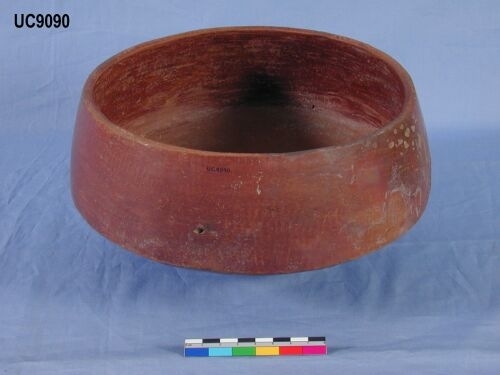
Badarian rippled and polished bowl UC9090
- Copyright of the Petrie Museum of
Egyptian Archaeology, UCL
Pots were still used predominantly for storage and serving water and food, and for transport. Badarian pottery remains some of the most wondrous ever produced in Egypt, and includes some exceptionally fine pottery figures.
From the earliest times Egyptians believed in the afterlife and took great care in burying their dead. Initially they were put into prepared trenches in a curled up position wrapped in animal skins, rush mats or cloth. In time the lining of matting was replaced by a wooden box that later became the sarcophagus, which was also a feature of Mesopotamian burial practice. Significant numbers of pottery vessels were left in tombs, often filled with food offerings as “grave goods”, or boats for transport in the afterlife.
As with other ancient Cultures, pottery and potsherds are tremendously important in understanding ancient Egypt. W M F Petrie, the archaeologist, devised various methods of sequentially dating Pre-Dynastic periods (before 3,100 BC) almost entirely from tomb pottery characteristics.

Badarian model of boat UC9024 - Copyright
of the Petrie Museum of Egyptian
Archaeology, UCL
One of his techniques was a dating method based on the handle characteristics of the pottery throughout this period. The handles started as functional but moved to become more ornamental (wavy handled) as the Pre-Dynastic period progressed. So the degree of this progression at any site in Upper Egypt gave a relative date of the pottery, hence of the site. The distribution of potsherds was equally important for casting light onto regional development and influence, and also trade. Pottery would be either taken for use by traders or colonists or used as a transport medium in trade (oil, wine etc). For example, sites dated well before 3,500 BC in Palestine have yielded pottery identified as being made from Nile clay. Recent analysis methods can even identify the residual traces of the contents of pots, giving great insight into their use.
| Page: 165 of 418 Go To Page: | |
◁◁ First | ◁ Previous | Next ▷ | Last ▷▷ |
Author: Dr. Stan Jones © Copyright 2010 -