

9. Ceramic Development in the Middle East
| 920 Page: 172 of 418 Go To Page: |  |
◁◁ First | ◁ Previous | Next ▷ | Last ▷▷ |
Both alphabets were used for religious purposes. Hieratic evolved into Demotic around 700 BC and was widely used.
Eventually it further evolved into the last stage of Egyptian script – Coptic - under the influence of the Greeks and Romans. Coptic was used extensively for biblical texts. Its alphabet was made up of Greek letters plus seven letters taken from Demotic and many Greek words were thrown in.
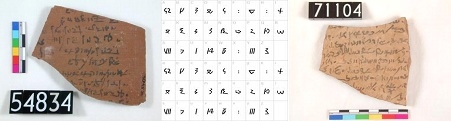
Demotic alphabet, source Macedonian Truth
Forum. Ptolemaic sherds, an account and a
story about a Greek Arion UC54834 and
71104 - Copyright of the Petrie Museum of
Egyptian Archaeology, UCL
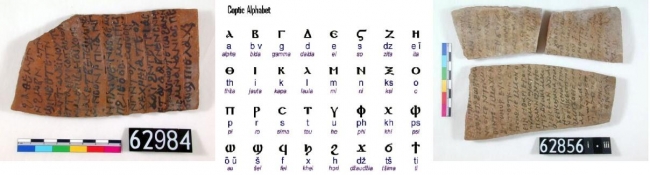
Coptic alphabet. Sherds, a letter on
behalf of a sick brother and a Byzantine
period letter referring to measures of
barley UC62984 and 62856 - Copyright of
the Petrie Museum of Egyptian Archaeology,
UCL
Returning to Egyptian hieroglyphics, its consonants do not correspond to our alphabet - they had four different versions of our “t” and “d” – so it is difficult to translate into English. It was only with the discovery of the Rosetta Stone, which had carved upon it a decree of Pharaoh Ptolemy IV in 196 BC, written in three of the four versions of written languages used at that time, Hieroglyphics, Demotic and Greek, that translation of hieroglyphics into English could be confidently made. Hieroglyphics can be read left to right or vice-versa, depending on the direction the symbols are facing (they “face” the start of the line) and can also be written up or down. There are three types of “symbol”, a graphic sign (picture) meaning one word, phonetic signs of 1,2 or 3 letters (consonants), and “determinants” which are not read but are used to clarify meaning. Writing was used exclusively for administrative purposes up to 2,650 BC with no continuous texts before this date. In fact almost all literary texts before 1,950 BC were lists of important traditional information or medical treatise. A few continuous texts from 2,600 to 2,350 BC were idealistic, describing a perfect world. During this time only 1% of the population was literate. One of the interesting sources of written information from the middle of the 2nd millennium was in building sites and stone quarries, as the craftsmen had the skills to write on potsherds or carve topical information onto rocks using hieroglyphics. Hieratic was the most practical version of early Egyptian writing and was used in scribal schools where they used reed pens on potsherds, as papyrus was too expensive. These inscribed potsherds are called by their Greek name, Ostracon. Egyptian script was rarely used for languages other than Egyptian, unlike the Mesopotamian cuneiform script that became multilingual. This may have been due to the cosmopolitan nature of Mesopotamia compared with the mainly singular Egyptian State. Nevertheless, in the mid-2nd millennium BC, Egyptian hieroglyphics may well have contributed to the later “alphabet” developed by the Phoenicians that became the most widespread writing system. Some evidence was found by Petrie in Sinai showing the transmutation from Egyptian hieroglyphics to the Semitic language that became, for example, Hebrew. In this proto-sinantic alphabet the symbol for a bull’s head – a circle with horns atop – was to become “a” (Hebrew for bull is “aleph”), the symbol for a house “beth” to become “b” and the zigzag sign for water “mem” to become “m”. The first recorded use of pigeons for “airmail” was in Egypt as early as 2,900 BC.
| Page: 172 of 418 Go To Page: | |
◁◁ First | ◁ Previous | Next ▷ | Last ▷▷ |
Author: Dr. Stan Jones © Copyright 2010 -