

9. Ceramic Development in the Middle East
| 954 Page: 207 of 418 Go To Page: |  |
◁◁ First | ◁ Previous | Next ▷ | Last ▷▷ |
Some pottery was very thin-walled black ware, typically jugs some with two spouts.
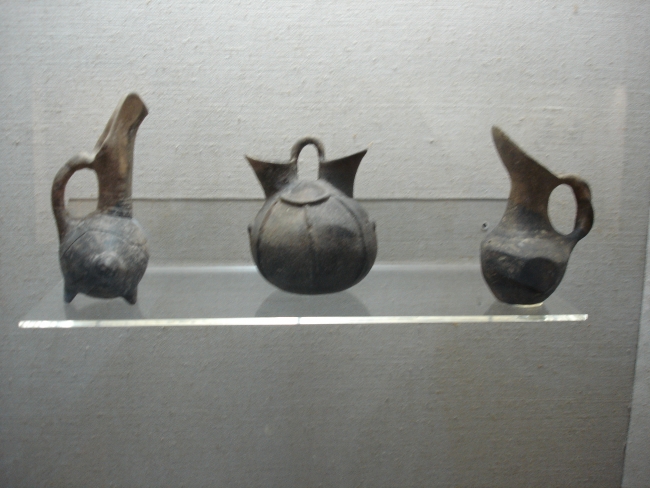
Thin walled black pottery 2,750-2,500 BC -
source Antalya Museum
Pots would have perforations through the rim for hanging.
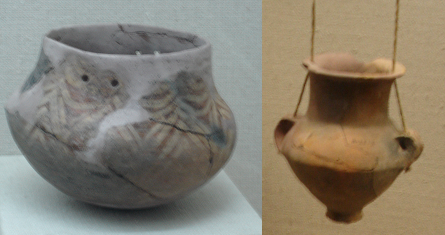
Perforated rim pots, decorated 3,000-2,000
BC and one hanging 2,500 BC - source
Antalya Museum
Some vessels were quite sophisticated such as a large footed serving dish with four horizontal handles made as twisted rope, often red burnished on buff.
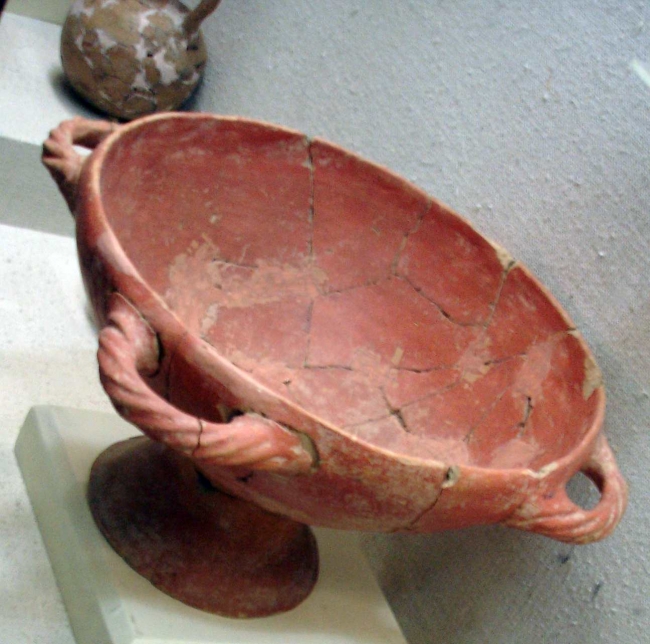
Large four handled pot with twisted
handles, 2,500 BC - source Antalya Museum
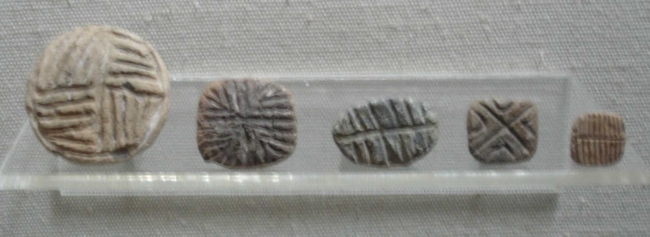
Pottery stamp seals, 2,500 BC - source
Antalya Museum
Clay brush handles have also been found together with pottery stamp seals.
The native people of the Central Anatolian Plateau were called “Hatti” and spoke a language that was neither Indo-European nor Semitic. The elite wrote in “court language”, cuneiform using Akkadian, picked up from Assyrian traders, hence our knowledge of their history. The general populace who wrote did so in hieroglyphics. Many impressions of cylinder seals from rulers of Syria and North Mesopotamia and their own stamp seals showed the richness of their Culture. From about 2,000 BC, links with Assyria were mainly based on metal trading, and caravans of 200 to 250 donkeys imported items such as clothes and tin in exchange for gold and silver to send to Ashur. Cuneiform clay tablets in Akkadian from Assyria found in the nearby ancient kingdom of Kanesh contained much information on trading, domestic and personal matters, such as court judgements, and some literary works.
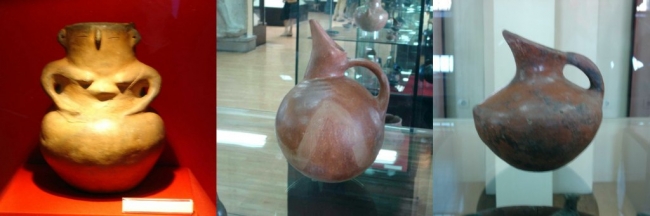
Bolu, female form cup and two
bird-beak-spouted burnished jugs,
3,000-2,000 BC - source Museum of
Anatolian Civilisations, Ankara
There was often fighting between the Anatolian kings, which caused many cities to be destroyed, although the Assyrian residents did not get involved. In fact there were several hundred years of Cultural interchange between the Assyrian’s Babylonian style and indigenous Hatti style that merged during the early part of the 2nd millennium. There was a very high level of art during the period of the Assyrian colonies in architecture and on seals, and through craftsmen working with metals, ivory and ceramics. Production of ceramics rose to new levels of creativity. They made monochrome and polychrome drinking vessels formed as animals, some decorated with geometric patterns; rather strange depictions of humans; vases decorated with birds and stylised trees, together with rather heavy jugs with bird-beak spouts covered in red and highly burnished.
| Page: 207 of 418 Go To Page: | |
◁◁ First | ◁ Previous | Next ▷ | Last ▷▷ |
Author: Dr. Stan Jones © Copyright 2010 -