

9. Ceramic Development in the Middle East
| 956 Page: 209 of 418 Go To Page: |  |
◁◁ First | ◁ Previous | Next ▷ | Last ▷▷ |
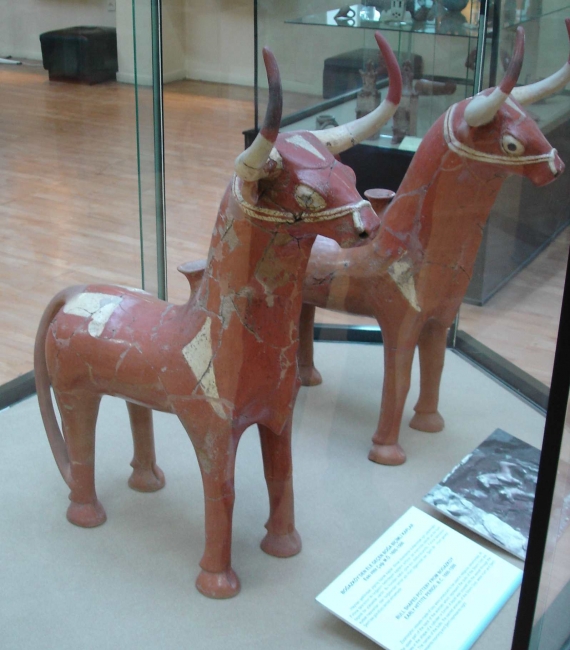
Bull-shaped pottery from Hattusas - source
Museum of Anatolian Civilisations, Ankara
Their houses contained vases and figures as ornaments, such as realistic red bulls with white decoration, dated to 1,550 BC found at Hattusas. The large vases from this era decorated with reliefs are some of the most expressive surviving objects. There is a particularly magnificent vase from the Inandiktepe Temple, 100 km north of Ankara, that is now in the Museum of Anatolian Civilisations. It has a red body with white, red, yellow and black paint, 4 strap handles, a high neck and flaring rim. Four bulls’ heads inside the hollow rim were designed to form spouts to fill the vase. There were four relief-decorated friezes on the body, depicting figures of musicians with long black hair playing lyres, cymbals and a lute, some people preparing food, others manufacturing pottery vessels, a bull sacrifice, male and female gods, acrobats and a marriage ceremony. A large terracotta bull statue and model of a shrine and god were found in a temple in Hattusas. A small pottery “grotto” containing a model of a cult figure would be used in houses.
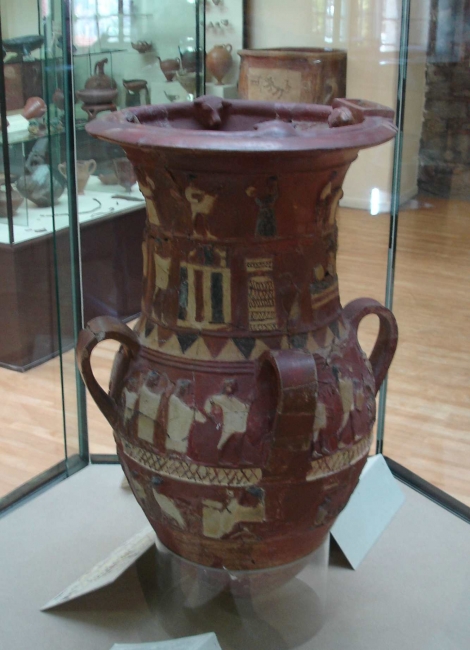
Large Marriage Ceremony urn
- source Museum of Anatolian
Civilisations, Ankara
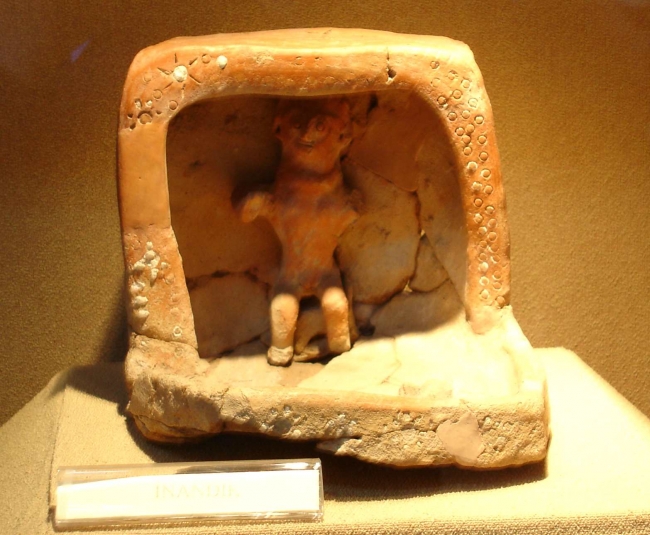
Hittite cult statue - source Museum of
Anatolian Civilisations, Ankara
Hittite potters made other models including boats decorated in a chequered pattern, drinking cups containing small models of people reclining on the insides and double vessels with a single handle, whose use is a bit of a mystery. Very large pottery vessels some 2m high, made in sections, were used for food and liquid storage.
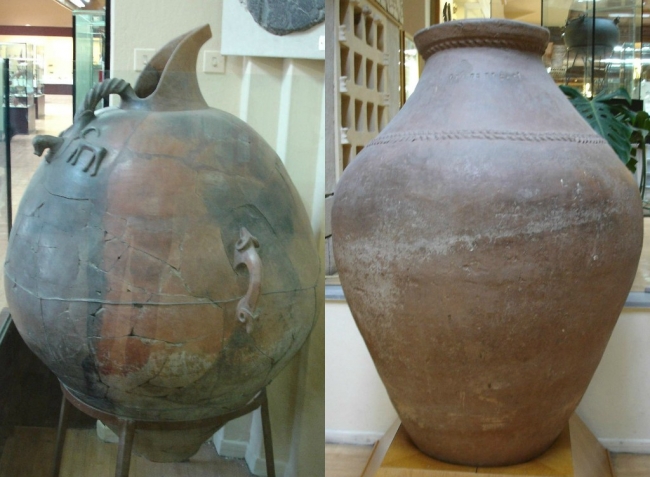
Large Hittite storage vessels, 4.5ft and
6ft tall - source Museum of Anatolian
Civilisations, Ankara
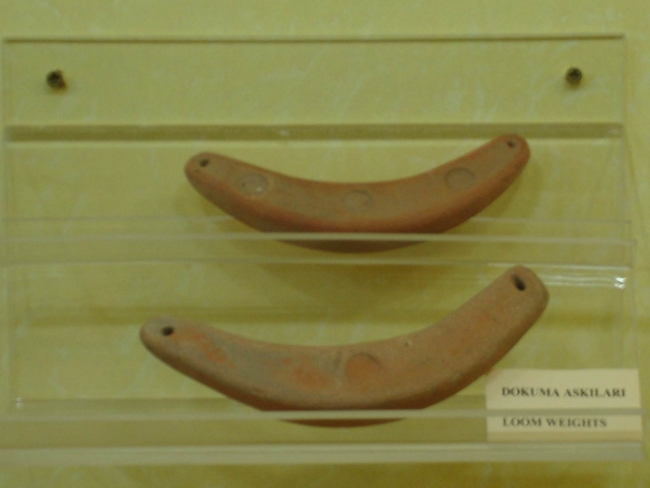
Loom weights, 1,450-1,200 BC - source
Hieropolis Museum
Some were plain but others had large spouts, fancy handles and applied moulded animal decoration. Many pottery Seals have also been found depicting king’s names in hieroglyphics and cuneiform and even a potter at his wheel. Practical items such as pottery loom weights were also produced
Hittite kings Hattusilis I (1,650-1,620 BC) and Mursilis I (1,620-1,590 BC) captured the rich City States in North West Syria from the Egyptians, absorbing the Kingdom of Yamkhad. Around 1,595 BC the Hittites passed through the Kingdom of the Mitanni and captured and sacked Babylon, but soon retreated taking with them a great deal of booty. Either this caused the final collapse of the Early Dynasties of Babylon or the Hittites objected to the Kassites having already taken over South Mesopotamia around 1,600 BC. Whichever it was, they ended up leaving Babylonia to the Kassites. However, contact with the Babylonians greatly influenced Hittite Culture that went on to infuse large areas of Anatolia. Mursilis I was assassinated around 1590 BC causing anarchy amongst the Hittites for several generations, which permitted the Mitanni to expand.
| Page: 209 of 418 Go To Page: | |
◁◁ First | ◁ Previous | Next ▷ | Last ▷▷ |
Author: Dr. Stan Jones © Copyright 2010 -