

9. Ceramic Development in the Middle East
| 962 Page: 215 of 418 Go To Page: |  |
◁◁ First | ◁ Previous | Next ▷ | Last ▷▷ |
In general the pottery was coarse as the large amounts of vegetable temper caused inclusions and pits. However there was a much better pottery called “Palace Ware” that had thin walls and was good quality. It was mainly used for bowls but included some beakers and vases.
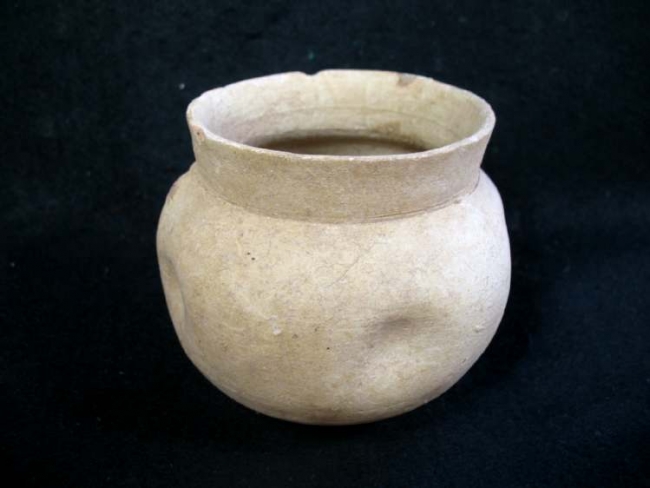
Assyrian palace ware 6th century BC
- courtesy Collector-Antiquities
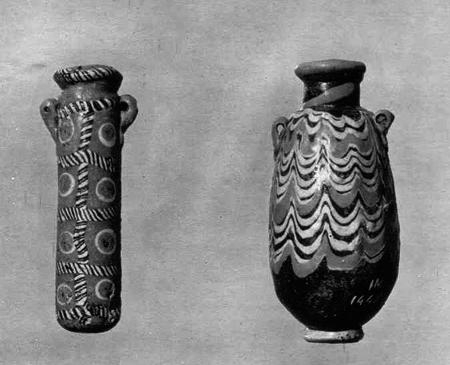
Neo Assyrian decorated glass vessels,
650-600 BC and 800-600 BC - source
National Museum of Iraq, Baghdad
Hollows were formed in the body, and the rims were flaring, making them very attractive. Glassware was also remarkably well made and decorated. The Assyrians and Babylonians excelled in using polychrome bricks and tiles with lustrous glazes to decorate buildings. Their alkali glaze now contained tin as an opacifier, probably first used in Southern Iraq. It did not seem to be used on general domestic pottery but only on special vessels such as the polychrome jars coloured in blue-green, orange, white and yellow with a leaf pattern around the shoulders. Glaze was used extensively on courses of decorated and glazed brickwork. Remarkable glazed brick panels have been found in the ruins of several Assyrian towns, including Nimrud, Nineveh, Ashur, Susa and Babylon decorated with a superb colour range.
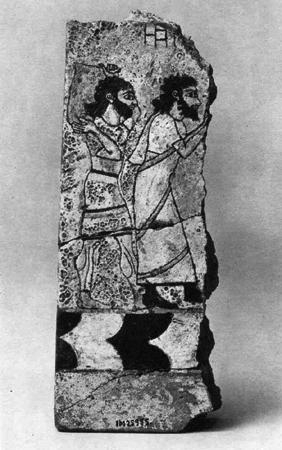
Neo Assyrian, fragment of painted,
glazed tile, Nineveh, 8th century BC
- source National Museum of Iraq,
Baghdad
A well-known fragment dated to about 870 BC is in the British Museum. It is thought to depict Ashurnasirpal II with his bodyguard, coloured in green, yellow, black and possibly red. Lead as well as tin was also found in the blue copper glaze of this date, possibly as a flux, but not in a high enough proportion to call it a lead glaze. During the reign of Tiglath-Pileser’s son Sargon II (721-705 BC) a temple entrance at his new capital, Khorsabad, was decorated with moulded and glazed brickwork depicting animals in procession. Khorsabad was short lived as it was abandoned on his death in 705 BC. Unfortunately this particular glazing technology appears to have been lost again after the fall of the Assyrians and had to be reinvented several centuries later. The Assyrians were also masters of stone carving and in the north had good quality stone to work on; however, it was so costly to ship that it was only used for special carvings and decoration in the stone-free south of their Empire. Also around 710 BC the first lock and key was invented in Assyria. It was made of wood with a key resembling a toothbrush. Peace was elusive and Sargon II faced constant hostilities from Babylon and Elam throughout his reign.
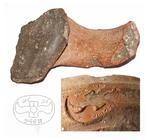
Judah royal seal on handle,
Sennacherib 701 BC
Nineveh, which had been a settlement before 5,000 BC, became the Assyrian Capital in 705 BC, at the start of the reign of Sennacherib (704-681 BC). In 689 BC Babylon was destroyed in retribution for rebellion and the murder by the Elamites of Sennacherib’s son who he had made the ruler of Babylon. Egypt was conquered in 671 BC and native princes were made Satraps to rule Egypt, paying considerable tribute to the Assyrian kings. As an example of Assyrian ruthlessness, Ashurbanipal (669-627 BC), was so aggrieved that the Elamites had supported Babylonia against him that in 648 BC he not only destroyed their cities but also sowed their fields with salt in retribution. At its height around 663 BC the Assyrian Empire stretched from North East Africa to the Caucasus and from the Mediterranean to the Iranian highlands.
| Page: 215 of 418 Go To Page: | |
◁◁ First | ◁ Previous | Next ▷ | Last ▷▷ |
Author: Dr. Stan Jones © Copyright 2010 -