

9. Ceramic Development in the Middle East
| 968 Page: 221 of 418 Go To Page: |  |
◁◁ First | ◁ Previous | Next ▷ | Last ▷▷ |
Darius The Great (521-486 BC) followed. He had tenuous links to the royal line, and had to legitimise his position by marriage to the widow of Cambyses, but became the greatest leader of them all. He expanded the Empire until it extended from Macedonia, north of Greece to Afghanistan and the Indus, along with the territories in North Africa. This huge Empire was split into 20 Provinces run by Satraps. Initially Darius’s Capital was Susa, but he started to build a new capital city in 518 BC at Persepolis, the heart of the Empire, to the east of the Persian Gulf. Around 500 BC he also built a major “royal” road from Sardis the capital of Lydia in Western Anatolia to Susa, a distance of 2736 km with 100 regularly spaced posting stations. He introduced the gold Daric and silver Shekel coins. At this time the Persians wrote in Aramaic, the North Semitic language – by then used extensively in the Middle East. The Old Persian language was used for Royal inscriptions using special cuneiform. However parchment replaced clay tablets for Aramaic documents around 460 BC. From the early Median period Persian religion was based on the teaching of the Prophet Zoroaster (Zoroastrianism). Subsequently Judaism, Christianity and Islam absorbed some elements of his teaching.
With the arrival of the Achaemenids, considerable advances were made in pottery manufacture, and utility ware became plentiful, with additional shapes appearing in the area such as the rhyton.
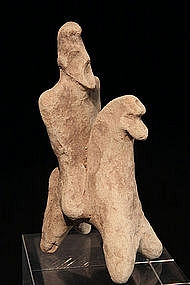
Persian rider and horse 600-400 BC
- courtesy Ifergan Collection
Wheel-thrown finer wares also advanced noticeably, with incised and moulded decoration and red painted carinated vessels. Some old ideas reappeared such as animal shaped vessels and animal figures attached to handles of rhytons and jars.
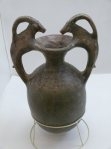
Achaemenid pot with
animal handles -
source Persepolis
Museum, Iran
Greek influences also became apparent, including amphorae, but now tailored to have spouts at the base for ceremonial drinking. Metalwork was copied with great success. By 500 BC the architectural glazed brick panels and friezes could be very large and elaborate, some 10m long, with beautiful patterns in relief coloured in blue, white, yellow, green and some purple. Several depicting soldiers and animals were found covering the walls of palaces at Susa. One particular example, “Archers of the Royal Guard”, is now in the Louvre. Others at the Winter Palace depicted the imperial guardsmen, lancers and archers. A fired clay tablet was found at Susa containing the names and home towns of the artisans who carried out this work, some of whom were from Babylon.
Lydia, in Anatolia, was ruled by a series of Persian Satraps, including Artaphernes, younger brother of Darius, and there were many Persians in their elite. However, by 499 BC, the Ionian cities were in revolt, joined by Athens and Western Greece against the Persians. Partly because the Greeks burnt his Western Capital, Sardis, to the ground in 497 BC, Darius attacked Greece but lost the battle of Marathon in 490 BC. Xerxes, his son and successor, also tried to defeat the Greeks using an army with supporters numbering some million people that overwintered in Sardis in 481 BC together with a huge fleet of ships but the fleet was defeated at Salamis in 480 BC and the army suffered great losses. The Egyptians formed a large part of the fleet (200 ships), led by Achaemenes, but they appear to have left the field of battle. Around 386 BC an agreement to cede Greek cities in Asia in return for autonomy for all other Hellenic States brought peace between Persia and Greece (known as the “Kings Peace”). However, revolts grew including in Phoenicia (put down very hard), Cyprus and Egypt. The Empire was weakened by continual nomadic insurgencies and in-fighting between Satraps. Although the Persians hit back, (reputedly killing 40,000 in Sidon in 343 BC), they were no longer invincible and when Alexander The Great of Greece attacked in 334 BC the Persian armies were defeated, Persepolis destroyed and the Empire collapsed in 333 BC. After the division of Alexander’s Empire, the Greek Seleucid Dynasty ruled Persia from 300 until 250 BC.
| Page: 221 of 418 Go To Page: | |
◁◁ First | ◁ Previous | Next ▷ | Last ▷▷ |
Author: Dr. Stan Jones © Copyright 2010 -