

9. Ceramic Development in the Middle East
| 981 Page: 234 of 418 Go To Page: |  |
◁◁ First | ◁ Previous | Next ▷ | Last ▷▷ |
In the early 1200’s AD lustre bowls were made in the city of Kashan with Kufic and Persian calligraphy and delicate scrollwork. A fragmentary jar in the British Museum is dated to 1179 AD. Another of the same date from Rayy is intricately decorated in red on white.
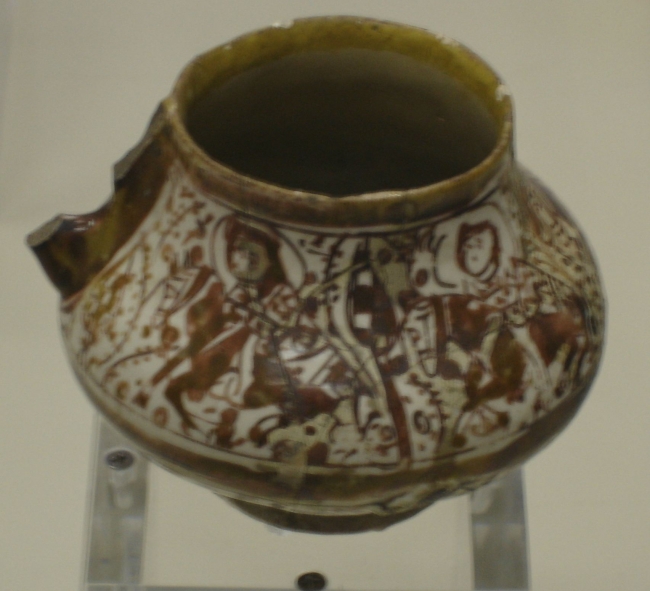
Rayy lustre vessel, late 12th century AD
- source museum Istanbul
However, Kashan was chiefly famous for lustre-painted tiles, which were distinguished by their fine workmanship, brilliance and design intricacy. They were square, rectangular and interlocking star shapes, each part of a large design, particularly when used for the mihrab or niche in a mosque indicating the direction of Mecca.
The inscriptions are frequently coloured with cobalt blue paint.
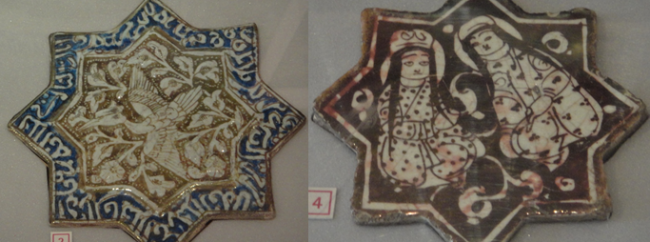
Persian eight pointed star shaped lustre decorated
tiles, one scarce with human forms - Image
courtesy of the Potteries Museum & Art Gallery,
Stoke-on-Trent
Quite a few of these tiles were dated and signed. One particular family contributed artists for three generations.
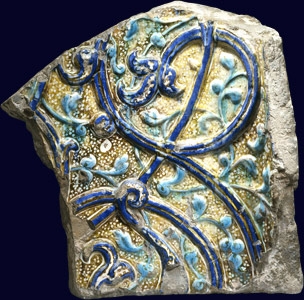
Kashan lustre tile sherd 13th century AD
- source Simon Ray
The usual drawback of earlier lead glaze on tiles had been experienced, in that colours under the glaze would run in the kiln. However, with the alkali glaze this did not occur. When the new fritware was introduced that took the glaze well, potters could produce elaborate underglaze decoration. This type of underglaze decoration was the second major Seljuk development, probably first produced in Syria in the early 12th century, no doubt based on the early underglaze work that had been done by the Abassid potters. The colours used now were cobalt blue, turquoise and black. The decoration was floral designs, script, animal and human figures, very similar to the range of subjects used on lustre ware, indicating the same artists possibly worked on both wares. A very successful variant called “silhouette” ware used a heavy black quartz-based slip, subsequently incised and covered with a blue or turquoise coloured translucent glaze using copper colourant. Some of these wares were dated, with the earliest known being 1166 and the latest 1278 AD.
The Seljuk potters were also the first to use overglaze painting in the late 11th century, more or less contemporaneously with the Chinese late Sung, but the latter were slower to popularise it. This was used on a further fine Seljuk ware, particularly associated with Kashan, called “Mina’i” (enamel). The fritware pot was covered in a cream or turquoise, tin-opacified, glaze and fired, and then painted in up to seven colours (hence the Persian name “heft-rengi”) - blue, green/turquoise, brown/black, red, yellow, white and gold - and fired again at a lower temperature than the original firing. The enamels were a mixture of pigments and glaze with alkali flux that melted at a temperature that did not damage the colours, and a carrier such as gum Arabic to help application. The colours came out matt except the blue. High-fired Chinese porcelain glazes gave colours of greater intensity and enamels sparkled more, but Persian glaze gave softer luxuriant colours and Rayy matt polychromes were particularly attractive.
| Page: 234 of 418 Go To Page: | |
◁◁ First | ◁ Previous | Next ▷ | Last ▷▷ |
Author: Dr. Stan Jones © Copyright 2010 -