

9. Ceramic Development in the Middle East
| 983 Page: 236 of 418 Go To Page: |  |
◁◁ First | ◁ Previous | Next ▷ | Last ▷▷ |
From the Mongol period onwards, illustrated manuscripts were a major expression of pictorial art in the Persian-speaking world. It started in the 13th century but became a princely pursuit under the Il-Khanid rulers of the early 14th century.
Immediately after the Mongol conquest the manufacture of pottery practically ceased, as cities such as Rayy, Jorjan and Kashan as well as Nishapur were destroyed. However, Kashan quickly recovered pottery production and the potters initially continued to make lustre, under and overglaze wares in the same bodies, shapes and decoration as before.
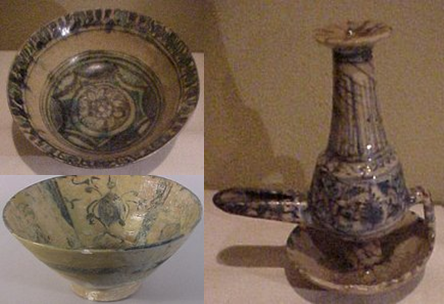
Kashan 13-14 centuries lustre wares, blue
and black and floral bowls and an oil lamp
- courtesy Milwaukee Public museum
There was a significant increase in the production of tiles for rebuilding, and for the new Il-Khanid building projects, usually palaces, mosques, madrasahs and shrines. Again some tiles were signed and dated and are inscribed in Arabic and Persian. There was a slow revival in the other pottery centres from the last quarter of the 13th century AD. Some Persian potters had migrated to Syria and continued producing lustre ware there, maintaining the technology. In the 12th century the Syrian potters had made large underglazed green jars and amphorae at Al Raqqa and items such as inkstands. Under Ghazan Khan, Rayy’s prominence as a pottery centre revived. They produced lustre ware, mainly golden brown, sometimes blue. It was applied over an opaque creamy glaze, although sometimes it was dark or lavender. Some vessels had striped blue and white lustre. After the Mongol invasion a simplified version replaced Mina’i called Lajvardina (Persian for lapis lazuli).
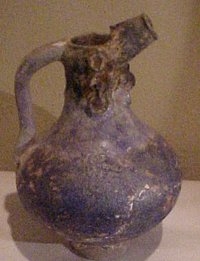
Rayy lajvardina pitcher 12-13
centuries AD - courtesy
Milwaukee Public Museum
Here the vessels were covered with a cobalt-based light blue or turquoise glaze and the simplified decoration of scrollwork and geometric designs painted in red, black and sometimes white, with much of the decoration executed in gold leaf stuck to the glaze. This developed into a polychrome ware over a rather matt cream glaze. Colours used were blues, turquoise, brownish-red, purple, green, red, black, white and applied gold leaf. Although Soltanabad was a pottery producing area well before the Mongol invasion, it was not until the late 13th century AD that it started to become really important. The Il-Khanids particularly liked rich, sombre colours such as dark blue, grey and black, so Persian potters produced pottery in these colours, especially on relatively thin, whitish bodies at Soltanabad. At the end of the 13th century their potters were producing underglaze wares with designs using radiating wedge-shapes with floral patterns in blue and black under a clear glaze. Another ware is decorated mainly in black paint on a greyish ground, some of the pattern in white low relief, all covered in a clear glaze, usually they were decorated with a central bird or animal and a floral background. The most popular shape was a bowl with splayed foot ring, hemispherical body and everted rim. Further wares had relief moulding under a turquoise or dark blue glaze and others with black slip under a transparent turquoise glaze. Probably originating in Syria, a new vessel shape appeared, the albarello, or drug jar, that became popular in Italy.
The Mongolians, having conquered both China and Eurasia, had a significant impact on ceramics through the greatly increased trading between these two regions. By the early 14th century Far Eastern influences are seen in the decoration, such as dragons and phoenixes, some in low relief. They also introduced green glazes, influenced by Chinese celadon.
| Page: 236 of 418 Go To Page: | |
◁◁ First | ◁ Previous | Next ▷ | Last ▷▷ |
Author: Dr. Stan Jones © Copyright 2010 -