

10. European Pottery to the Fall of the Romans
| 998 Page: 247 of 418 Go To Page: |  |
◁◁ First | ◁ Previous | Next ▷ | Last ▷▷ |
The beakers were the pre-eminent pottery artefact of the Early Bronze Age across Europe. They had a distinctive inverted bell-shape, were mainly for drinking but were of various sizes up to 2 litres, and were possibly a development of the Northern European Corded Ware beaker. They were well made, particularly those for funerary use, attractive, finely burnished and skilfully fired, with a red/brown body having much thinner walls than previous vessels. Generally these vessels contained considerable amounts of “grog” as a temper.
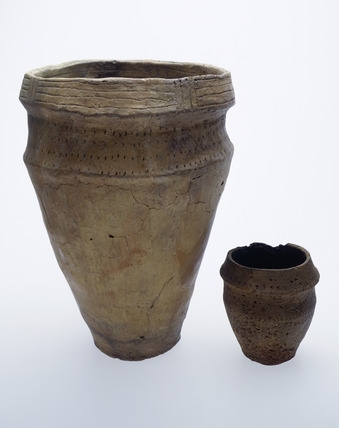
Early Bronze Age crematorium collared
urns, larger with finger nail lines to rim,
smaller with bird bone impressions,
2,200-700 BC, found London
- © Museum of London
They were decorated with horizontal bands of incised or impressed patterns some of which were very intricate. The pottery was made locally with a balance struck between emulating the standard design and local identity. Early examples of around 2,800 BC were of two types, one with cord impressions made by pressing double-stranded twisted cord into the clay, and another with bands filled with impressions made with a comb.
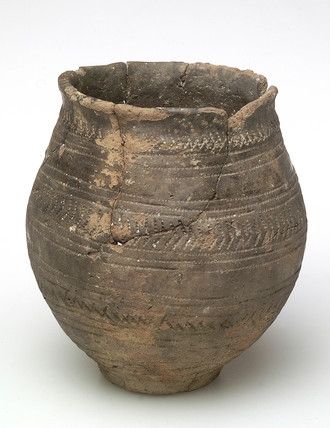
Globular beaker, East Anglia type
2,500-1,500 BC - © Museum of London
In Britain this latter style is similar to the “Grooved” ware that followed Peterborough ware. The beakers were used for drinking recently introduced alcoholic beverages (beer and mead residues have been found), for smelting copper ores and as funerary urns in their burial pits that were arranged in round barrows surrounded by stone circles. The Bell Beaker People co-existed for centuries with the Northern European Corded Ware Beaker People, but superseded them until the Bell Beakers People themselves declined around 1,800 BC. There was a number of regional variations that were no doubt to differentiate groups; so much so that the large number of Bell beakers found in Portugal led some to believe it was their origin. Apart from corded and combed wares there was a “Maritime Ware” from Iberia and Southern France that was decorated with a version of “barbed wire” or “herringbone” pattern with narrow dotted bands filled with slanted parallel lines, usually on a red/orange body, and a “Continental Ware” with wide bands of geometric motifs, sometimes with a grey body. Anthropomorphic jars were also produced and one representing a female with incised decoration and traces of colour dated to 1,800 BC was discovered in Romania. The potters also produced many large cooking pots.
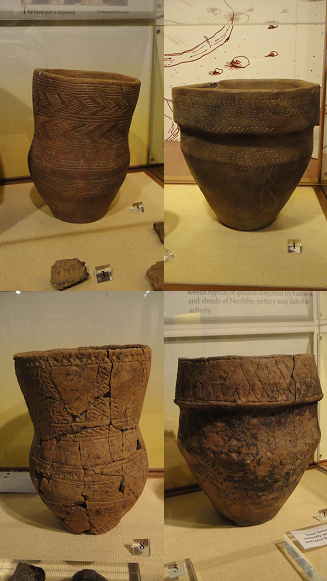
Beakers and urns 2,000-1,500 BC,
beaker with impressed comb
decoration, collared cremation
urns and burial beaker - Image
courtesy of the Potteries Museum
and Art Gallery, Stoke-on-Trent
Notable innovations other than bronze and pottery were in agricultural and mortuary practices and the design of jewellery, especially worked gold. The Bell Beaker migrants were pastoral farmers, good traders, seamen and archers and a relatively warlike people who, by 2,000 BC, had the advantage of bronze weapons and short, very effective bows with barbed arrowheads. They used characteristic wrist guards to protect themselves from the bowstrings. Their warrior chiefs had elaborate burials with significant quantities of rich grave goods and a clear belief in some form of afterlife requiring “provisions”. Arrowheads that were attractive and so delicate they could never be of practical use illustrate the latter.
In Ireland, vessels the same shape as ones they used for food were used as grave goods rather than beakers. These eating bowls, some with inscribed spiral decoration, made their way to North England around 2,200 BC. This started the slow decline in beaker use in Britain from 2,150 BC until it disappeared around 1,700 BC. The Irish also introduced the “halberd”, a broad blade on a 1m long handle, producing a weapon with much greater reach that passed into Europe around 2,400 BC.
| Page: 247 of 418 Go To Page: | |
◁◁ First | ◁ Previous | Next ▷ | Last ▷▷ |
Author: Dr. Stan Jones © Copyright 2010 -