

10. European Pottery to the Fall of the Romans
| 1035 Page: 273 of 418 Go To Page: |  |
◁◁ First | ◁ Previous | Next ▷ | Last ▷▷ |
The main Culture in Central Europe from 1,200 to 750 BC was the “Urnfield Culture”. Coil-built pottery was well decorated by incision and the application of thin clay rolls to form ridges, as well as forming bosses by pressing from the inside of the pot – possibly imitating metal vessels. By about 1,000 BC the finish on some of the pots was dark grey or black, often glossy.
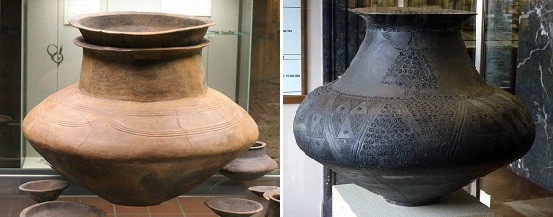
Urnfield urns - source Wikipedia &
Vienna National History Museum
The following Culture was the “Hallstatt Culture” from 750 to 500 BC. Pots were initially made from red clay, probably moulded then incised with geometric motifs (triangles, circles, diamonds and stars). Some pots had white slip applied to the incisions. Others would have graphite rubbed into parts after firing to contrast with the red body, then be polished until black and shiny.

Map of Europe circa 1000 BC - courtesy
Thomas Lessman, worldhistorymaps.info
Some vessels of buff body colour, having impressed marks, would have patterns painted with red slip then graphite to achieve a remarkable tricolour effect. It seems that the potters were again trying to reproduce a metallic effect. In the 7th century BC the graphite was replaced by a black iron slip possibly containing manganese.
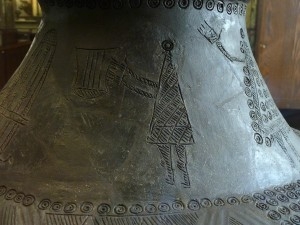
Hallstatt urn, 6th century BC - source
Vienna National History Museum
Around 600 BC, when the Iron Age culture had became predominant, a second wave of Celts from around Austria spread throughout Europe. This time they were a military autocracy whose military technology was so advanced (they invented chain mail) that they had been used as mercenaries by other tribes. They were not a united people but a number of very warlike tribes who often fought between each other. This tribal behaviour was reflected in their pottery that was decorated with local tribal patterns. They had a rather unpleasant ritual of believing that the heads of defeated enemies would bestow power on them, so they beheaded their victims and used the heads as trophies. They had a distinct class system, enjoyed poetry, music and philosophy with a new artistic style influenced by Greek and Etruscan art. They were on very good terms with the Greeks and admired their pottery, but they put their artistic effort mainly into metalwork. They buried their dead rather than cremate them. Unfortunately they wrote little with almost all communication being oral, limiting our knowledge of these people. They conquered Spain around 500 BC, defeating the Carthaginians. Around 450 BC their Culture had developed further and is known as “La Tene”, after a Swiss lake where much Celtic weaponry was found.
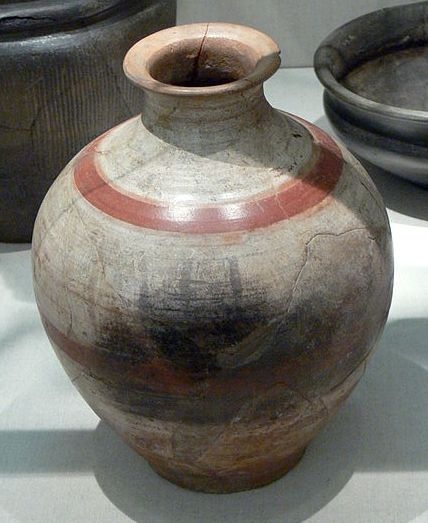
La Tene vessel - source Weissenburg
Romermuseum via Wikipedia
The pottery of this Culture was wheel-made, and shapes were more elegant. Incised decoration included animals in friezes. Pots were initially black, but became red with freer decoration using brushed slip, often using motifs of broad-lobed leaves.
Meanwhile in Britain the Iron Age began around 650 BC and the complexity of society slowly developed, although it was peripheral to the activities of the great powers of the time. The general quality of its pottery improved, with new technology being introduced such as burnishing powdered haematite into the surface of a vessel to achieve a metallic finish, using arcs and swags in decoration, incisions filled in white and eyelet handles for suspension. Influence from the Continent grew, bringing in shapes such as pedestal bases. Trading with Gaul brought in tableware, glassware and wine in amphorae in exchange for slaves, greatcoats and hunting dogs. The introduction of the potter’s wheel in the late Iron Age did not make much impact, with general use possibly as late as the 1st century BC, again probably influenced by the Continent.
| Page: 273 of 418 Go To Page: | |
◁◁ First | ◁ Previous | Next ▷ | Last ▷▷ |
Author: Dr. Stan Jones © Copyright 2010 -