

10. European Pottery to the Fall of the Romans
| 1042 Page: 280 of 418 Go To Page: |  |
◁◁ First | ◁ Previous | Next ▷ | Last ▷▷ |
Unfortunately, it does make it difficult to judge the veracity of their accounts, and present day historians argue over fact and fiction. Rome’s armies expanded its control and by 500 BC it covered more than 300 square miles with a population of perhaps 40,000. However, Rome, which was the leader of the Latin League, and its allies, suffered pressure from adjacent tribes throughout the 5th century BC and much effort was needed to keep these at bay. The Celtic Gauls sacked Rome in about 387 BC, and a large ransom of gold was needed to remove them. This first invasion by a Celtic Tribe caused the Romans to respect them in future clashes. It took the Romans some 50 years to recover their lost territory, and it started to expand again. However, significant Roman Imperial expansion really started in 295 BC when they defeated the combined forces of the Etruscans and Rome’s eastern neighbouring tribe the Samnites.
What seems to have sustained Rome’s determination for expansion was largely due to the culture it developed of glorifying victory over its “oppressors”, lavishing personal acclaim and riches on its victorious military leaders. However, they preached that they only fought “just” wars, which meant only if they were threatened or attacked, and at times this led to some pretty contrived reasons why they thought war was justified.
The Roman Culture absorbed much from the Greeks. The Romans admired their earlier civilisation and adapted Greek Culture and artefacts. From the 3rd century BC they adopted Greek as a second language, and many spoke it, especially the elite, who were often taught by Greek slaves. The Romans excelled in the military and organizational aspects of rule, compared with the more intellectual and artistic endeavours of the Greeks. They adopted Greek literature, but they were not overly interested in philosophy.
The Greek influence on the black glossy fine wares declined around 400 BC, and the Greek-style painted wares had disappeared before 200 BC. However, black glossy wares had become pervasive round the Mediterranean and new versions of pottery using the same glossy black slip appeared in Roman Italy. These fine wares were exported from around 300 BC mainly as bowls with small, stamped decoration, some having white figures painted on the black surface. Tableware was plain black slipped.
In the Middle Republic, say from 280 to 133 BC, Rome expanded to encompass all of Italy apart from the North West of the Arno. They also controlled the islands of Corsica, Sardinia and Sicily. The Romans took Taranto in South Italy in 272 BC, but only after several battles with the army of Greek general Pyrrus, where both sides lost so many men that victory for either side was debatable (the “Pyrric victory”). This “defeat” of the Greeks put an end to “Magna Graecia”.
Probably the most significant clashes of this period in the Mediterranean were the wars between the long established Carthaginians and the upstart Romans. There were three “Punic” (Carthaginian) wars. The first from 264 to 241 BC was over control of Sicily, but led to the destruction of the formidable Carthaginian fleet. The Romans had realised their ships were inferior, so they captured a Carthaginian one, disassembled it and with amazing speed made a sufficient number of copies to overcome the Carthaginians. A peace treaty was signed but broken by the Romans so they could seize Corsica and Sardinia. The Carthaginian leader, Hamilcar, had to replace the resources from these islands, so he colonised parts of Spain between 237 and 228 BC.
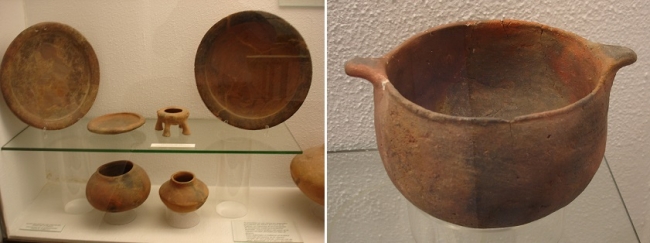
Early Spanish pottery, bowls and platters
2,800-2,300 BC, and a handled bowl,
2,500-2,000 BC - source Museo
Arqueologico, Seville, Spain
Waves of Celts had settled in North and Central Spain from the 8th to the 6th centuries BC, while earlier indigenous tribes remained in southern parts. In Spain’s South and East, these Iberian tribes had their own Culture and early pottery. Later their distinctive pottery styles were exported to Southern France, Sicily and Africa. They had also been importing some fascinating pottery from Greece
| Page: 280 of 418 Go To Page: | |
◁◁ First | ◁ Previous | Next ▷ | Last ▷▷ |
Author: Dr. Stan Jones © Copyright 2010 -