

11. Pottery Technology 2
| 1059 Page: 299 of 418 Go To Page: |  |
◁◁ First | ◁ Previous | Next ▷ | Last ▷▷ |
Trial pieces, usually small test cups, were placed where they were accessible for removal through holes in different parts of the kiln. They showed the fireman the progress of firing during the later stages by their degree of contraction and translucency (in bone and hard-paste porcelain), indicating the temperature reached. Skilled firemen managed to achieve the accuracy of 20 degrees C necessary for successfully firing bone china. In the late 18th century wood fuel was replaced by coal, but it was a very inefficient process, as well as unpleasant for the operators. The clean air act closed bottle ovens in the UK in the middle of the 20th century when the more easily controlled gas and electricity took over.
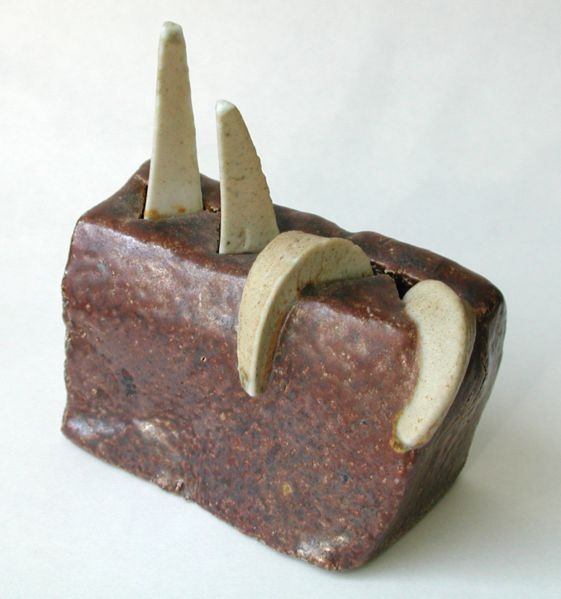
Segar cones - source Wikipedia via tinux
Measurement of temperature and time (or heat work) is critical and was the subject of much development. Early methods, including Wedgwood’s early work on coloured clays and the shrinkage of clay rings, leading to today’s “Buller’s” rings or discs, or the sagging of “Holdcroft bars” as used by Bottger, eventually led to the use of universal Seger cones. These are 3 sided, slim pyrometric pyramids made of materials from low temperature glazes to pure alumina, the tips of which bend as the temperature increases until they are the same level as the base. There are 60 different compositions with standard index numbers representing temperatures from 600 to 2000 degrees C. Today thermocouples measuring gas temperature or optical pyrometers measuring ware temperature are used in kiln control systems or as spot checks.
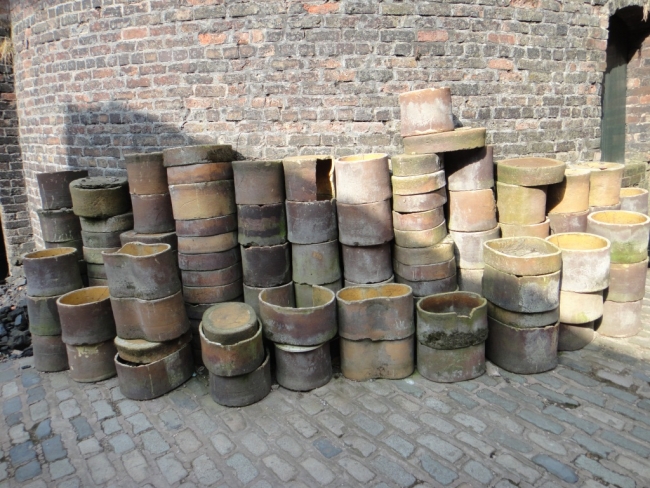
Saggers stacked outside bottle kiln. Image
courtesy of the Potteries Museum and Art
Gallery, Stoke-on-Trent
Another step in technology was to use “saggers” (a contraction of the word “safeguards”) that were pre-fired, strong ceramic supports and separators so that pots could be protected further from direct contact with the flames, as well as supported and stacked in the kiln with increased packing density and significant reduction in damage during firing. They were typically made from 50% fireclay and 50% grog, but would only last for a few firings before they failed from thermal shock. Other ceramics can be used but they are invariably more expensive. More recently zirconia (ZrO2), which is inert to glaze vapours, has been used for glost kiln furniture. As it is expensive it is sometimes used as a coating. The saggers were very carefully stacked in the kiln to ensure they would not move, as this could otherwise cause significant damage.
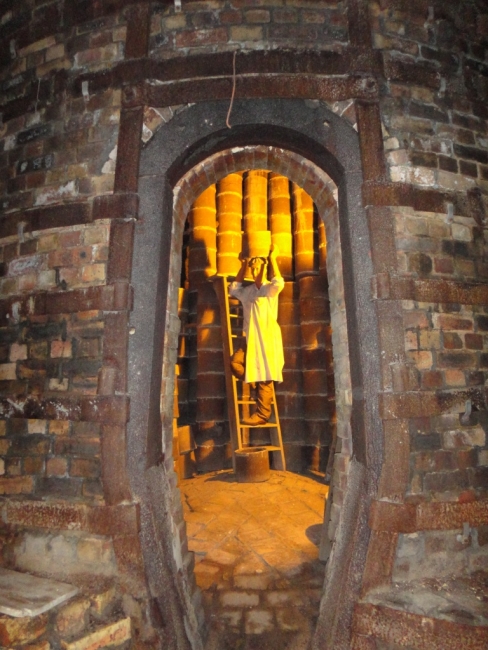
Depiction of bottle kiln being stacked.
Image courtesy of the Potteries Museum
and Art Gallery, Stoke-on-Trent
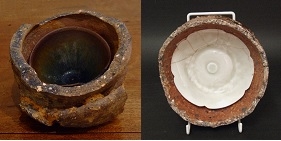
Chinese Sung period kiln wasters,
hare’s fur Jian ware and Qingbai bowl
- courtesy R&G McPherson Antiques
However, things often went wrong in the kiln and many examples exist of distorted vessels still attached to their saggers. The pots were placed in the saggers that were shaped to suit the different wares. Flat wares such as plates were placed on beds of calcined flint that did not melt in the biscuit kiln or stick to the ceramic. Ceramic rings could be used to keep items such as cups and bowls in shape. The saggers were then sealed with wet clay to keep out gasses and smoke.
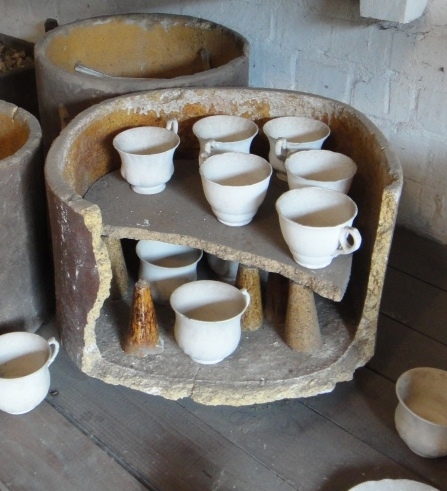
Cups stacked in cut-away sagger.
Image courtesy of the Potteries Museum
and Art Gallery, Stoke-on-Trent
As it takes so much time to stack a kiln, modern “moving hood” kilns are used. Here a portable, large oven with large doors either end can be moved back and forth on rails over an assembly of wares to be fired. This allows a greater utilisation of the kiln, as one batch can be assembled together while another is being fired at the other end of the track.
| Page: 299 of 418 Go To Page: | |
◁◁ First | ◁ Previous | Next ▷ | Last ▷▷ |
Author: Dr. Stan Jones © Copyright 2010 -