

11. Pottery Technology 2
| 1062 Page: 302 of 418 Go To Page: |  |
◁◁ First | ◁ Previous | Next ▷ | Last ▷▷ |
Standards of design were achieved by using “design books” that would be used for reference by painters. Today a typical decoration procedure would start with the biscuit-fired body to which an underglaze colour would be applied by transfer printing.
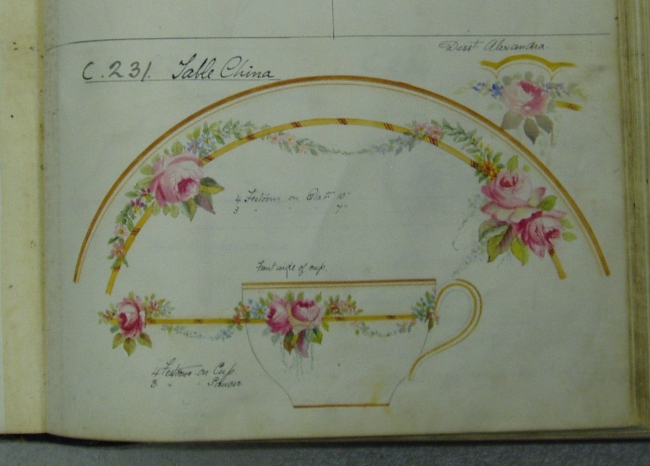
Page from design book for floral teaware, 1914
- courtesy Worcester Porcelain Museum
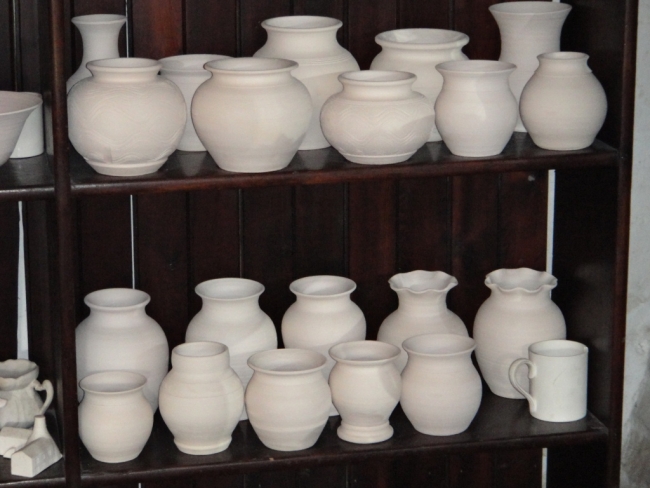
Biscuit wares - Image courtesy of the Potteries
Museum and Art Gallery, Stoke-on-Trent
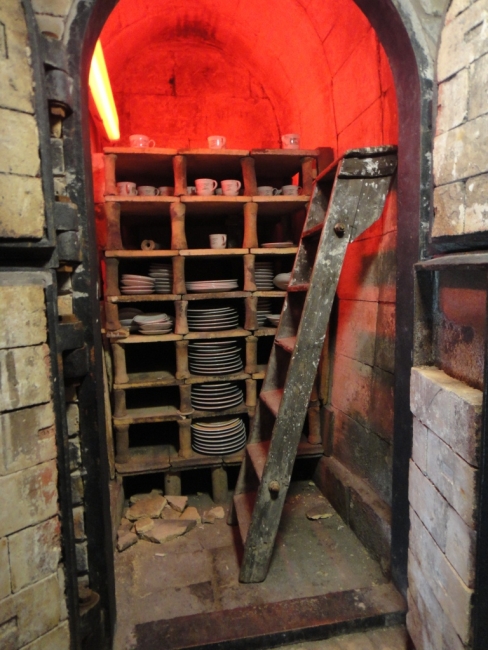
Muffle kiln - Image courtesy of the
Potteries Museum and Art Gallery,
Stoke-on-Trent
Next the item would be glazed and dried. The use of automatic tunnel dryers through which the wares pass on a conveyor belt speeds up drying. The glaze is then fired. The painter applies the first layer of on-glaze coloured enamel paint on the item that is then fired in a “muffle” kiln, (named after the protective structure inside the kiln). The gums used in the earlier enamel paints have now been replaced by synthetics. Further stages of painting follow, building up the depth of colour to give a three dimensional appearance, requiring perhaps 3 to 5 enamel firings (exceptionally 10). Also undercolours are used to highlight the final colour that might be quite different. Translucent colours are used over lighter colours underneath to add lustre. As pointed out previously, overglaze enamels were less durable than underglaze until the more recent introduction of fast firing. Today zircon silicate is used as a basis for colours, and as an example a mixture of 62% zirconia, 30% silica, 3% sodium fluoride and 5% ammonium vanadate produces blue, but varying the % of vanadium produces greens and yellows.
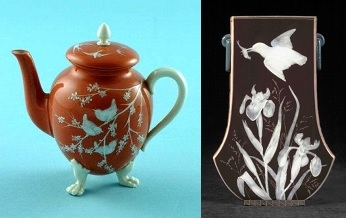
Pate-sur-pate by William Pointon -
courtesy Worcester Porcelain Museum and
Wedgwood banjo vase - Image Courtesy
of the Wedgwood Museum
A new decorative technique was found accidentally in Sevres in the 1850’s called pate-sur-pate (paste-on-paste), when the potters were trying to copy Chinese decoration. The technique uses white slip built up layer upon layer to form a relief design on the porcelain biscuit body that is then glazed and fired. It is also used on coloured bodies.
In Britain towards the end of the 18th century platinum lustre was used to simulate silverware. The amount of platinum metal used was very small so this ware was much cheaper than the solid silver metal alternative.
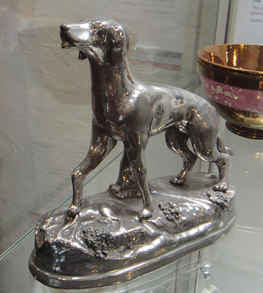
Platinum lustre dog - Image courtesy of
the Potteries Museum and Art Gallery,
Stoke-on-Trent
They also achieved a background of gold and later copper lustre, leaving “reserved” areas white for later painted decoration. This was done by using a shellac “resist” that was painted or stencilled over the first, transparent glaze. This prevented the lustre pigment adhering, so that the resisted pattern remained white.
| Page: 302 of 418 Go To Page: | |
◁◁ First | ◁ Previous | Next ▷ | Last ▷▷ |
Author: Dr. Stan Jones © Copyright 2010 -