

12. European Pottery - Fall of Romans to the Present
| 1411 Page: 312 of 418 Go To Page: |  |
◁◁ First | ◁ Previous | Next ▷ | Last ▷▷ |
The Moors introduced their Culture into Spain and developed it over these 800 years. They created one of the most notable and magnificent ceramic wares, which are now known as Hispano-Moresque. The principal decoration on these was colourfully painted tin glazing together with lustre pigments originally based on the technology from Egypt. They were produced in Spain from the 13th century. This ceramic technology of the Moors, particularly the art of metallic glazes, was perfected in Spain and had a lasting effect throughout Europe, particularly in Italy, although tin-glazed pots also found their way to Britain. The body of these wares was made from fairly coarse clay, fired to a pink/buff requiring a temperature of at least 1000 degrees C, producing hard earthenware. It was covered with a white opaque glaze made of a basic lead glaze with the addition of tin oxide in varying proportions. Often dishes were decorated in blue (cobalt) and sometimes purple (manganese) on this pure white ground. It was also used for wall and floor tiles that were extensively used. Less common than dishes were the Middle Eastern albarellos or waisted drug jars that later came to bear the names of their intended contents, generally in cryptic Latin.
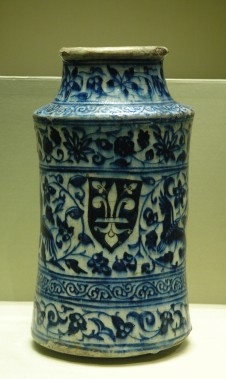
Albarello with fleur-de-lys
decoration, 14th century AD
- source Louvre Museum
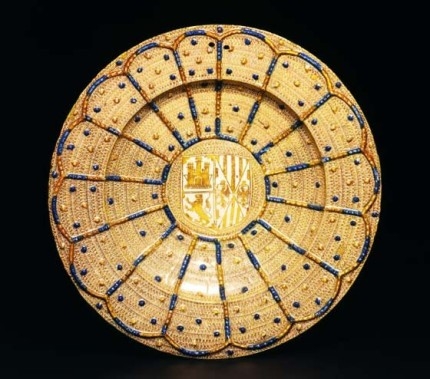
Hispano-Moresque lustreware 1475 AD
- source cerawiki
Lustre finish was added over the fired glaze and in the early period this had a golden yellow colour that was derived from silver or a red colour that was probably derived from copper. The technology of the important tin-glazed earthenware that was produced in Manises and Paterna near Valencia, Spain, in the 14th and 15th centuries, predominantly using green (copper) and purple decoration, later spread to, and greatly influenced, Italian potters. Many dishes from Valencia were ordered by noble Italian families to be decorated with their coats-of-arms.
After 1500 AD tiles were made by the Moorish “cuerda seca” method, where outlines of the motifs were drawn with manganese oxide pigment mixed with grease, preventing the coloured glazes from mingling. This method produced deeply impressed glaze patterns, which were often complemented with a lustre finish.
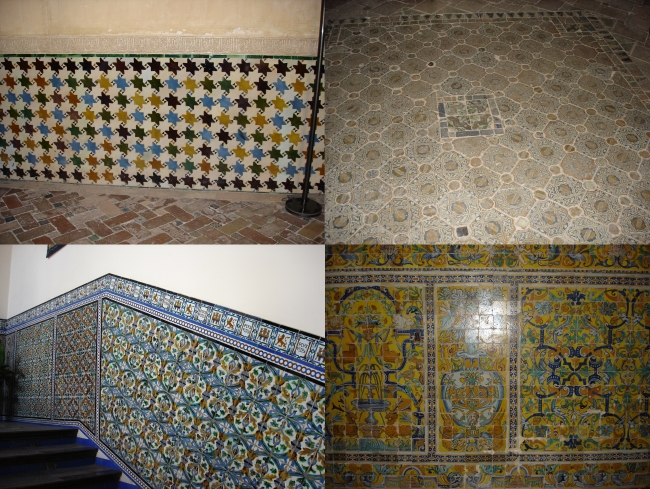
Tiled walls at Alhambra,
Grenada, and Alcazar, Seville
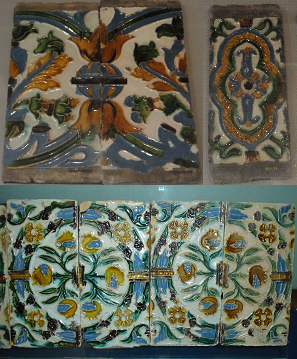
Sixteenth century tin glazed Spanish
tiles, relief moulded, Seville and Cuenca
- Image courtesy of the Potteries Museum
and Art Gallery, Stoke-on-Trent and Set of
four tiles - source Alcazar, Seville
The Moors produced fantastic glazed tiles such as those decorating the Alhambra palace at Grenada, built in the 13th and 14th centuries, as well as large pottery jars decorated in multicoloured arabesque designs.High quality Moorish style leaf, arabesque and writing script decoration occurred up to about 1525 AD, after which their influence declined because of their expulsion from Spain. Subsequently the Spaniards continued with the tradition, but the quality declined as Spanish artists tried unsuccessfully to copy the Kufic and Arabic motifs and they became meaningless. Later, quality improved with animal decoration including lions and eagles, then deer and antelope. Much good quality tin-glazed pottery was made during the 17th and 18th centuries at Talava de la Reina, Spain, where green and purple decoration was enhanced with orange/red and grey.
The “Istoriato” style of decoration from Urbino, Italy, where production was supported by the Dukes of Urbino, was copied by the Talava de la Reinan potters, showing the two-way flow of technology. Tin-glazed tiles were used extensively to decorate ordinary houses. Initially thin tiles were cut into pieces and bedded in mortar as a form of mosaic, a typically Persian technology. Today in Southern Spain many houses are still decorated with tiles and other ceramic ornamentation.
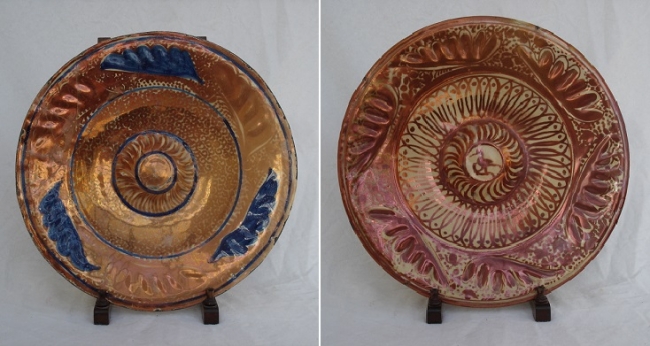
Spanish lustre plates, 17 and 18th
centuries - courtesy Glade Antiques
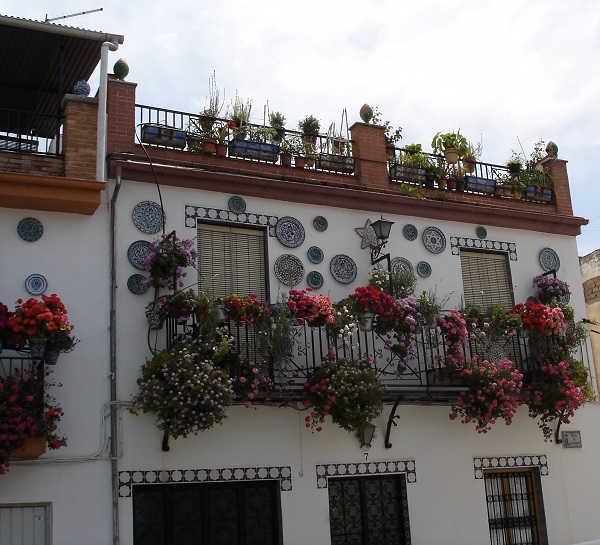
House with decorated plaques,
Grenada, Spain
| Page: 312 of 418 Go To Page: | |
◁◁ First | ◁ Previous | Next ▷ | Last ▷▷ |
Author: Dr. Stan Jones © Copyright 2010 -