

12. European Pottery - Fall of Romans to the Present
| 1413 Page: 314 of 418 Go To Page: |  |
◁◁ First | ◁ Previous | Next ▷ | Last ▷▷ |
There were only a few shapes used for majolica, as they were mainly vehicles for painters to show off their skills rather than for general use. Dishes were most popular for display in homes, and gaily-coloured drug jars for decoration in pharmacies. The Spanish albarello shape was used for dry drugs and a spouted jar for wet ones. Other shapes were ewers based on the Greek oenochoe and massive jars. Classical motifs such as grotesques displaced the Gothic style.
In Italy the term majolica was used fairly loosely from the 15th century to denote all tin-glazed earthenware with brilliant polychrome decoration. In the 16th to 18th centuries the major factories were at Caffaggiolo, Castel Durante (Urbino), Deruta, Faenza, Siena and Venice.
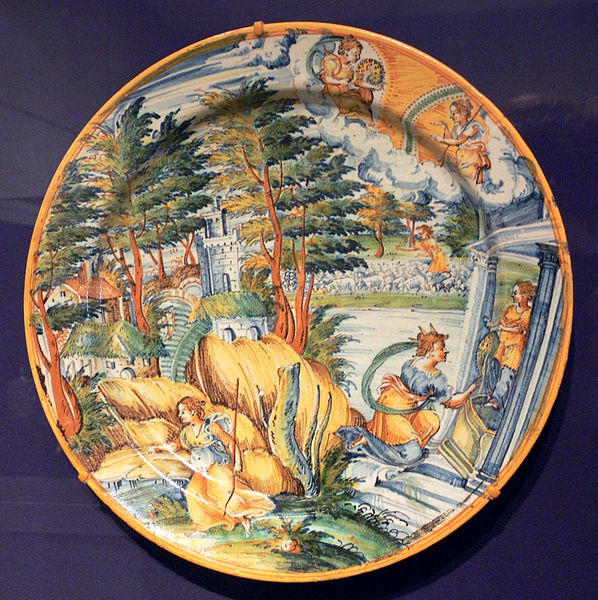
Majolica charger Faenza
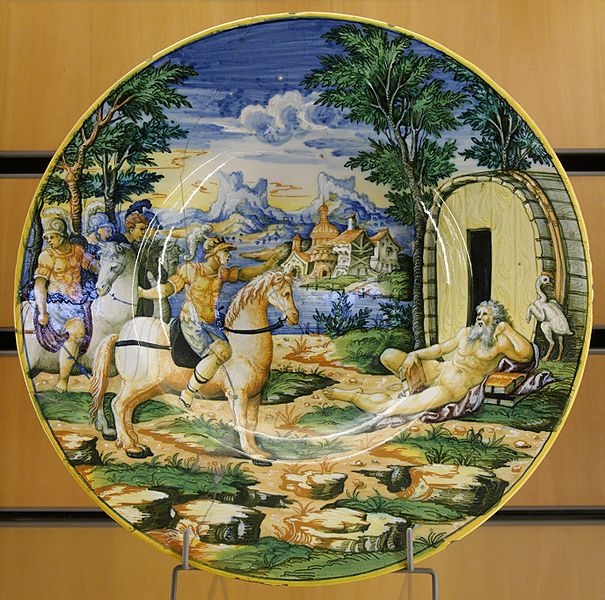
Urbino charger depicting Alexander and Diogenes,
16th century - source Museum of Fine Arts,
Lyon, via Marie-Lan Nguyen
The Duchy of Urbino was the main production centre for high quality majolica from 1520 AD. Typical wares were large platters containing beautifully painted religious, historical and mythological scenes in which perspective has returned.
This style on majolica displaced the classic style and reflected the best contemporary oil painting. It was originally developed in Faenza in about 1500 and is referred to as “Istoriato”. Istoriato majolica items, particularly if signed and dated (although this is rare), are ceramic “old masters” at a fraction of the price, and the pigments will not fade. The paintings are sometimes bordered, but often cover the whole surface as if using the ceramic as a canvas, regrettably disregarding its shape, but producing very colourful ornaments. Some of the majolica that was made in Venice between 16th and 18th centuries reflected its international role leading to its designs sometimes copying Iznik and Chinese Ming styles.
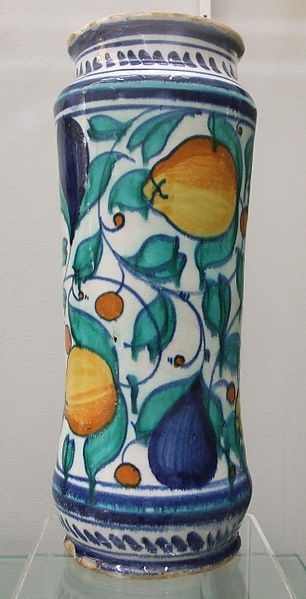
Majolica Albarello, Venice or
Castel Durante, 16th century
- source Burrel Collection
via Marshall46
Deruta potters were probably the first in Italy to use lustre pigments, producing some high-quality, prestigious wares with a pale yellow tone; however, Gubbio (Urbino) became famous for these majolica lustre wares. They were based on the Hispano-Moresque wares from Valencia that were imported in the 14th and 15th century. The resulting transfer of technology brought the golden yellow and the beautiful ruby lustres to Italy. To achieve the necessary reduction atmosphere, the potters fed brushwood into the kiln during the final firing stages. The Deruta potters later sent items to Gubbio for the lustre finish.
Sgraffito wares that were mainly made in Northern Italy around Bologna were inspired by examples made from the 11th century by the Byzantines in the Middle East, and the manufacturing methods used were similar to those used by the Byzantines. The leatherhard body would be dipped in a white clay slip and dried. Designs were then scratched to reveal the body colour with a wooden or iron tool. After the first firing a yellowish lead glaze was applied followed by a second firing. Early, fairly crude examples were produced around the Po Valley and in Venice from the 13th century. Initially the decoration was geometric, but in 14th century it included pomegranates and palmettes. Sgraffito decoration became more sophisticated and popular in Italy in the 15th and 16th centuries, partly because they were cheaper to produce than majolica, and because of additional technology that was transferred from Cyprus. (Cyprus was ruled by Venetians from 1472 to 1570 AD). Coloured pigments were added to embellish the incised designs under the lead glaze to produce polychrome sgraffito ware. Colours used were blue, green, purple, brown and yellow, but they tended to run during firing. Italian pottery development had a major influence outside Italy; not only throughout Europe, but occasionally even Ming porcelain decoration seems to reflect Italian design, so the flow of culture was in both directions.
| Page: 314 of 418 Go To Page: | |
◁◁ First | ◁ Previous | Next ▷ | Last ▷▷ |
Author: Dr. Stan Jones © Copyright 2010 -