

12. European Pottery - Fall of Romans to the Present
| 1425 Page: 323 of 418 Go To Page: |  |
◁◁ First | ◁ Previous | Next ▷ | Last ▷▷ |
In 1717 AD Augustus offered his Prussian cousin Frederick I a trade for 151 specific pieces of Chinese porcelain from the Prussian Royal Collection in exchange for a regiment of 600 of his Saxon troops! Accordingly the larger Imperial Chinese vases he received were later called “Dragoon” vases. Frederick had enlarged the Oranienburg Palace, building a large porcelain room that was covered from floor to ceiling with ceramics, joining those at two of his other palaces.
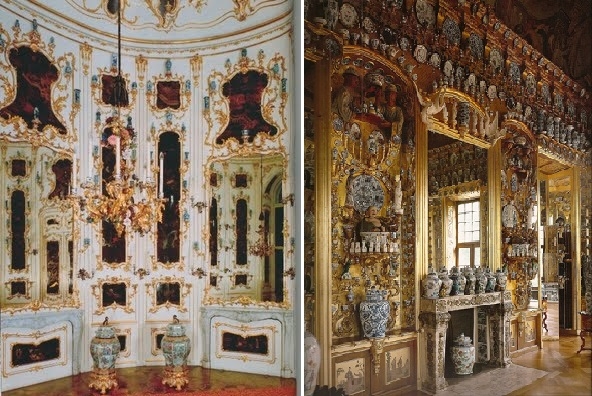
Examples of porcelain rooms, Schonbrunn
Palace, Vienna - source Bridgman Art Library
and Queen’s porcelain cabinet, Charlottenburg
Palace, Berlin - source Quintessence
Augustus was spending such huge sums buying Chinese and Japanese porcelain that he decided to try to find a way of producing it more cheaply in Saxony. He sponsored Count von Tschirnhaus, a Saxon nobleman and inventor who had been experimenting since 1675 AD with lenses and mirrors to focus the sun’s rays to produce high temperatures. He started to carry out experiments on refractory materials such as high temperature clays mixed with fusible rock. Almost certainly he had produced samples of porcelain by the end of the century. Meanwhile, Johann Friedrich Bottger (1682-1719 AD), an apprentice in the Berlin apothecary Zorn, was an alchemist who claimed to have the secret of turning base metal into gold. This came to the attention of Fredrick I of Prussia, and having been warned of this, Bottger fled to Saxony in 1700 AD. However, he was seized by Augustus who held him as a prisoner in Meissen, near Dresden. As he was having little success in producing gold, he tried to escape but was recaptured. In 1706 AD Tschirnhaus convinced Augustus to let Bottger help him. By 1707 AD they had developed a fine red stoneware, coloured by the ferric oxide in the original clay, which became the precursor to hard porcelain in Europe. This stoneware was so hard it could only be cut on a jeweller’s wheel, which was used to engrave decoration such as coats of arms and to provide a polished finish. The red stoneware was the initial product of the first factory in 1708 AD. At the start the forms and moulded decoration were in the Chinese style, but these were replaced by the baroque style. The first Harlequin from the Italian Commedia dell’arte was made by Bottger using his red stoneware.
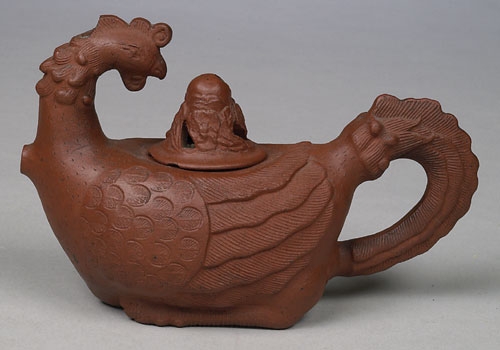
Bottger Meissen red teapot - source
Cowan’s Auctions
Also in 1707 AD clay containing kaolinite was discovered in Colditz, Saxony. There is an account written in 1857 AD stating that John Schnorr, a rich ironmaster, was riding his horse through the countryside near Aue, Germany, when he noticed it slowing, and looking down he saw the horse was struggling through heavy white clay. He instantly recognised the potential of this clay as – wig powder! Up to then wig powder had been based on flour, which with perspiration became a sticky mess. Schnorr set up in business selling this wig powder in Dresden, Leipzig and other large towns. The record goes on to describe how Bottger came across a packet of the powder, realised it was a very fine white clay and was likely to improve his formula, and later found it was kaolin. To keep the secret of kaolin’s importance, the clay was transported to the factory in sealed barrels and the Elector banned the export of the newly discovered ingredient.
| Page: 323 of 418 Go To Page: | |
◁◁ First | ◁ Previous | Next ▷ | Last ▷▷ |
Author: Dr. Stan Jones © Copyright 2010 -