

12. European Pottery - Fall of Romans to the Present
| 1438 Page: 327 of 418 Go To Page: |  |
◁◁ First | ◁ Previous | Next ▷ | Last ▷▷ |
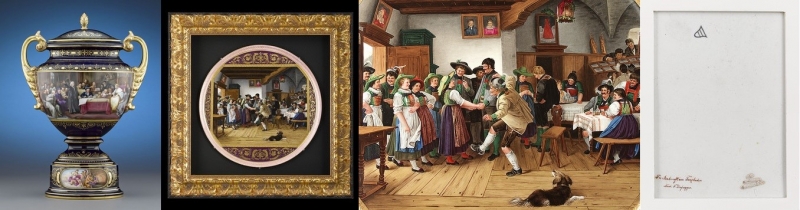
Vienna porcelain, superb vase painted by Scheindler,
1880 AD, fine framed plaque, close up and reverse showing
beehive mark - courtesy M S Rau Antiques, New Orleans
As mentioned earlier J J Ringler and some of the workmen from Vienna, who knew the secret of hard porcelain, left and moved to the Hochst faience pottery around 1750 AD. It started porcelain production in 1752 AD alongside its faience. Various German rulers were soon sponsoring factories producing hard-paste porcelain, including Frederick II the Great of Prussia (1712 -1786 AD). Frederick was well known for his love of porcelain, and he commissioned Meissen to produce pottery such as large dinner services, and visited them to give detailed instructions for designs and decoration.
Modelling fine porcelain figures became a speciality of German factories in the 18th century. Of particular note, apart from the previously mentioned figures designed by Kaendler at Meissen, are those made by the Luck brothers at Frankenthal, F.A.Bustelli at Nymphenburg and the delightful little figures of children moulded by J. P. Melchior at Hochst (1767-1779 AD).
The Hannong family set up the Strasburg faience and porcelain factory in 1721 AD, but as Sevres had been given the monopoly over porcelain manufacture in France, Paul-Anton Hannong moved to set up in Frankenthal, near Mannheim, Rhineland, in 1755 AD.
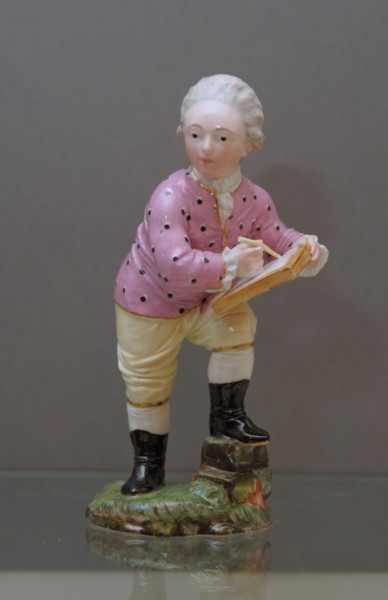
Frankenthal figure, Melchior
1770-80 AD - Copyright © 2011
On Line Galleries.
All Rights Reserved
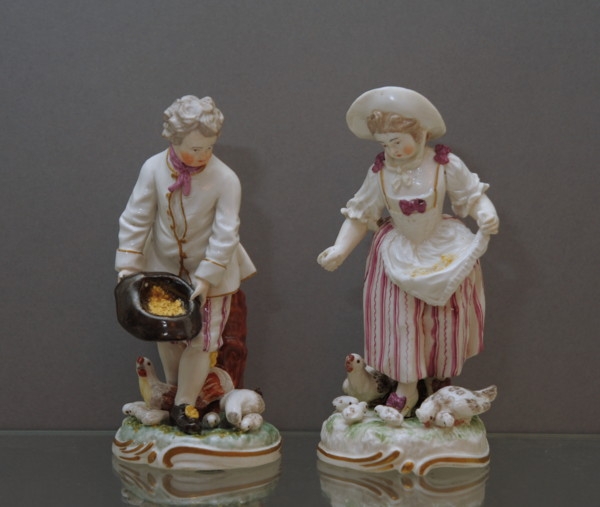
Frankenthal figures, Luck 1771 AD
- Copyright © 2011 On Line Galleries.
All Rights Reserved
He took some craftsmen with him, and was supported by the Elector Carl Theodor. Paul’s son Peter Anton continued running the Strasburg faience factory. On the death of Paul-Anton in 1760 AD, his son Joseph Adam Hannong ran the company but it soon failed and he sold the operation to the Elector in 1761 AD. Fine figures were made by J W Lanz, the brothers J F and K G Luck, F K Linck and J P Melchior, who arrived in 1779 AD. Services were also produced that were well painted and with relief decoration. The Elector moved to Munich in 1777 AD, reducing his support, and French troops invaded in 1794 and the factory changed hands several times before it closed in 1799 AD.
Maximillian III, Elector of Bavaria, wanted to set up a porcelain factory in Bavaria, so in 1747 AD he put Neudeck Manor, near Aue, at the disposal of F I Niedermayr and sponsored his development work. After six years of experimentation, he was not successful so in 1753 AD the State appointed the experienced J J Ringler to take over. A year later the first porcelain was produced. F.A.Bustelli became “Modellmeister” in 1754 AD from which date the factory produced fine painted porcelain figures. Between joining and his death in 1763 AD, Bustelli modelled over one hundred figures that are amongst the finest anywhere.
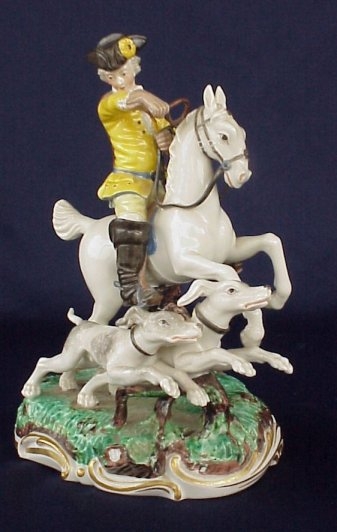
Nymphenburg hunting scene
- source Burchardgalleries
In 1761 AD the factory was moved to the grounds of the Nymphenburg Palace, located near Munich, and is still in operation there. D Auliczec followed Bustelli, producing further fine figures including animals for hunting groups, mythological figures as well as vases and services notably the “Perl Service”. Melchior joined in 1793 AD following his spell in Frankenthal from 1779 to 1793 AD and took over when Auliczec retired in 1797 AD.
In 1756 AD Frederick II launched a surprise attack on Saxony starting the “7-year war”, and Augustus III and von Bruhl junior fled to Poland. Meissen influence diminished after the 7 years war, as Frederick occupied Dresden and removed what craftsmen and equipment he could from Meissen to Berlin. The Berlin factory had been set up by W Wegely in 1751 AD, with the support of a monopoly granted by Frederick II, and craftsmen from Hochst and Meissen. It failed in 1757 AD, probably because of the Seven Years War and painting problems. Encouraged by Frederick II, J E Gotzkowski took over the factory in 1761 AD, recruited craftsmen from Meissen and successfully built it up, producing a grey body and yellowish glaze.
| Page: 327 of 418 Go To Page: | |
◁◁ First | ◁ Previous | Next ▷ | Last ▷▷ |
Author: Dr. Stan Jones © Copyright 2010 -