

15. Present Day Industrial Applications
| 1855 Page: 379 of 418 Go To Page: |  |
◁◁ First | ◁ Previous | Next ▷ | Last ▷▷ |
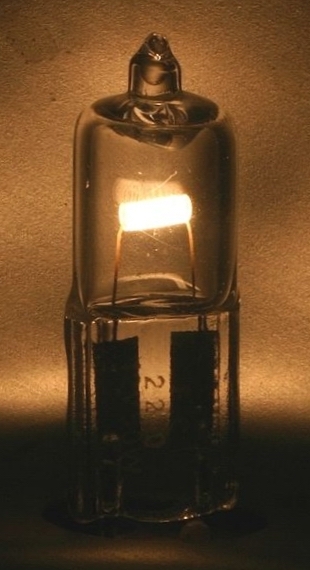
Halogen bulb
- source Wikipedia
via Alan Liefting
Fused silica envelopes enabled the development of halogen lamps that appeared on the market around 1960. They were incandescent lamps using a tungsten filament in a halogen atmosphere that formed a continuous chemical reaction returning tungsten to the filament, which reduced the blackening of the inside of the envelope. They were erroneously called “quartz” halogen lamps, although more accurately quartz is the crystalline not the glassy form. It is transparent to ultraviolet and visible, but has to be moulded as it does not soften like soda glass and cannot be easily blown. Quartz iodine lamps used iodine as the halogen gas and were initially found in car headlights. Lamp internals were made of borosilicate and aluminosilicate glasses that have a much lower expansion coefficient than soda or lead glass so are resistant to cracking. A new metal connection had to be devised to match the fused silica, which was not easy to find, but finally flattened strips of molybdenum were found to be suitable.
The fluorescent lamp or discharge tube that became available in the 1930s consisted of a low-pressure borosilicate envelope having electrodes at the two ends. It contained an ionised gas producing light from the ensuing plasma when an appropriate electric field is applied. The first discharge lamps used low-pressure mercury as the ionising gas producing a blue light, but most energy was ultraviolet. To improve their performance they had a fluorescent coating of rare earth doped phosphors on the inside of the envelope that converted some of the ultraviolet light to visible.
The next development used neon as the ionising gas producing red light that was mainly used for advertising. The use of a fused silica envelope allowed higher operational temperatures and efficiencies.
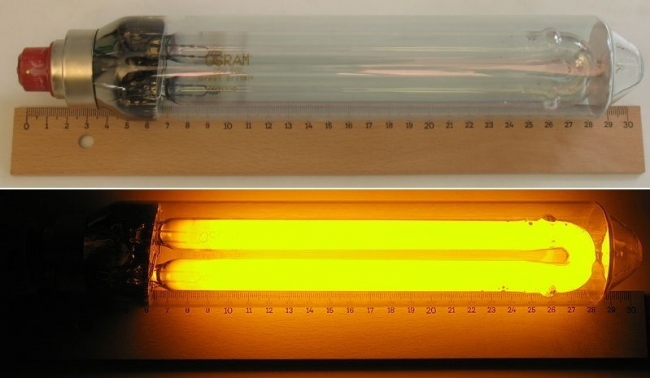
Low pressure sodium lamp: Osram 35W lamp
Sodium discharge lamps were used extensively for road illumination, but had a very narrow yellow wavelength making it impossible to differentiate illuminated colours. The sodium was solid when cold and could not start on its own, so a little neon gas was used to start the discharge and when, after a few minutes it was warm enough, the sodium vaporised and took over the discharge. This gave the initial red then yellow colours. Hot sodium is very reactive so a special envelope was developed to contain it. This was a soda glass envelope with a thin layer of silica-free aluminoborate glass on the inside. The outer layer kept out moisture and the inner layer resisted the sodium.
The development of the high-pressure sodium discharge tube in the 1970s broadened its spectrum to “salmon pink”, which permitted most colours to be seen when illuminated.
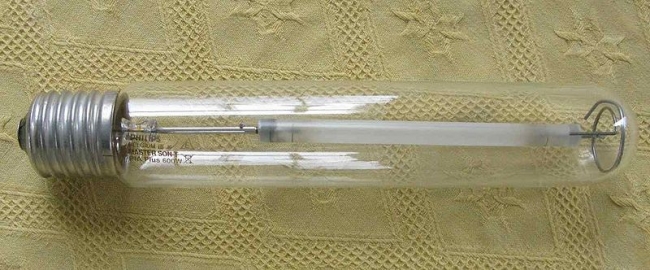
High pressure 600W sodium lamp
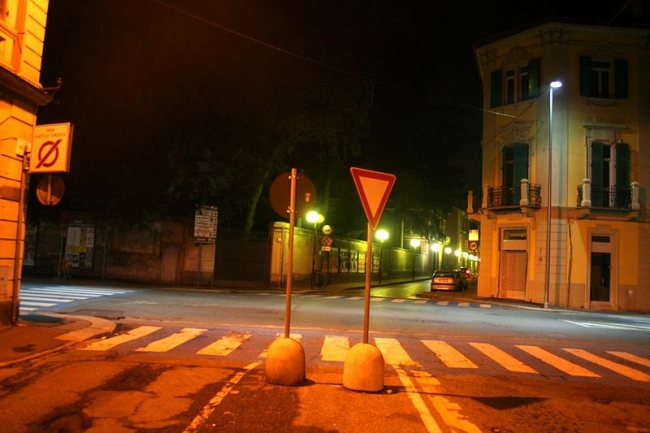
Comparison of lamp types: rear is mercury (bluish),
centre LED (white) and front sodium (yellow)
This was made possible by using transparent doped alumina for the discharge tube, which was unaffected by the hot sodium plasma. The alumina was cast as a hollow tube and the alumina end caps cemented with a sodium resistant glass. Niobium leads were used to match the expansion coefficient of the alumina, and xenon was used as the starter gas. The latest phosphors are used in vapour form within the discharge tube. They are alkaline-earth ceramics such as barium magnesium aluminate for blue, calcium silicate for pink or zinc silicate for green.
The latest development is to use Light Emitting Diodes (LEDs) that can provide very high quality illumination.
| Page: 379 of 418 Go To Page: | |
◁◁ First | ◁ Previous | Next ▷ | Last ▷▷ |
Author: Dr. Stan Jones © Copyright 2010 -