

16. Characteristics and Applications of Advanced Ceramic Materials
| 1870 Page: 390 of 418 Go To Page: |  |
◁◁ First | ◁ Previous | Next ▷ | Last ▷▷ |
A significant step forward was made in 1966 with the discovery of superconductivity in a ceramic, strontium titanate. In 1979 barium lead bismuth oxide was found to become superconducting at 13 degrees K. A further breakthrough occurred in 1986 when a lanthanum barium copper oxide ceramic was found to have a superconductivity critical temperature of 35 degrees K, for which work the discoverers, Bednorz and Muller, received the Nobel Prize. Critical temperatures have been raised with ever more complex, tailored ceramics, such as yttrium barium cuprate with a critical temperature of 92 degrees K. The critical temperature reached 120 degrees K in 1988, well within the capability of being cooled by liquid nitrogen (boiling temperature 77 degrees K), which is much cheaper to use than helium. In 1993 mercury based ceramics (mercury barium calcium cuprate) reached 135 degrees K. This century, research has also revealed some interesting iron based superconducting ceramics.
Forming usable conductor structures from these ceramics is more difficult than with metals because of their brittle, non-malleable nature, but by forming the ceramic into metal tubes, by tape casting and epitaxial deposition of thin films, researchers have achieved considerable success.
 coating on single sapphire fibres.jpg?rnd=20150213125235)
Superconducting fibres with ceramic
coating on single crystal sapphire
- source Tel Aviv University

Superconductor on coiled stainless steel
- source Martin Lohan, Karlsruhe IT
Superconductors are particularly useful for generating high magnetic fields with very small magnets. They can be used in medical diagnostics (MRI scanners), frictionless magnetic levitation for railway trains (maglev), naval mine neutralisation, particle accelerators for high-energy nuclear research and fusion reactor containment magnets. It is estimated that in 2016 global superconductors will be worth 5Bn Euros, two thirds of which will be for body scanners.
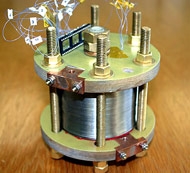
Superconducting superpower high
field electromagnet
Superconductors can also be used in the electricity distribution system as high capacity conductors over medium distances such as into the centres of urban areas. In a recent demonstration a 30m long cable was operated at 24,000 to 48,000 Volts (24 to 48kV) for ten 24-hour cycles carrying a record breaking 3200 amps, or five times that of a similar conventional copper cable. The ceramic used was bismuth strontium calcium copper oxide embedded in a silver matrix. The ceramic alone has a conductivity of 150 times that of copper. The cables used are concentric, containing the superconducting tape (that can now be made in very long lengths to avoid jointing), as well as containing the liquid nitrogen path, conventional dielectric insulation and outer protection. This indicates the practicality of using such technology in areas of high density electricity usage. It will also reduce energy loss, as the overall resistance/km can be 800 times lower than overhead lines.
| Page: 390 of 418 Go To Page: | |
◁◁ First | ◁ Previous | Next ▷ | Last ▷▷ |
Author: Dr. Stan Jones © Copyright 2010 -