

16. Characteristics and Applications of Advanced Ceramic Materials
| 1873 Page: 394 of 418 Go To Page: |  |
◁◁ First | ◁ Previous | Next ▷ | Last ▷▷ |
The latest mobile phone technology uses a piezoelectric ceramic actuator creating vibrations along much of the display screen, transmitting clear audio to the user making it much easier to hear in a noisy environment.
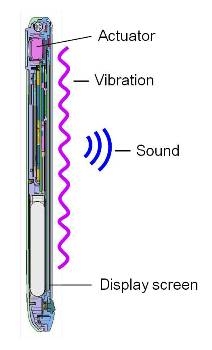
Diagram of Kyocera mobile
phone - source Wikipedia

Helicopter with suspended sonar
- source Wikipedia
Another particularly relevant application is to use piezoelectric sensors to listen to acoustic emissions from cracking porcelain during cooling, helping to optimise the firing regime.
An interesting development is the use of piezoelectric ceramic “patches” to detect vibration in windows due to external noise, and to vibrate the window in antiphase to cancel the noise out. Initially the patches were installed in the frame, but in the future transparent ones could be stuck on the glass.
The recent development of a new class of single crystal, multi-oxide piezoelectric with ultrahigh electromechanical coefficients has had a significant impact on the performance of devices, and has accelerated work on a comprehensive theory that will permit materials to be designed from scratch.
16.16 Bulk and Surface Wave Devices
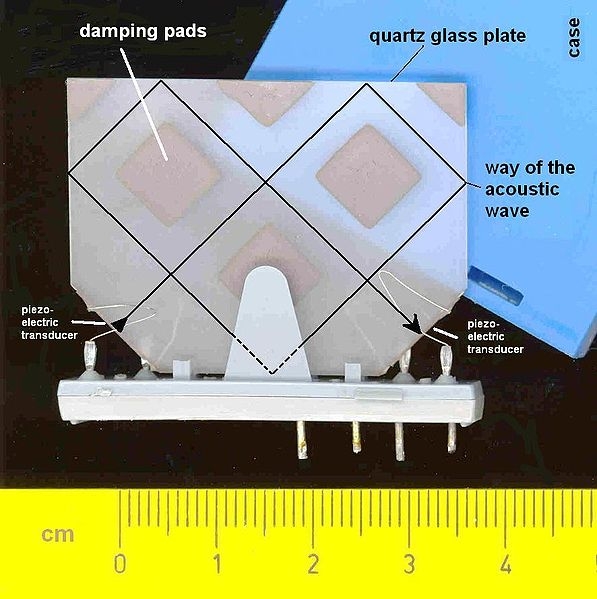
Ultrasonic television delay line
- source Wikipedia via Ulfbastel
Piezoelectric ceramics can also support mechanical waves (“ultrasonic” or “acoustic waves”) in the bulk of the material and on its surface. The simplest devices that can be made using acoustic bulk waves in a piezoelectric material are delay lines. They could be simple bars of piezoelectric material such as single crystal quartz or lithium niobate with transducers at each end, providing a delay dependant on the length of the bar and the velocity of the bulk waves through the material. However, more complex shapes can produce a better use of material. A carefully designed multi-faceted piezoelectric slab can be used that has transducers mounted at appropriate points as input and output. When an electrical signal is applied to the input transducer, a mechanical wave is launched into the material that travels at the bulk wave velocity of the material. The wave propagates through the ceramic, repeatedly reflecting off sides until it reaches the output, to be converted back into an electrical signal after the designed delay. Such a device is used in TV sets to provide a 64-microsecond delay to improve picture quality.
These devices also act as resonators and are found as frequency filters in mobile phones and televisions
As the name suggests, surface waves travel on the surface of a piezoelectric material. Transducers can be made from a pattern of simple metallic fingers deposited on the surface of the piezoelectric. A signal applied between adjacent fingers will launch surface waves that can then be picked up by another surface mounted metallic finger pattern and converted back to electrical signals.
| Page: 394 of 418 Go To Page: | |
◁◁ First | ◁ Previous | Next ▷ | Last ▷▷ |
Author: Dr. Stan Jones © Copyright 2010 -