

16. Characteristics and Applications of Advanced Ceramic Materials
| 1874 Page: 396 of 418 Go To Page: |  |
◁◁ First | ◁ Previous | Next ▷ | Last ▷▷ |
There are a number of other relatively complex ceramics that are tailored for particular spectral bands, and block transmission outside these. As an example, when yttrium oxide and thorium oxide are fired at 2200 ºC under very high pressure, the result is a very dense ceramic that is transparent to visible and infrared light. Another example is the ceramic made of silicon and germanium oxides with aluminium tantalate that is used for infrared heat detection in missiles.
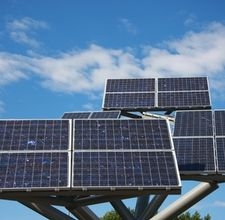
Solar array with indium tin oxide coating
- source Wikipedia via ehow
Thick and thin films that are transparent to the specific radiation frequencies required can also be deposited on to surfaces. A simple early but vital use was the conductive and transparent indium tin oxide ceramic film used to heat aircraft windscreens in the Second World War, keeping them free of ice. A current example is the use of indium tin oxide as an electrode transparent to visible light for hundreds of millions of Liquid Crystal displays (laptops, phones), semiconductor light sources and solar cells. Solar cells can be made of semiconducting titanium dioxide with a dye to absorb the sunlight sandwiched between a transparent plate and a metal electrode. Potentially very large cells could be produced in this way.
Simpler ceramics such as alumina are used, sometimes as single-crystal sapphire, but the latter is very hard and difficult to grow into ideal shapes. However, sapphire windows are used for applications such as high intensity lamps and missile heat-seeking sensors that have to withstand high temperatures.
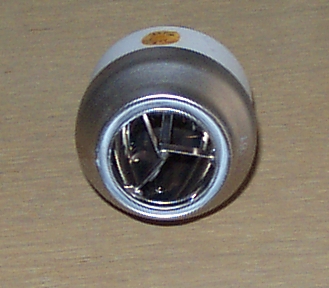
Xenon arc lamp with sapphire window
- source Cermax
Ceramics are also used to cover radar arrays (radomes) in higher temperature applications (over say 300 ºC), where their thickness is made a quarter of a wavelength to reduce attenuation (0.5 cm at 10 GHz if alumina is used). Alumina is also used for microwave windows, electronic tube envelopes and missile nose cones.
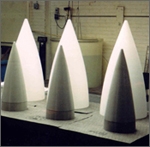
Ceramic missile radomes
- source Ceradyne
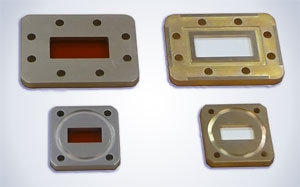
Ceramic microwave waveguide windows
Beryllia is also used for microwave windows, and because of its high thermal conductivity (7 times alumina) and radiation resistance it is used in high power microwave generators such as cyclotrons and travelling-wave-tubes. However, powdered beryllia is very toxic so it is more difficult to use it to manufacture components.
Other applications of transparent ceramics include the glass-ceramic hob plates for domestic cookers that have high resistance to mechanical and thermal shock, and high transmission in the near infrared to allow the heat from the tungsten halogen lamps used to pass through. They also let red light through to indicate on/off, but are opaque to the rest of visible light, so they appear opaque to the eye.
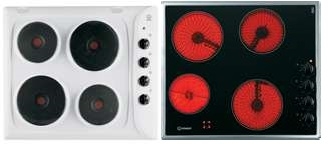
Indesit hobs
X-Ray windows are based on lithium, magnesium and boron oxides that are used in medical vacuum image intensifiers, and the glass-ceramics used to encapsulate helium-neon lasers are based on lithium, aluminium and silicon oxides.
The aim of today’s research is to integrate active transparent components, such as transparent thin-film transistors, into various devices. The longer term objectives are to make transparent electronics, aiming to produce devices such as the futuristic see-through computer showing a map in the film Red Planet, which is still a long way off. Transparent electronics could find many uses, such as to provide information on car dashboards and windows.
| Page: 396 of 418 Go To Page: | |
◁◁ First | ◁ Previous | Next ▷ | Last ▷▷ |
Author: Dr. Stan Jones © Copyright 2010 -