

16. Characteristics and Applications of Advanced Ceramic Materials
| 1888 Page: 400 of 418 Go To Page: |  |
◁◁ First | ◁ Previous | Next ▷ | Last ▷▷ |
The second type is the Solid Oxide Fuel Cell – SOFC, typically made of sintered zirconia with around 8% yttrium oxide, which has a conductivity comparable with liquid electrolytes in the temperature range 900 to 1000 ºC.
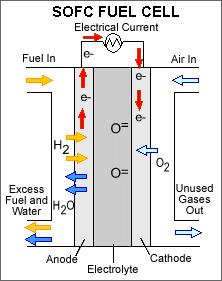
Diagram of solid oxide fuel cell
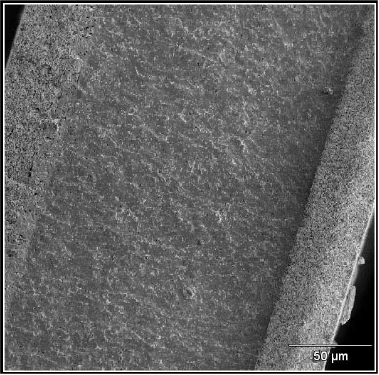
Cross section of solid oxide fuel cell
showing anode, electrolyte and cathode
As the electrolyte is solid, many problems associated with MCFC are eliminated, and the high temperature allows efficiencies up to 60% to be achieved. One example of the method of manufacture is based on a tubular structure and was originally developed by Westinghouse. Here a porous ceramic support tube has various layers deposited on it by vacuum deposition or plasma spraying. The layers are a porous cathode, impermeable electrolyte, porous anode and impermeable interconnector.
Oxygen ions are created at the cathode and migrate through the electrolyte to the anode where they combine with the hydrogen forming water. One ceramic used as the cathode in solid oxide fuel cells is lanthanum strontium manganate, capable of operating as a conductor in a highly oxidising atmosphere at 1000 ºC.
The voltage from the cells is only around 1 volt, so bundles of cells are mounted together to provide high voltage and high power units. Designs such as “monolithic” or “planar” have the advantages of higher power densities and potential mass production by tape casting or screen-printing.
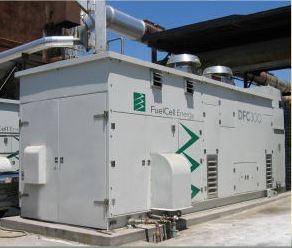
TST 500 kW fuel cell generator
There is also the potential to use fuel cells in stationary power generation at megawatt levels using natural gas, biogas or ethanol as fuel. As examples, a consortium (TST) have built a fuel-cell-based generator of 500 kW using hydrogen from natural gas.
Also a generator designed by Rolls-Royce is based on low-cost ceramic flat tubes with the active cell materials formed by screen-printing. These form individual 30-watt units that can then be stacked into a 15 kW cell. Six of these are then placed in a cooled circular container and stacked in three layers to form a 250 kW module 2.6 m high. Four of these, together with a micro turbine to provide the pressurised environment for operation, and ancillary control equipment, make a self contained 1 MW generator the size of a standard container.
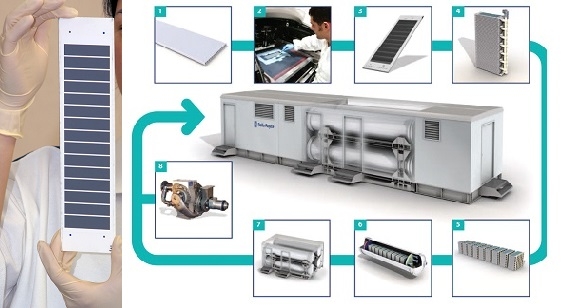
Fuel cell element and 1 MW generation system
1. flat ceramic tube, 2. multiple screen printing,
3. fuel cells both sides of tube, 4. multiple tubes
combined into bundles and then 5. into stacks
within pressure vessels forming a generator
module. Four modules form a skid 7. with
associated turbine 8. and power electronics
to form the 1MW power plant
- courtesy Rolls-Royce
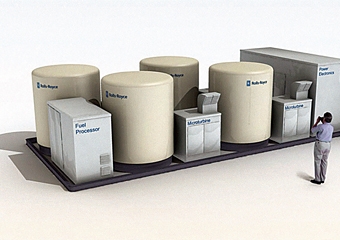
Depiction of final system
- courtesy Rolls-Royce
A smaller example by Wartsila runs on landfill biogas operating at a temperature of 800 ºC using solid yttrium doped zirconia ceramic as the electrolyte, a porous anode of the same material allowing the fuel to flow to the electrolyte, and a cathode of lanthanum strontium manganate. A nickel catalyst converts the landfill gas into methane, hydrogen and carbon monoxide.
| Page: 400 of 418 Go To Page: | |
◁◁ First | ◁ Previous | Next ▷ | Last ▷▷ |
Author: Dr. Stan Jones © Copyright 2010 -