

17. Ceramic Thick and Thin Film Circuits
| 1907 Page: 414 of 418 Go To Page: |  |
◁◁ First | ◁ Previous | Next ▷ | Last ▷▷ |
The ever-increasing density of integrated circuits needs ever-smaller components, hence higher dielectric constants. In memories the initial ceramic was silicon dioxide, then tantalum oxide and alumina but now work is being carried out with BST allowing significant reduction in size. As the processing temperatures are restricted, the use of ceramics with a higher dielectric constant such as BST requires novel firing techniques.
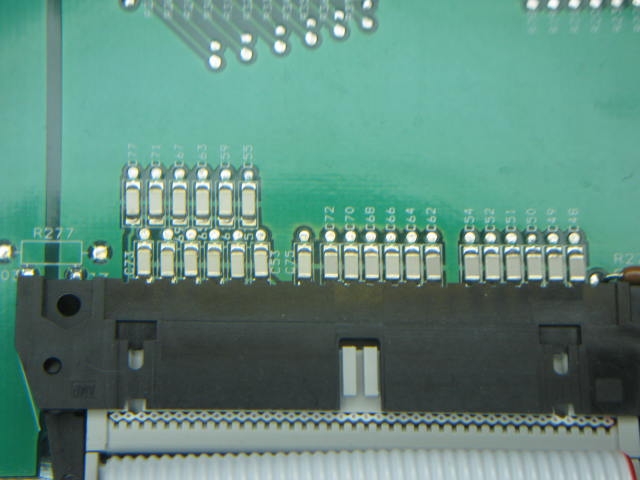
Array of surface mounted decoupling
capacitors - courtesy ERL Phase
Thin film capacitors for decoupling, which are typically less than one micron thick, are made from silicon oxynitride and are integrated onto the surface of analogue and digital circuits, however, they take up much of the chip area.
Thin film capacitors are also used as surface mounted discrete devices along with the silicon active devices in high-density packages. Again to save space and cost, thin film capacitors are being incorporated into the high-density package itself. To facilitate this, thin film high dielectric constant ceramic is deposited onto a copper foil and this is laminated into lower levels of a multi-layer substrate.
Acoustic Wave Applications - Bulk and surface acoustic wave thin films are used for microwave resonators for telecoms applications. The bulk wave ceramic film has to be supported off the substrate so it is free to resonate, and a 1-micron thickness corresponds to 2-4 GHz. Materials used include lithium niobate and lithium tantalate on silicon and gallium arsenide semiconducting substrates. They are also used to measure torque, vibration and pressure, operating at around 400 MHz. Examples are thin film strain sensors using zinc oxide piezoelectric sputtered onto silicon resonators, and a 2GHz filter using a 1 micron PZT thin film on silicon, where the ceramic forms four thin film bulk acoustic wave resonators.
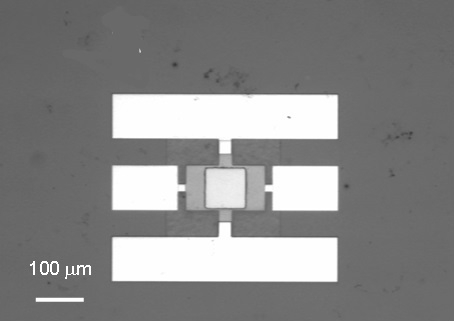
2 GHz acoustic wave filter - courtesy
Roger Whatmore, Cranfield via ESPRC
Ferroelectric Applications - A lot of attention has been paid to thin film ferroelectric ceramics, as the technology can be made compatible with semiconductors. In particular researchers wanted to exploit their polarisation characteristics to make solid-state memories for computers. At first it was thought that as films of ferroelectrics became thinner than 0.1 microns (100 nanometres), the ferroelectric effect would reduce until it became zero. However, effective switchable films of PZT have been made down to 3 to 4 nanometres, making very large non-volatile memories achievable.
One of the first commercial applications of a ferroelectric integrated with a semiconductor used barium strontium titanate on gallium arsenide in 1988. Such devices were used in mobile phone amplifiers covering the frequency range from 800 MHz to 2.3 GHz. They were 50 times smaller than their predecessors and in 2001 some 270 million were produced.
In 1993 ferroelectric films were integrated with silicon technology to produce another early commercial device called FERAM (FerroElectric Random Access Memory), which uses silicon devices to address each memory cell. The materials used are lead zirconate titanate (PZT) and strontium bismuth titanate (SBT). The materials have to be tailored to achieve the required characteristics and PZT is usually doped with calcium, strontium or lanthanum oxides. The devices were larger than alternatives, by a factor of 100, and are therefore used in niche applications, such as with the embedded processor in “smart credit cards” introduced in 1997. In 2001, 2.5 million such smart cards were produced. They were also used for radio frequency identification tags, as they can retain data for 10 years. In 1998 the first 16 kbit FERAMs were used in 8-bit silicon microprocessors, and in 2000, 4Mbit FERAMs were produced using PZT or SBT. Also ferroelectric thin-film memories have been developed for RAMs using potassium niobate, which makes them resistant to radiation.
Another device called the FEFET is a “field effect transistor” where the usual silicon dioxide insulator is replaced by a ferroelectric. Hafnium-based ceramics have been used in this way that reduces the gate leakage by 10 and the size by 2. It is early days for this technology and several obstacles remain.
A further phenomenon exploited in thin film technology is the variation of permittivity with electric field. This can be used for electronically variable capacitors and phase shifters, particularly for very high frequencies, over 10 GHz, when their performance exceeds that of semiconductors. It is used in military radars, telecoms and satellites. Barium strontium titanate is the material currently chosen.
| Page: 414 of 418 Go To Page: | |
◁◁ First | ◁ Previous | Next ▷ | Last ▷▷ |
Author: Dr. Stan Jones © Copyright 2010 -