

6. Spread of Agriculture, Pottery and Civilisations
| 843 Page: 49 of 418 Go To Page: |  |
◁◁ First | ◁ Previous | Next ▷ | Last ▷▷ |
The spread of the Vedic Culture is revealed through its pottery, illustrating how valuable it is in tracing our past. The pottery evidence shows how this Culture spread eastwards to the Ganges Basin over the next few hundred years. Painted grey ware was prevalent between 1,000 and 600 BC in the North Indus Valley and Central North India (centred on Delhi, Mathura and north into Punjab). This was associated with earlier Indo-Aryan settlements in the Upper and Middle Ganges. (Grey ware has been found all over India and appears to have spread from Iran around 6,000 BC via Baluchistan around 4,000 BC).
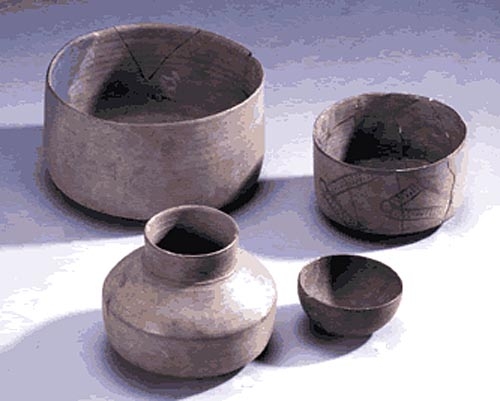
Painted Grey Ware
This was followed by a red and black ware that was also found further East and South, along the banks of the Ganges, Bihar and Uttar Pradesh. The Great Plains in the north were ideal for agriculture, and the wealth created led to cities being built round 800 BC in the Ganges Valley, and various Vedic influenced kingdoms were also set up by 500 BC. The red and black ware was in turn replaced by its direct descendant – northern polished black ware- that dates from these first cities on the Ganges. This ware spread as far south as Nasik in Maharashtra.
There is considerable uncertainty and debate concerning the relationship between the culture in South India and that in the Indus Valley. Some suggest a very early migration from the south, northwards, and others a much later migration from the Indus Valley to the south. There was a Neolithic culture and language (non-Indo-European Dravidian) in South India that could well have developed independently. While there are numerous similarities with the Indus Valley culture in pottery styles and symbols on them, such as leaves and triangles and even bricks having the same overall size ratio, they could have been transferred by trade and the movement of some people over time. Certainly there was considerable maritime trading throughout South Asia from 10,000 BC, with South India playing a major part. It is also thought that gold from Hati, Karnataka was traded widely. This transferred Harappan technology could have persisted in South India after dying out in the Indus Region.
| Page: 49 of 418 Go To Page: | |
◁◁ First | ◁ Previous | Next ▷ | Last ▷▷ |
Author: Dr. Stan Jones © Copyright 2010 -