

7. Pottery Technology 1
| 849 Page: 55 of 418 Go To Page: |  |
◁◁ First | ◁ Previous | Next ▷ | Last ▷▷ |
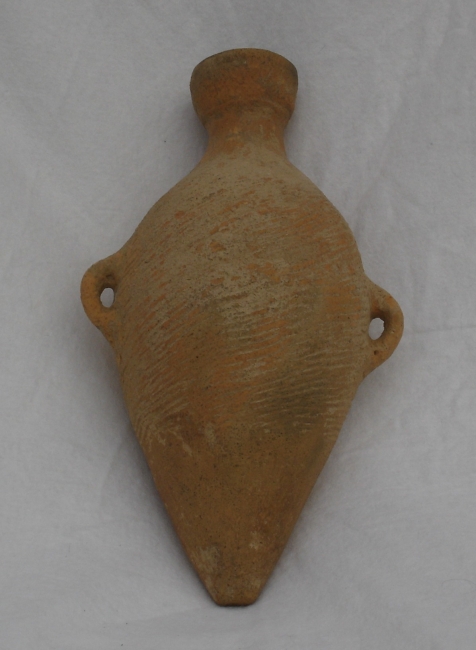
Chinese amphora 3,500 BC - courtesy
Glade Antiques
Historically there were pulses of cultural, artistic and technological development that sometimes waned to the point of being lost and had to be reinvented later. An example is the discovery of tin opacified glaze by the Assyrians in the 8th century BC, which was then lost until rediscovered in Mesopotamia by the Moors 1,500 years later in the 8th century AD.
As a reminder, pottery is basically hard, non-flexible, brittle, not affected by heat or cold, or most chemicals including strong acids. It is virtually indestructible but can be cracked or broken and glaze can be scratched. There are the three broad types of common ceramics. Earthenware is the earliest form of pottery, usually using high-plasticity clays with lots of temper, and requiring the lowest firing temperature – around 750 to 1,100 degrees centigrade (C) for relatively the shortest time. The maximum temperature is about 1150 degrees C; otherwise an earthenware item would slump, collapse and melt in the kiln. It has a wide range of fired textures and colours ranging from black to almost white and red to buff. The coarseness of the fired body depends on the grain size of the clay and temper, and the firing temperature. After firing, it remains porous, which can be useful for keeping liquids cool, but at the cost of them evaporating away. For this reason earthenware is sometimes treated to make it more waterproof.
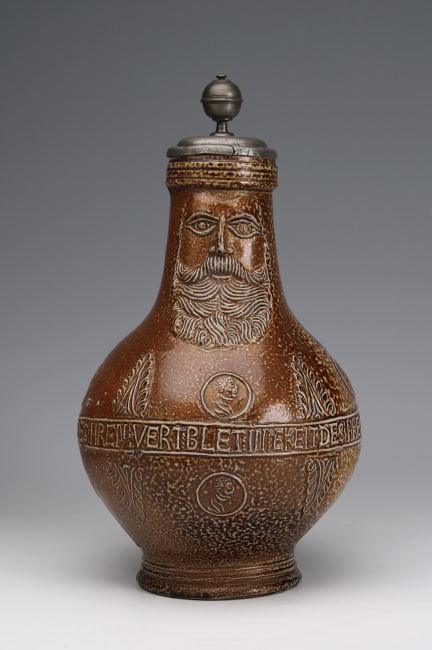
Stoneware Bellarmine 16C AD
- courtesy Louwers Antiques
The Middle East and all countries in the West were unable to take the step to produce stoneware and porcelain that was taken by China in the Shang Dynasty (1766-1046 BC) and Tang Dynasty (618-906 AD) respectively. In the West they had to persist with the more easily damaged earthenware, or imported wares from China, until, in the case of stoneware the 12th century AD, or hard-paste porcelain the 18th century AD, when they started to be made locally. Prior to that Western potters had not recognised the importance of a heat resistant (refractory) clay such as kaolin as an ingredient, so their clay mixtures would not withstand the necessary temperature without melting.
The second type, stoneware, is fired at a sufficiently high temperature to cause it partly to vitrify, meaning some lower temperature constituents such as feldspars melt, but the shape or form is retained. This is typically 1,200 to 1,300 degrees C that has to be maintained for several days. The product becomes extremely hard and strong. Stoneware has a similar variety of natural colours and textures as earthenware. Glaze may or may not be used on stoneware for decoration.
| Page: 55 of 418 Go To Page: | |
◁◁ First | ◁ Previous | Next ▷ | Last ▷▷ |
Author: Dr. Stan Jones © Copyright 2010 -