

7. Pottery Technology 1
| 851 Page: 57 of 418 Go To Page: |  |
◁◁ First | ◁ Previous | Next ▷ | Last ▷▷ |
The plasticity of the clay depends on the size of the clay particles, the finest (smallest particle) clays being the most plastic. These are typically secondary clays, where the clay particles have been reduced in size by the natural sifting and weathering processes. Plastic clays are also known as “fat” clays and less plastic as “short” clays (compare pastry). Adding water to the dry clay produces a sticky mass, but the water layer on the surface lubricates the potter’s hands and tools so that it can be shaped and the clay will hold its shape. However, very fine clay on its own holds too much water and is too “sticky”. Primary clays, found in their places of origin, are usually of lower plasticity, more refractory, and white to buff in colour. Early on, potters tended to select clay by colour, so it neither collapsed when being worked nor dried too quickly – greenish/blue clay was a favourite. In early times consistency of the clay constituents was a major problem, but as time went on the quality of materials improved.
It is common to improve the suitability of clay as dug by treating it in various ways. Clay often contains non-plastic inclusions such as sand, shale and rock fragments, which detract from its plasticity. While a certain controlled proportion of non-plastic material adds strength to a clay by providing friction between the particles and aids the drying process, an excess of such inclusions, especially large ones, will make the clay hard to work as well as causing other problems. To improve the clay it was often dried, crushed and ground, so that unwanted inclusions could be removed by sieving when the clay is in a dry and powdered state, by picking out by hand, or by mixing the clay with water and allowing it to settle out, with the heavier particles falling to the bottom first. A somewhat more sophisticated method was to use “levigation”, which relies on water to carry particles along inclined slopes, where the larger particles (e.g. sand) drop out first and the fine clay last. Different grades could then be mixed to obtain the clay mixture the potter wanted for his particular product. As an example of an early preparation process, in Egypt dry clay was placed into 6 to 10 ft diameter soaking pits a few inches deep, wetted and then trampled to break up and homogenise the clay.
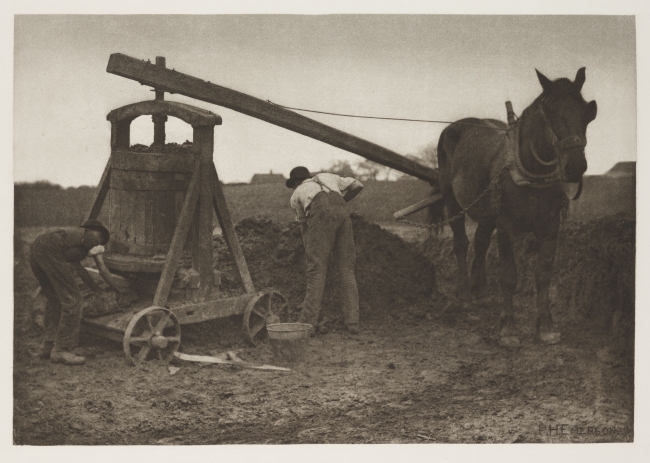
Horse powered clay mill, 1888 - courtesy
Royal Photographic Society/NMeM/SSPL
The strength of the clay is improved by bringing the clay particles closer together, which involves compression and removal of any air. This was achieved by “wedging” (vigorous kneading) or trampling. Ageing, by storing the clay in a damp state, has the same effect – water slowly penetrates between the clay particles and breaks them down into smaller sizes, which become compressed under the weight of the stack of clay. Ageing is often combined with souring, which involves the breakdown of organic matter in the clay by bacterial action. The decomposition releases amino acids that surround and coat the fine particles and create a gel that improves the plasticity of the clay. It also causes various unpleasant gases to be given off, making pottery manufacture a rather unpopular activity for its neighbours. Often potteries are grouped together in specified areas in a city, or just outside the city walls, to minimize this problem.
| Page: 57 of 418 Go To Page: | |
◁◁ First | ◁ Previous | Next ▷ | Last ▷▷ |
Author: Dr. Stan Jones © Copyright 2010 -