

7. Pottery Technology 1
| 858 Page: 64 of 418 Go To Page: |  |
◁◁ First | ◁ Previous | Next ▷ | Last ▷▷ |
Another method of achieving a relief pattern was called Barbotine and was popular during the Roman era. Viscous clay is “iced” on to the vessel surface as in cake decoration to achieve a relief decoration.
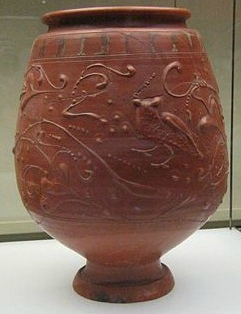
Roman Barbotine decorated Terra Sigillata
- source Koln Museum via Wikipedia
Other forms of decoration involve the elaboration of techniques for finishing the surface of a vessel, such as polishing, burnishing and slipping. Polishing is carried out on the wet clay with a damp soft cloth or similar, which removes some of the surface roughness, bringing smaller clay particles to the surface and aligning them. Polishing can also be performed after firing to improve the surface appearance. Burnishing was used from the earliest times and is carried out by rubbing the partially dry but unfired surface of a pot with a tool such as a smooth pebble, bone or cloth to produce an attractive shiny surface by compression and alignment of the clay particles also producing a denser, much less porous surface. The entire pot did not have to be burnished as the technique was sometimes used to form patterns. Slip may be applied by dipping, painting or wiping over the surface of a pot to give a better-looking smooth finish that is easier to decorate. Because slip is viscous it helps to conceal any imperfections in the surface such as protruding inclusions in the clay. It can also reduce the porosity of the pot by sealing surface pores. It was also used to change the background colour. It was difficult for ancient potters to make pottery bodies using white clay, so darker bodies were covered in white slip so they looked white, and when this slip was dry they might apply another contrasting slip for decoration, possibly while rotating on a wheel. Patterns scratched or incised through a contrasting slip are known as sgraffito decoration. Here the slip is incised to reveal the underlying body so that after firing the pattern is revealed as body colour lines against the surface slip colour background.
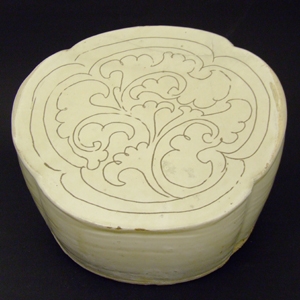
Chinese Sung Pillow with Sgraffito
Decoration - courtesy R&G McPherson
Antiques
“Slip-trailing” is where the slip is dribbled, poured or squeezed onto the pot to create a decorative effect. The slip often melts becoming glassy while the ceramic body fires conventionally.
Piercing, also known as reticulation, is used for decoration, and is usually carried out when the pot has dried. It was quite rare, but was practiced in China during the Ming period when it was known as “demon’s work” as it seemed to take magic to produce.
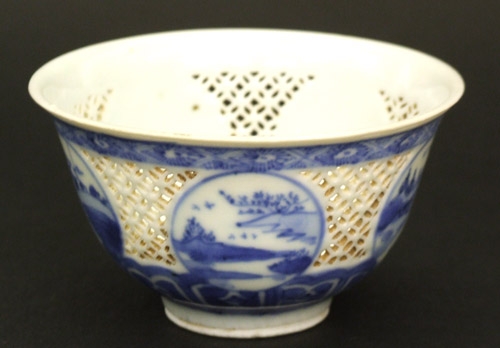
Chinese Ming Reticulated Porcelain bowl
- courtesy R&G McPherson Antiques
Elaborate piercing was also practiced in Britain on stoneware in the 18th century and on porcelain in the 19th and 20th centuries. Cut-outs were sometimes triangular to give the appearance of a lattice.
| Page: 64 of 418 Go To Page: | |
◁◁ First | ◁ Previous | Next ▷ | Last ▷▷ |
Author: Dr. Stan Jones © Copyright 2010 -