

7. Pottery Technology 1
| 870 Page: 76 of 418 Go To Page: |  |
◁◁ First | ◁ Previous | Next ▷ | Last ▷▷ |
Another phase of Greek settlements and colonies occurred around the 8th century BC, initially including itinerant potters from Euboea, settling in Sardinia; Italy (Etruria, Veii, Campania and Calabria) and Al Mina (Syrian Coast). Again imports, copies and local adaptions were available. Etruscan nobles were very keen to use original imports for funerary use, but poorer people would want to “keep up” using cheaper copied versions. Decoration would progressively be modified to better suit the local Culture. Pottery was a commercial business and producers would have been sensitive to the wishes of their customers, for shapes, style of decoration and price. Local production would be exported to third parties, undercutting the original source. Some later regional potters actually made replicas of older style vessels as fakes! Large quantities of fine ware reached Italy in about 550 BC from Corinth, including not only typical Corinth vessels but also some tailored particularly to the Etruscan taste. The Etruscans traded it throughout Italy, as they did with Athenian Attic ware around 525 BC. Potteries were set up to manufacture these locally, so reducing the volume and cost of imports. When styles changed in the originating country, production of existing designs might continue elsewhere if consumers dictate, so the “red figure” style of Greek mainland Classic decoration continued and developed in Italy long after it was superseded at home in Greece and died out there.
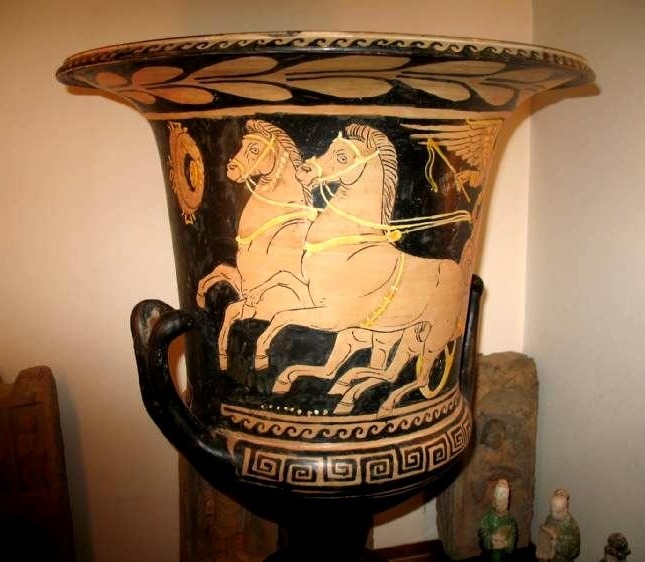
Late Italian Red Figure Decoration
- courtesy Collectors Antiquities
It is a fact though that on many occasions pottery ascribed to one region is later found to have been produced elsewhere and transported. As examples, Helladic style ware found in the Levant that was thought to originate in Cyprus was later proved to be from mainland Greece, and although there were kilns in Western Anatolia producing Mycenaean style pots in the 18th century BC, such pots found in Troy were not local but originated in Mycenae. Analysing pottery associated with Cyprus is particularly complex as it not only made its own style of pottery and copied others, but it also had a major role in the transport of pottery around the Mediterranean.
A similar problem exists with Roman style amphorae that were used very extensively for trade throughout their Empire.
They were made in potteries from Britain to North Africa and Spain to the Middle East. Their forms were standard depending on the content – most often for wine, olive oil and fish paste. If unbroken they would undoubtedly be reused. Accordingly, identifying the manufacturer by body composition is difficult enough, but determining its travels even worse.
Various theories are put forward to explain the available data, but experts often disagree with each other, and new evidence will continually change our understanding of our ceramic heritage.
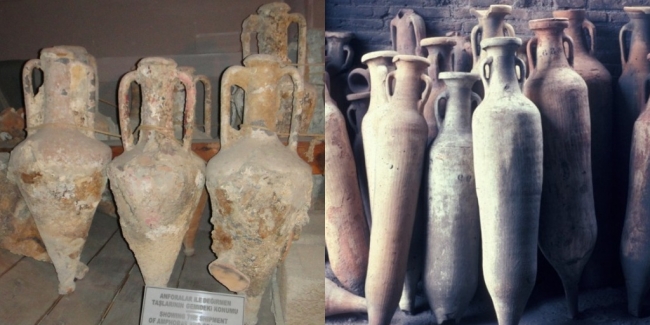
Roman Amphorae a) First Century AD for
Fish Sauce b) 290 BC from a Shipwreck -
sources Associated Press and Kyrenia
Castle Museum
| Page: 76 of 418 Go To Page: | |
◁◁ First | ◁ Previous | Next ▷ | Last ▷▷ |
Author: Dr. Stan Jones © Copyright 2010 -