

8. Ceramic Development in China
| 884 Page: 82 of 418 Go To Page: |  |
◁◁ First | ◁ Previous | Next ▷ | Last ▷▷ |
The meaning behind the decoration on early pots is not always clear, but in some cases it may be reasonably deduced, for example from 5,000 BC, Chinese pots were decorated with stylised fish indicating their importance as a staple food from the rivers. Most vessel types at Banpo were limited to the bulbous pot or Guan, the bowl or Pen and the amphora-like bottle or Ping.
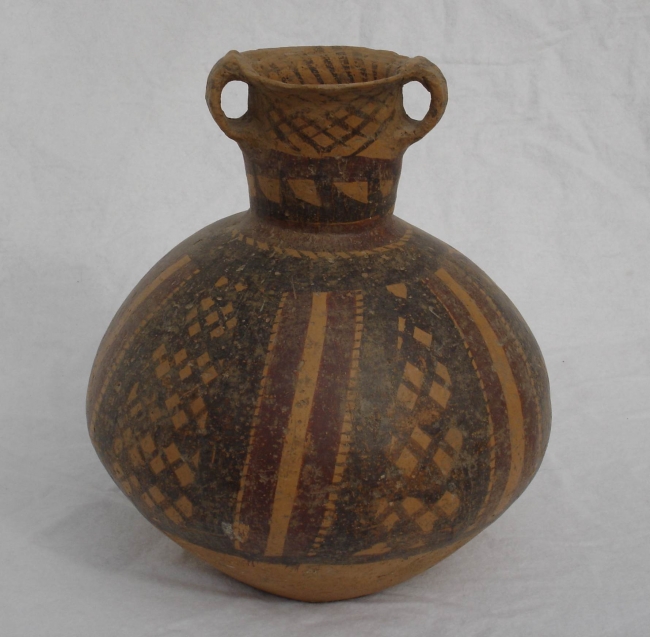
Yangshao Painted Pot 2,500 BC
- courtesy Glade Antiques
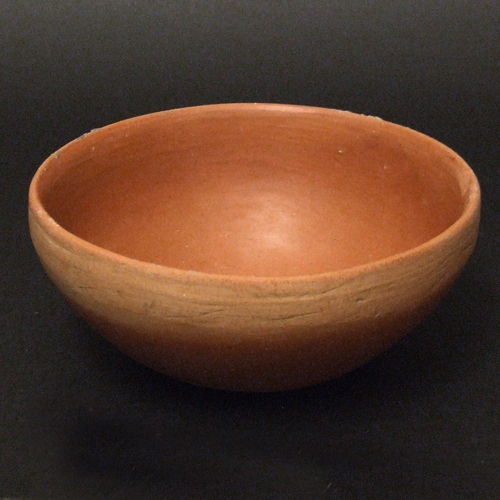
Early Yangshao Burnished Bowl 4,800-3,300 BC
- courtesy R&G McPherson Antiques
This may have been due to the method of manufacture as this type of Yangshao pottery was manufactured using the coiled clay method. There is evidence of some vessels at Banpo having been worked on mats, but, unlike Longshan, there was no potter’s wheel. The Yangshao culture also seems to be the original source of the Chinese Dragon, as its first known depiction was found as a mosaic of mussel shells set into the floor of a tomb.
The Yangshao culture, illustrated by the Banpo, caught on and between 4,500 and 2,500 BC it spread along and between the Yellow and Yangtze Rivers. This “painted pottery” with mainly black paint on fine red terracotta was at its height at this time. Large storage vessels (guan) are particularly notable, decorated with dots, spirals and lines. By 2,500 BC stick-like figures appeared as decoration. Although perhaps only 2-3% of pots were painted around 4,000-5,000 BC, by 2,000-3,000 BC it was nearer 50%.
Local technology developed and from around 4,200 BC mainly red-bodied vessels were to be found in Hebei and Henan Provinces, some of which were now finished on a slow wheel and fired at a high heat. They include jars and tripods, round and flat-bottomed and ring-footed bowls, however, there were few painted designs in these particular examples.
Unpainted pottery continued to be produced for two thousand years. However, between 3,800 and 2,000 BC richly painted and semi-sculpted brown/red bodied pottery has been found further west in the Upper Yellow River Region of Kansu (present Gansu), Qinghai and Ningxia Provinces, attributed to the Majiayao culture. Parts or the whole human form appears on some of the pottery, occasionally as a mask in relief with dark painted skeleton beneath. The decoration could be extremely complex, including spirals, sawtooths, zoomorphic stick figures (particularly arms and hands) and cowrie shells that were used for money. Often the decoration only extended to those parts of the vessel that would be visible to the Neolithic user, predominantly the vessel shoulders, neck and the inside surface of bowls.
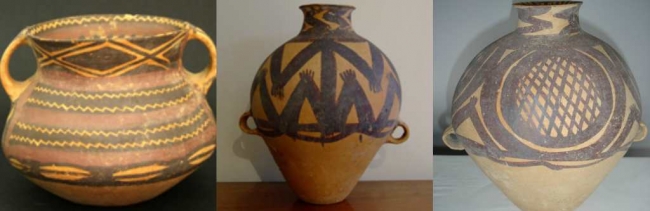
Majiayao bulbous pots 2,300-2,000 BC
- courtesy R&G McPherson Antiques
The types of vessels were relatively unchanged from earlier Yangshao. Pottery represented the highest artistic form in Neolithic times, and although large quantities of everyday pottery were made throughout China, the great artistic expression of potters was reserved for ritual and grave pottery.
| Page: 82 of 418 Go To Page: | |
◁◁ First | ◁ Previous | Next ▷ | Last ▷▷ |
Author: Dr. Stan Jones © Copyright 2010 -