

8. Ceramic Development in China
| 761 Page: 98 of 418 Go To Page: |  |
◁◁ First | ◁ Previous | Next ▷ | Last ▷▷ |
The Northern Wei were succeeded in 534 AD by a number of petty, but some ceramically important, dynasties (E. Wei, W Wei, N. Qi and N. Zhou) until reunification came about in 581 AD under the Sui Dynasty, which was set up by a partly-Chinese General, Yang Chien.
In the North, the impact on ceramics from the fall of the Western Jin in 316 AD until the middle of the 6th century AD was severe. The production of ceramics would have continued, but little is known of its detail, apart from tomb furniture. Much of this was no longer glazed, but was heavy low-fired earthenware, often with white slip and with unfired painting in fairly bright colours (red, blue and green).
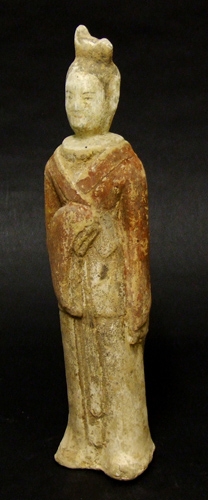
Northern Wei cold painted figure -
courtesy R&G McPherson Antiques
They moved away from copying bronzes, shapes became simpler and decoration more fluent. Trade flourished despite the disturbances and models of heavily laden camels were a feature of the Northern Wei period. Figures now portrayed Western Asians with beards, together with caparisoned horses of warring Princes with Sassanian Persian decoration on their bridles. These were made in two halves in moulds then detailed by the potters.
Many very elegant funerary figures from all walks of life have been found in Northern tombs. In the late 5th century there were changes in their style, being elongated rather than stout, and having smiling faces. Previously, stamped grey earthenware bricks and tiles in tombs were flatter with low relief, but Buddhism influenced the designs so the relief was much deeper and more rugged. The impressed and moulded decoration was pictorial (now with a more obvious relationship between pictorial elements) and geometric (some based on textile designs). In a tomb in Teng-hsien, each brick was decorated with a complete scene, similar to the rich carving and paintings in 5th century shrines and temples. Ostentation in death was expected – every brick was different, using a separate mould.
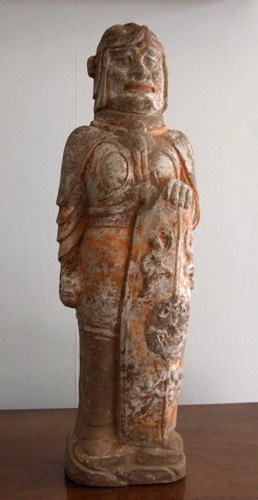
Northern Qi large tomb guardian, soldier
in full armour - courtesy R&G
McPherson Antiques
Up to this time it was likely that there were relatively few potteries operating, however, from the time the Northern Qi took over in the West in 550 AD and the Northern Zhou the East in 557 AD changes become evident and Northern kilns began significant activity again.
As mentioned earlier, in the North during the Period of Disunity, for reasons that are not clear, lead glazing was discontinued for over 300 years until reintroduced in the 6th century. Both high-fired stoneware and lead-glazed earthenware were then produced, typically as fairly large, well-constructed, stout jars. However, now the earthenware body was almost white rather than reddish-brown. Some decoration was elaborate and reflected the tastes of the previous Turkish Rulers, together with other Central Asian and Persian influences, as there was lively trade with the West and foreign settlers in the cities. Shapes changed to suit the latest tastes such as earthenware flasks imitating leather bottles. Some had moulded reliefs of Persians playing musical instruments or dancing, in their native costumes, covered in a green or amber brown glaze. Some had colourless glaze with streaks of green, foreshadowing the Tang “splashed polychrome” effect. Large, dramatic, stoneware vases were made from several wheel thrown parts with relief banded decoration. Their bodies were hard, light grey stoneware with a green, brown or yellowish glaze called “Northern Celadon”.
| Page: 98 of 418 Go To Page: | |
◁◁ First | ◁ Previous | Next ▷ | Last ▷▷ |
Author: Dr. Stan Jones © Copyright 2010 -