

8. Ceramic Development in China
| 753 Page: 104 of 418 Go To Page: |  |
◁◁ First | ◁ Previous | Next ▷ | Last ▷▷ |
The pigments used were copper, iron and later cobalt for blue, imported from the West, usually by camel. In the early 8th century lead polychrome glazes switched from being applied raw to being fritted. This coincides with the introduction of the blue cobalt, which was transported as glass cabochons (crudely “blobs”) from the Near East, ready for use after grinding and fritting with lead glazing material. The use of cobalt as a blue colourant was to have significant future impact on Chinese ceramics.
Small hand-made wares were also produced with a marbled effect by using two types of clay of different colours. They were lead-glazed amber or green. Clearly potters were allowed to experiment again under the Tang and try out new ideas, and there was a ready market for such novelties.
Dating Chinese stoneware is quite difficult and it is thought that much presently attributed to the 10th century and later may be 8th or 9th century. From the middle of the Tang period onwards there was a general move to an improved stoneware using finer material, fired at temperatures of about 1300 degrees C. This provided a denser less-porous product.
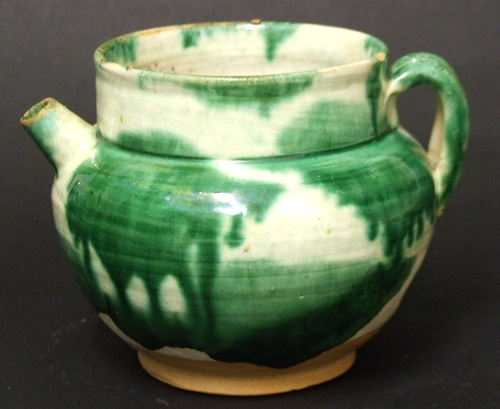
Tang ewer, red body cream slip splashed
green with transparent glaze - courtesy
R&G McPherson Antiques
Stoneware was usually covered in white slip and rouletted with dots or chevrons and had a thin soft-toned brown or pale yellow glaze.
Chemical quality became a priority. At the same time “Muffles” came into use. These were capsules of fireproof clay to hold items to be fired and protect them from the direct heat of the kiln. This reduced the number of accidents to pots during firing and led to better quality glazes. Decoration of stoneware in the Tang period was more sombre, with subdued colours as high-fired glazes in China were dependant on iron oxide. Early pottery and stoneware forms from Henan were small, stout ewers with straight spouts and small handles.
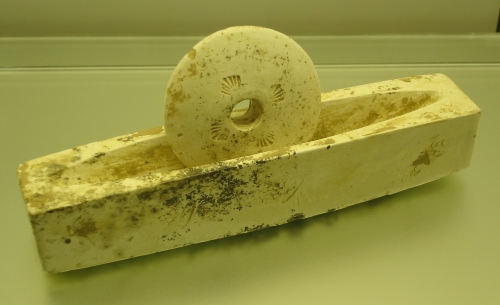
Tang stoneware grinder - source Hong Kong
Museum
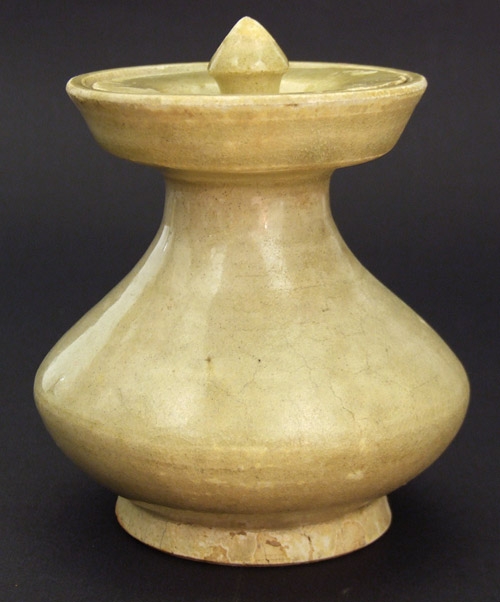
Tang early white stoneware jar - courtesy
R&G McPherson Antiques
In Zhejiang many hundreds of kilns produced celadon stoneware, which the Chinese now called Yueh wares. The most important were around Shang-lin Hu and, further east, Hsin-hsien near the port of Ning-po. Both produced refined wares of great elegance. The very finely grained, pale grey body was hard and extremely compact (dense). The glaze was thin and pale, almost silvery olive green over plain, undecorated or incised decoration, on a very diverse range of shapes including mimics of chased metalwork. Imitations of this ware were made further south around Wen-Chou, which included large vases with false spouts for tombs. Kiln control permitted large-scale pieces to have consistent pale green glaze. Yueh celadon was distributed widely to local markets but was also exported from the mid Tang period to the Philippines, Indonesia, India, the Persian Gulf and Egypt. They were very popular because their hardness had no parallel outside China at the time.
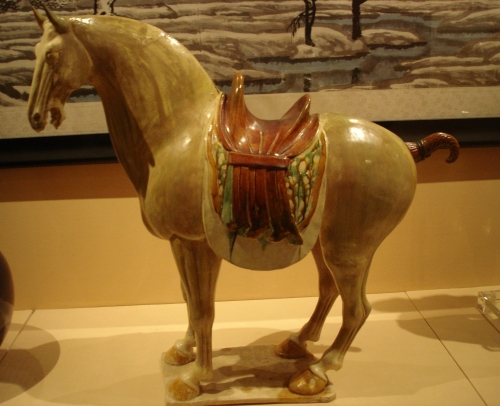
Tang sancai glazed horse - source Hong
Kong University Art Centre
The Tang period was the second high point in funerary ceramics after the Han. Burials would include realistic funerary figures of humans and animals, often having sancai coloured decoration, including, of course, the famous Tang models of the Ferghana horses.
These models of horses are among the most celebrated examples of ancient Chinese art. In the Tang Dynasty the horse was seen as very important for security reasons, as the northern barbarians were very adept at horse riding warfare.
| Page: 104 of 418 Go To Page: | |
◁◁ First | ◁ Previous | Next ▷ | Last ▷▷ |
Author: Dr. Stan Jones © Copyright 2010 -