

8. Ceramic Development in China
| 754 Page: 105 of 418 Go To Page: |  |
◁◁ First | ◁ Previous | Next ▷ | Last ▷▷ |
The Chinese set about building up a large pool of horses that by the mid - 7th century reached 700,000. Horses were often given as gifts and tribute, and models of horses were regarded as status symbols. Other figure groups show people following normal domestic occupations. Colour schemes were often appropriate, but occasionally not – for example blue horses. As well as glazed, there were also a large number of unglazed earthenware grave goods, often cold painted, presumably to reduce the cost. Modelling became more sophisticated and new shapes of vessel were introduced. Northern Chinese potters borrowed shapes from West Asia more freely, for example, amphorae (originally a Greek design but now with dragon handles) and bud-headed ewers. They also included pieces derived from Central and West Asian metalwork (including Persian).
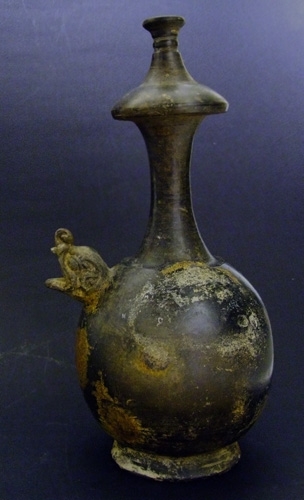
Tang Buddhist water sprinkler, original
Indian metalwork - courtesy R&G
McPherson Antiques
Now, the modelling included a greater level of detail, with very realistic clothing and headgear. Some details though, such as faces, were often left to be cold painted, since to glaze this level of detail was beyond their technology. Han figures had been somewhat abstract, but Tang figures were very realistic, which is not a common feature in any Chinese art form, so figures could be readily differentiated.
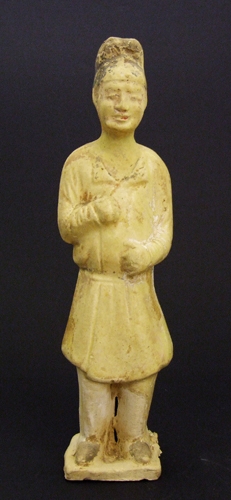
Tang male figure - courtesy R&G
McPherson Antiques
For example, an official with a swooping falcon on his headgear is a military rather than a civil administrator. In the 7th Century figures of women were modelled with slender long bodies and rectangular faces.
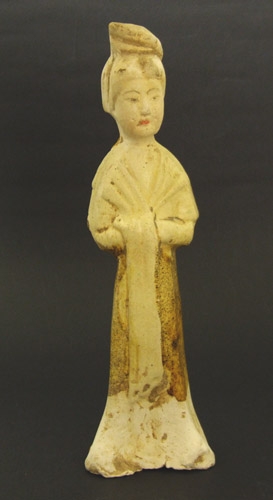
Tang female figure - courtesy R&G
McPherson Antiques
In the 8th Century, there was a change in perceived beauty to fuller bodies and round faces. This is thought to reflect a particular Imperial concubine Yang Guifei, who apparently had these characteristics.
Now the guardians of tombs “Fang Hsiang” became more important than ever. They were usually grouped in pairs of savage warriors with alarming faces (to frighten evil spirits away) and fabulous creatures with horns (to keep evil spirits penned down). They protected the tombs from disturbance by demons and also to prevented the souls from leaving.
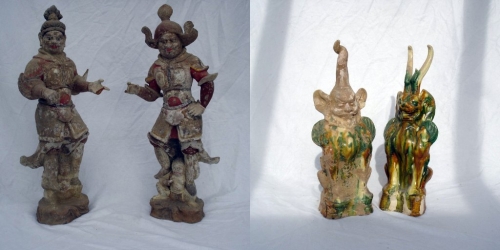
Tang tomb guardians, angry appearance to
frighten evil spirits - courtesy Glade
Antiques
Grave goods increased in number as well as quality and size. In excavated tombs many ceramic figures were found in especially built niches in corridors. Upper class people would have models of Western subjects such as Central Asian and Semitic merchants with deep-set eyes and jutty noses (anything foreign was popular). These figures were produced in the metropolitan areas of Chang-an and Lo-yang, indicating how cosmopolitan the cities were at this time. Foreign motifs included hunting, boys with garlands, swags and vines, as well as Buddhist symbols. There were also Chinese figures of servants, actors, female dancers and musicians, all exhibiting exquisite grace, together with camels and horses carrying figures of musicians and singers on their backs. The size of figures also increased with the richest people having vessels 1m high. Because so many resources were being buried with the dead, Tang rulers tried to legislate to limit the number of funerary figures allowed. In the middle of the 9th Century a minimum of 20 and a maximum of 100 was permitted, depending on status, although the adherence to the regulation was limited.
Tombs provide a valuable insight into everyday life in the Tang period as it did in the Han and other Dynasties. Small replicas of objects used in ordinary life were given as grave goods including, now, the ox cart. Also rich people had wall paintings in their tombs that are often well preserved and indicate the way of life of the time.
| Page: 105 of 418 Go To Page: | |
◁◁ First | ◁ Previous | Next ▷ | Last ▷▷ |
Author: Dr. Stan Jones © Copyright 2010 -