

8. Ceramic Development in China
| 765 Page: 106 of 418 Go To Page: |  |
◁◁ First | ◁ Previous | Next ▷ | Last ▷▷ |
Horses, that were thought to be related to dragons, had been trained to dance since the Han Dynasty, and became very popular during the Tang Dynasty. One hundred horses were trained to dance to amuse the last Tang emperor Hsuan-Tsung (712-756 AD) with specially composed music and lyrics called “the song of the upturned cup”. Pottery models of these dancing horses became very popular.
Before the end of Hsuan-Tsung’s reign, the army suffered disastrous defeats in Central Asia, particularly the battle of Talas River in 751 AD, losing much of the region to the advancing Arabs. A rebellion in 755/6 AD by a frontier general, An Lushan, who captured Chang-an almost brought the Dynasty down, and in 763 there was an invasion by Tibetans who also reached Chang-an. The Tang continued for a further 150 years, but their greatest years in terms of geographic expansion were over.
After the middle of the 8th Century AD there was a decline in the quality and quantity of Northern Chinese tomb wares. For example, just before the An Lushan rebellion polychrome figures came to an abrupt end. As the Empire shrank and economic crises worsened, the government and people turned against foreigners and foreign religions. (The State religion at this time was Confucianism). In 845 AD all foreign-based religions were proscribed, and temples and monasteries destroyed or used for non-religious purposes. While the ancient heartland of Chinese Civilisation in Henan and Shaanxi reduced in political and economic importance, the Southeast became more populous and prosperous. In the last 100 years of the Tang Dynasty the Southeast became again the cultural centre of China.
Meanwhile in the North – Henan and Shaanxi – the stoneware had a very fine-grained grey body, sometimes speckled brown from particles with higher iron content. Most date from the late 8th to the 9th century. Kilns in Chia-hsein near Yu-hsein started in the late 8th century and became a major centre during the Sung and Yuan periods. The wares were covered with a viscous high-fired glaze that did not run. They were coloured yellow, black, white and some mottled. These are regarded as the precursors to the later famous Chun ware. Vessels were characteristically stout, strong and mainly well finished and black was a very commonly used glaze.
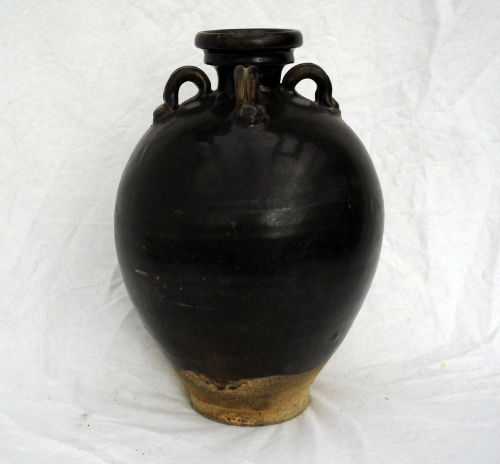
Tang black high fired stoneware - courtesy
Glade Antiques
From Yao-Chou in Shaanxi Province a grey-bodied stoneware was produced from about 800 AD with grey-green glaze that was the forerunner of the Yao-Chou Northern Celadon of the Sung period. Some wares were white slipped then painted black and covered with a transparent glaze.
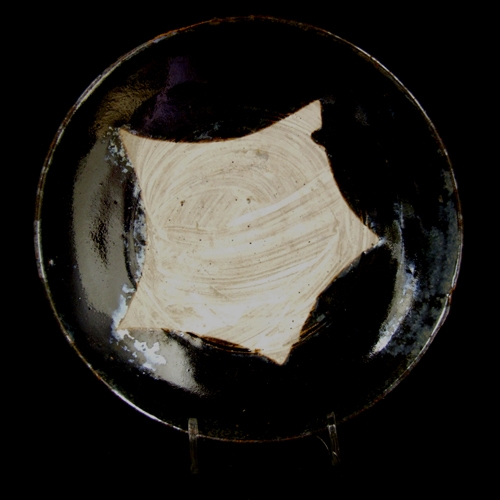
Tang stoneware dish dipped in black glaze
to leave unglazed centre - courtesy
R&G McPherson Antiques
Some small boxes with black painted decoration were precursors to the later Tzu-chou (Cizhou) wares. The brilliant black and white contrast was extremely attractive compared with the sombre tones of most contemporary stoneware. Almost all the stoneware in the North used oxidising kilns giving yellow glaze colours if the iron content was ½ to 1% and brown-black when 5%. However the grey-green glazed pieces from Yao-Chou were the exception, being fired in a reducing atmosphere in kilns probably influenced by the “Yueh” tradition in Zhejiang.
| Page: 106 of 418 Go To Page: | |
◁◁ First | ◁ Previous | Next ▷ | Last ▷▷ |
Author: Dr. Stan Jones © Copyright 2010 -