

8. Ceramic Development in China
| 770 Page: 111 of 418 Go To Page: |  |
◁◁ First | ◁ Previous | Next ▷ | Last ▷▷ |
Now the “horseshoe” kiln had been developed, which was simple and efficient and permitted close control of the required reduction process. The firebox (coal-fired) was on the perimeter of a semicircular kiln chamber, having a domed roof and a straight back wall. A series of vents from ground level through the back wall led to two chimneys. After the kiln had been stacked with pots, a light “bag wall” was built to separate the fire from the wares. The heat and flames went over the bag wall and were deflected by the domed roof down through the wares and out through the vents. When reduction firing was needed, stone doors were closed outside the stoking area, cutting off the air (and oxygen). This kiln was found in many Northern Sung sites. Northern potters had also become more imaginative in the use of material and decorative techniques. For over 300 years the ceramics from Northern kilns were of very high quality, regarded as “classic” and esteemed highly by the Chinese.
There were kilns manufacturing ceramics all over the country at this time, and some individual kilns would produce various products. However, the body of the pots and the colour of the glazes can differentiate those ceramics surviving today. These include, in the North, Ding (that by this period had taken over from Hsing as major producer of Northern whitewares), Ju, Chun, Northern Celadon, Tz’u-chou (Cizhou) and brown and black glazed wares.
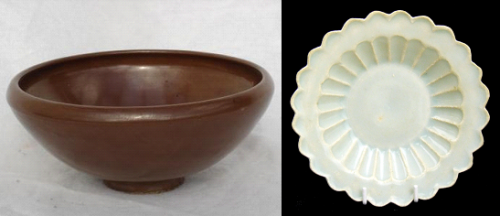
Sung bowl and qingbai (Jingdezhen) flower
shaped porcelain dish - courtesy Glade
Antiques and R&G McPherson Antiques
In the South there were Jingdezhen white wares, Longquan and Guan celadons and black Fujian ware. These Sung pieces, often undecorated, rely for effect solely on the timeless elegance and beauty of their shape and the quality of the tone and colour of their glaze. Sung stoneware elicited a delight in the form of a piece and the tactile pleasure it gave. Decoration was subordinated to shape that became part of the visual poetry of the age.
Ding ware was made at Chien-tzu-tsun, 35 miles north of modern Tsung Hsien, in the Northern Province of Hebei, from the end of the Tang Dynasty to at least the end of the 13th century. Ding ware was supplied to the Imperial Court in the Five Dynasties, Northern Sung and Chin Dynasties. The predominant output was hard and very white-bodied translucent porcelain with a white or warm ivory glaze that made the Ding kilns famous. Specialisation meant more consistent quality and greater economy. The range of shapes was more varied in the late 10th and early 11th centuries, including vases and jars with heavily carved decoration of lotus petals. By the second half of the 11th century, production concentrated on open and flatware with carved and incised decoration of floral scrolls and sprays, ducks and geese in reeds, dragons and fish.
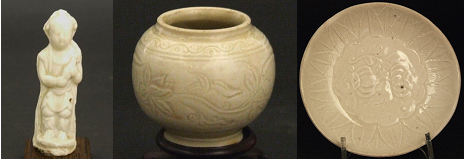
Northern Sung figure of boy holding
flowers, Ding carved water pot and moulded
dish with melons - courtesy R&G
McPherson Antiques
The decorative techniques used required specially trained craftsmen with highly developed skills. One process involved throwing a bowl in the normal way, carving and incising the decoration, then placing it on a mould to change the shape of the top half of the bowl without spoiling the decoration – a very skilled operation. When dry, the glazed wares were stacked in saggers and fired at about 1260 degrees C. Standardisation of sizes meant they could be stacked very efficiently on special stepped saggers. They were fired rim-down, as this distributed the weight better, reducing warping. As the rim was unglazed and rough, it was covered with an attractive thin copper, silver or gold band. Some of these thin-walled ceramics were left entirely undecorated, but when the body was incised under the glaze it was clearly visible only under the right light conditions.
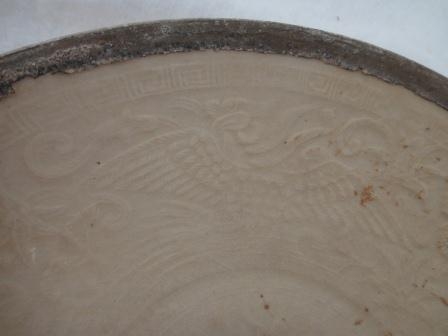
Sung whiteware dish with traces of silver
on rim - courtesy Glade Antiques
At the start of the 12th century a new decorative technique arose using richly carved (in reverse) domed-shaped stoneware moulds. The decoration was usually organised as designs rotating round a central point. The mould was placed on the turntable, the clay laid on it and beaten with a wooden paddle as it rotated. More time could be spent decorating the mould, so it became richly decorated with a much greater range of designs. Use of these moulds permitted less-skilled workers to produce identical wares, so the spontaneity of the decoration in the earlier years could not be replicated.
| Page: 111 of 418 Go To Page: | |
◁◁ First | ◁ Previous | Next ▷ | Last ▷▷ |
Author: Dr. Stan Jones © Copyright 2010 -