

8. Ceramic Development in China
| 771 Page: 112 of 418 Go To Page: |  |
◁◁ First | ◁ Previous | Next ▷ | Last ▷▷ |
For plates a fast wheel was used with a patterned mould. A profile was brought down on the clay with sufficient pressure to obtain the shape and decoration as well as shearing off excess clay. This process, used today, is called “jollying”. These potentially “mass production” techniques had a major impact later. Hand-carved porcelain continued to be made in parallel as it had a good market.
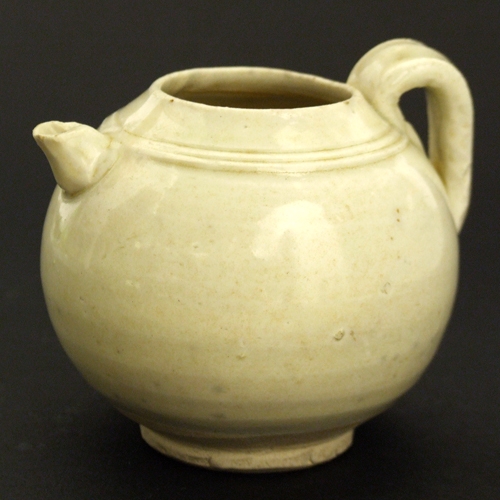
Northern Sung stoneware ewer - courtesy
R&G McPherson Antiques
The best wares were taken by the Sung Court and later the Chin patronised the kilns for its high quality, but when the Mongols took over the quality deteriorated and the kilns closed around 1300 AD. Much white stoneware was also produced in the Sung period.
Sung Northern Celadon was a stoneware having a grey body and olive green/brown transparent glaze. Manufacturing methods were similar to the Ding Wares, but using very different styles. The most important kilns were at Yao-chou in Shaanxi Province 70 miles Northeast of Chang-an, and at Lin-ju Hsein in the mountains south of Lo-yang. These wares also used technology developed from the 9th century Tang reduction-fired Northern Celadon. The glaze had a small amount of iron and in good pieces it is bright, glassy and very transparent. Early output had a wide range of forms, but reduced later to bowls and dishes. Moulding was introduced in the early 12th century, but much more delicate and smaller scale designs than in Ding Wares. In Yao-chou, the carving of the moulds was exceptional, making it much more difficult to tell the difference between moulded and hand-carved pieces. Firing was carried out in saggers with items on their bases rather than their rims.
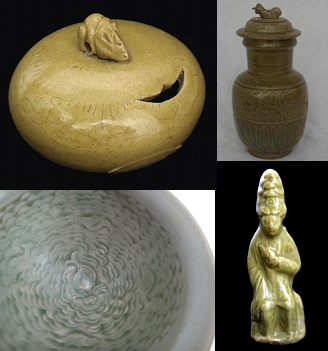
Northern Sung celadon, hand warmer with
mouse, jug and cover with bird, central
decoration of tea bowl and lady with high
hairdo -courtesy Glade Antiques and
R&G McPherson Antiques
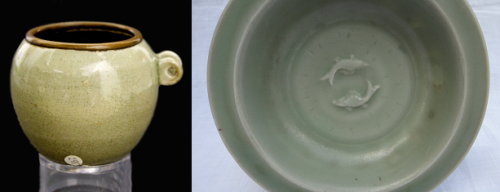
Northern Sung Longquan celadon, bird
feeder with bronze rim and dish with two
fishes denoting harmonious marriage -
courtesy R&G McPherson Antiques
During this period celadon ware was also made in the Longquan kilns in Southern Zhejiang.
Chun (Jun) ware was a close relative of the Northern Celadon, with important kilns in Henan Province near Lin-ju Hsien, 100 miles south-west of Kaifeng and Yu-Hsien further east. However, the wares were produced by many kilns over a wide area, particularly Shanxi province, so there is a great variety of body colours and textures. It was popular from early Sung until well into the Ming period. Early on it was thick-walled, heavy, low-fired stoneware with a thick pale-blue/lavender glaze.
It appears to have been fired twice, firstly with no glaze at a relatively low temperature, then the glaze was applied and the pot fired again. Chun glaze is one of very few that can with certainty be termed an ash glaze (using burnt plant material), from the phosphorous content not found in feldspathic materials. The lavender colour comes from small amounts of iron oxide and reduction firing. There is a considerable variation in colour, surface texture and brilliance, depending on the firing temperature, its profile and soak time.
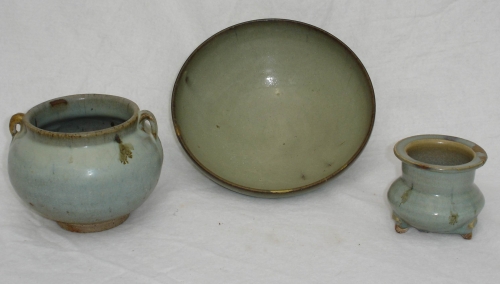
Sung Chunware - courtesy Glade Antiques
There was often insufficient soak time, so bubbles were not driven out of the body and glaze. The finest quality pieces were smooth, glossy and brilliant. The high gloss was due to very fine grinding of the basic materials, and the bubbles provide the characteristic Chun opacity. Of the forms made, one speciality was (rather hard) neck-pillows. Pots were of a single colour with the velvety/creamy glaze effect. Early in the 12th century there was a phase of decorating the wares with splashes of purple or crimson using copper oxide before firing, which contrasted well with the subdued lavender tone. Sometimes excess copper oxide oxidised to bright green on small patches of the surface adding to the attraction, but this process was not controllable. The finest Chun ware was of very high quality, but later Chun wares created a less attractive “mottled” effect which Ming connoisseurs later referred to as “mule’s liver”.
The Emperor Hui-Tsung, an accomplished calligrapher, replaced Ding ware by the much more exclusive Ru or Ju ware in late Northern Sung. It is generally considered the most illustrious and highly prized of the Sung ceramics, but only some 60 examples remain. It was related to Chun and Northern Celadon, and was a low-fired stoneware with a soft milky glaze of blue or greyish-green having a hair-thin crackle, covering a pale grey or buff body. It was simple in shape but very effective. It was only produced for a few years in Lin-ju Hsien, as the kilns closed when the Sung moved south.
| Page: 112 of 418 Go To Page: | |
◁◁ First | ◁ Previous | Next ▷ | Last ▷▷ |
Author: Dr. Stan Jones © Copyright 2010 -