

8. Ceramic Development in China
| 772 Page: 113 of 418 Go To Page: |  |
◁◁ First | ◁ Previous | Next ▷ | Last ▷▷ |
Cizhou ware was the popular decorated stoneware named after the town now called Tz’u-hsien in South Hebei where the principal factory was located. It was well developed by the early 11thcentury and by the end of that century there were many kilns producing it in Hebei, Henan and some in Shanxi Provinces. Some kilns were alongside others making more specialised products, such as fine quality Chun Ware in Yu-hsein. Cizhou ware had great diversity and was the mass-produced pottery of the Sung period that was still being produced in the Yuan and Ming Dynasties, using the same colours and decoration. The stoneware was fired at 1200 degrees C and the body varies widely from grey, off-white and buff to dark grey and dark brown in later periods. The glaze is normally transparent, colourless or green. These glazes were fluxed with lead, could not withstand stoneware temperatures, so had to be applied after the first firing and fired again at 950 degrees C. The sturdily potted jars, vases and bowls, having strong shapes, were always coated in white slip and boldly painted with patterns, using black and brown slips.
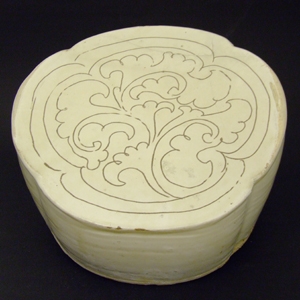
Sung pillow with sgraffito decoration -
courtesy R&G McPherson Antiques
There was a very wide repertoire of decorative designs, including inscriptions from single characters to poems. Mei-ping shaped (bulbous shoulders and narrow base or inverted baluster) vases show off this decorative technique well, as do headrests with flattened tops decorated with landscapes. Roulette wheels were also used to produce very attractive spiral patterns.
After the Tang, the kilns making Cizhou ware further north in the northeast and Liao territory were also important in keeping the polychrome lead-glazed technology alive. The body used was pink to reddish earthenware, often slipped before decoration. Colours were mainly amber and yellow – there was no cobalt blue and little iron red.
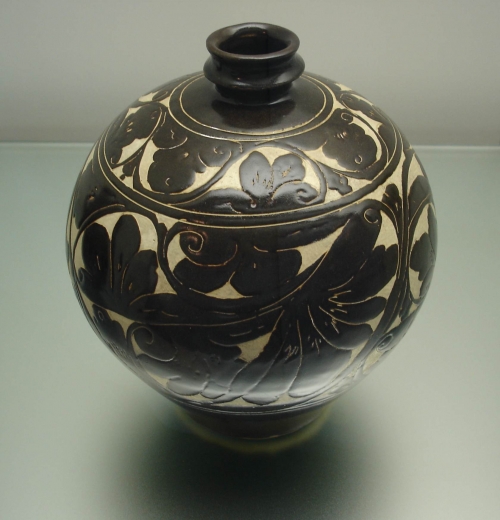
Northern Sung Cizhouware jar with black
sgraffito decoration - source Hong Kong
Museum
Another well known Cizhou technique that lasted from the late 10th century to the end of the 14th century used two layers of slip, firstly a thin haematite (iron) brown slip followed by a thick white slip on a grey stoneware body. Decoration was carried out by carving or incising through the white layer so that after glazing and firing the decoration showed up dark brownish grey or red, the latter being characteristic of an iron slip (this technique was later known as sgraffito).
A variant was to use a white first slip then a black slip thickly applied to carefully designated areas - details were then incised through to the white slip beneath. This produces a bold and pleasing effect, and was also continued through to the 14th century. The glaze was usually colourless but some green lead-glazed items were produced in the 12th and 13th centuries. Black wares are inseparable from other Cizhou Wares as they have similar bodies and were made in the same centres from the late 10th to the late 14th centuries. Most pieces were covered in a thick black slip and a transparent brown glaze, both heavily loaded with iron oxide, producing a black ware when fired in an oxidising atmosphere.
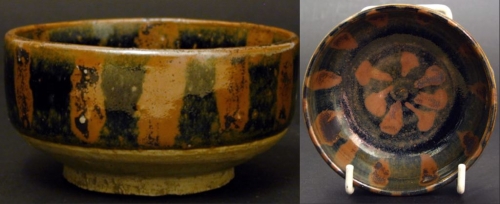
Sung or Chin, Cizhou bowls black glaze
with splashed brown markings - courtesy
R&G McPherson Antiques
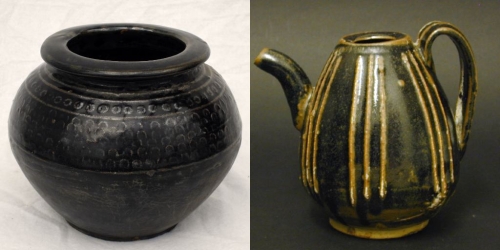
Sung blackware jar and ribbed ewer (glazed
twice, once brown then black) - courtesy
Glade Antiques and R&G McPherson
Antiques
Various attractive effects could be obtained by varying the firing techniques and colour balance in the slip and glaze. A period of reduction near the end of firing caused excess iron to be precipitated out in crystalline form, producing a lustrous effect known as “oil spot”. This fascinating finish looked like drops of oil on the surface of water. This effect is mainly found on plain bowls and cups without handles.
Black Ware was very popular and by the 14th century was to be found in most households, but was not considered to be a “collector’s ware”. Cizhou pottery was used all over China as well as being exported.
| Page: 113 of 418 Go To Page: | |
◁◁ First | ◁ Previous | Next ▷ | Last ▷▷ |
Author: Dr. Stan Jones © Copyright 2010 -