

8. Ceramic Development in China
| 776 Page: 116 of 418 Go To Page: |  |
◁◁ First | ◁ Previous | Next ▷ | Last ▷▷ |
Longquan (Lung-ch’uan), was the chief market town on the Hsi river in South Zhejiang, and had been producing ceramics with monochrome glaze and appliqué decoration since the time of the Southern Dynasties. Longquan potters were also well patronised by the Southern Sung and made fine celadon with a shimmering bluish-green glaze, the best of which was supplied to the Imperial Court (sometimes as Guan ware). The demand for celadon wares similar to those produced in the North caused Southern Potters to refine their glazes, eventually firing jade-green glazes on red-brown bodies. More generally the body material varied from heavy, compact grey stoneware to almost white porcelaneous material. Except in the finest whitish-bodied wares, the exposed foot turns bright reddish-brown, not found in Northern Celadon. The glaze is opaque, grey-green/grey-blue, as usual depending on firing and reduction.
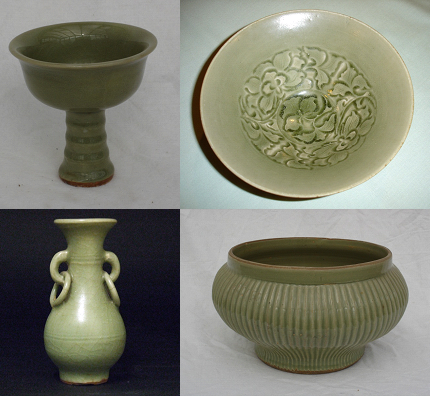
Southern Sung celadon stem cup, dish,
bronze-form vase and large ribbed bowl -
courtesy Glade Antiques and R&G
McPherson Antiques
It was fired at 1180-1280 degrees Celsius, the glaze being greener at higher temperatures. Opacity is due to plant ash and bubbles scattering the light. Dragon Kilns were used which could fire 20-25,000 pieces in one cycle, so it was a big industry. All ceramics were fired in saggers and from the middle of the 13th century some of these were very large. Quality was better from the top levels where the temperature rise was extended and very even. Simple bowls predominated, but there were also mallet-shaped vases with dragon or fish handles. Decoration, if used, was simple lotus petals round the outside of some bowls; however, with time the carved decoration increased and became more elaborate. From the middle of the 13th century, sprig-moulded elements such as the two fish in the centre of the bottom of a dish became popular. Potters making this ware also copied archaic models closely, as these were greatly admired by the scholar class. Examples included “Cong” vases that were rectangular in shape and found only in the tombs of boys and men, together with “Kuei, Li, Tsun and Ku” vessels. A variant of Longquan with strongly marked crackle became known as Ko ware, named after the elder brother of the factory Director.
Kilns in wooded hills round Chien-yang in North Fujian Province produced the best-known Chien (Jian) Black Ware of Southern China, from the middle of the 11th to the early 14th centuries, for local domestic use and export to Japan. The main product was heavily potted, dark brown or black stoneware tea bowls covered with thick black glaze.
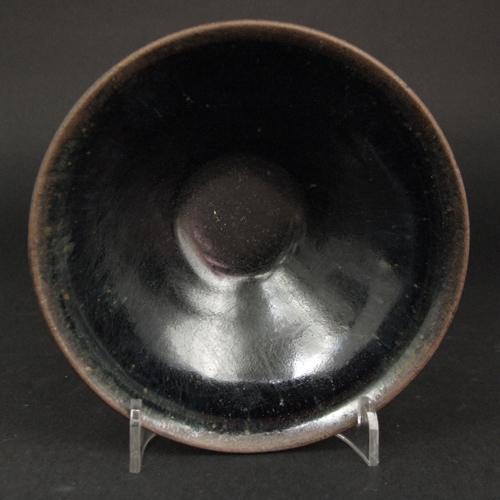
Southern Sung Jian ware black tea bowl -
courtesy R&G McPherson Antiques
The thick glaze had an iron content from 2 to 10%. The lower concentration fired a pale glossy yellowish-brown, often transparent. Higher concentration produced the finest and rarest of these conical-shaped Jian tea-bowls that have streaks or oil-spot effects referred to as “hares fur” or “speckled partridge feather” glazes, caused by the iron precipitating out of the glaze.
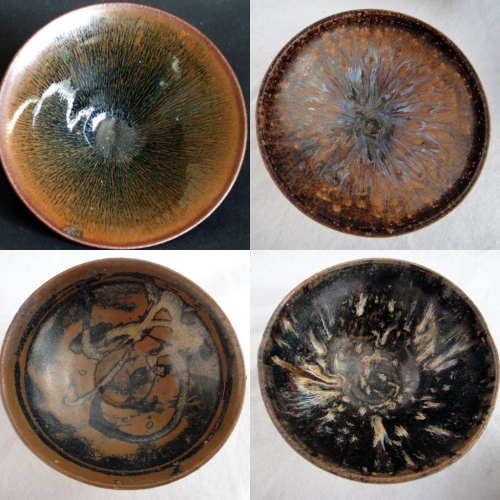
Sung Cizhou blackware Jian teabowls -
courtesy R&G McPherson Antiques and
Glade Antiques
They were much prized and in great demand for use in the tea ceremony which the Emperor had caused to become a social event. These, and the tea ceremony itself, were exported to Japan, which was heavily under the cultural influence of China at this time. Japanese Tea Masters called them Temmoku ware, after Tien-mu the sacred Buddhist Mountain in Zhejiang Province near the port where it was shipped to Japan.
| Page: 116 of 418 Go To Page: | |
◁◁ First | ◁ Previous | Next ▷ | Last ▷▷ |
Author: Dr. Stan Jones © Copyright 2010 -