

8. Ceramic Development in China
| 775 Page: 117 of 418 Go To Page: |  |
◁◁ First | ◁ Previous | Next ▷ | Last ▷▷ |
Chi-Chou (Jizhou) wares were named after the market centre in South Jiangxi, but were made by a small group of kilns lower down the Kan River at Yung-ho. These kilns started in late Tang, peaked in the Sung and then declined as potters moved north to Jao-chou in the late 13th century. A disaster caused their closure in 14th century. The bodies were both porcelaneous and stoneware, with neutral, transparent glazes for the former and opaque celadon and higher iron yellowish-brown, dark brown and black for the latter. The best-known decorative techniques are using leaves, called “leaf Temmoku” by the Japanese, and paper cuts. The outside of the bowl was usually plain black, or mottled with a second application over the black of a pale yellowish glaze, producing a tortoiseshell effect.
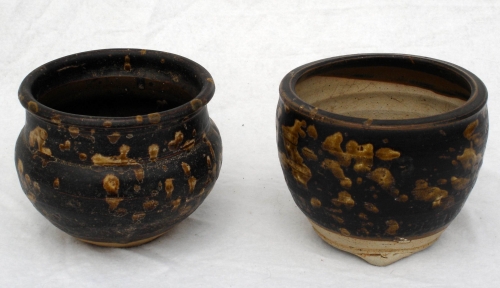
Southern Sung tortoiseshell or tigerware
bowls - courtesy Glade Antiques
A leaf or leaves were stuck to the inside of the unfired body and the whole surface, including the leaf, covered with a high-iron glaze. Oxidising firing burnt out the leaf carbons, leaving it a pale yellowish-brown shadow against the brown/black background. The paper cut method is similar but uses reduction firing so the carbon in the paper remains black against the flecked pale buff glaze.
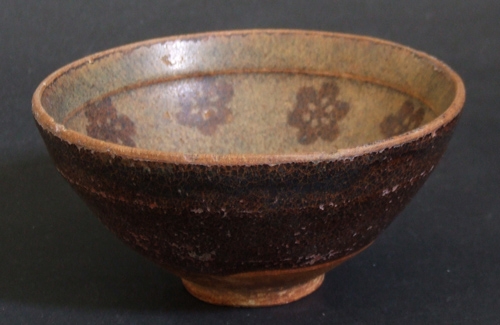
Southern Sung Cizhou paper cut decoration
- courtesy R&G McPherson Antiques
Often the decoration used characters as a message such as “long life”. Other products were decorated by painting with a pale slip on a dark ground, or dark brown on a cream slip.
There is also a variant of the cut glaze effect. In Chi-Chou ware, paper cut outs are lightly stuck onto the unfired body with small tabs sticking out. After glazing with a viscous glaze, but before it dried, the tab is used to pull off the paper leaving an unglazed area for hand painting and incising before firing. This method was used on both bodies, but dark glaze was used for stoneware and pale blue transparent glaze for porcelaneous.
Moulding was only used for manufacture and decoration of the white-bodied porcelaneous ware. These wares were mainly conical bowls with prunus and crescent moons carved in low relief covered with neutral or celadon glaze. Chi-Chou ware was quite variable in quality from very good to coarse, sugary, fragile and lightweight. The latter was reserved for tomb ware.
Kilns began operating at Jingdezhen in Jiangxi Province in the 7th or 8th century during the Tang dynasty, but only when the demands for agriculture permitted, as farmers were part-time potters. In the Sung Dynasty, from the start of the 11th century, many centres that were important in the production of a variety of ceramics were active in North Jiangxi, near Po-yang Lake. They were already producing extremely refined porcelain from local kaolin and “petuntse”, and some considered it likely that “true” porcelain originated several hundred years earlier in this region rather than further North or East. Petuntse is derived from the phrase “pai-tun-tzu” or little white bricks. This white highly feldspathic and micaceous (platelets) material was mixed in the region, then crushed, washed and dried and formed into the little white bricks for transport to the potteries. The porcelain factory at Jingdezhen was founded in 1004 AD. It was privately owned and operated by families solely manufacturing porcelain, and it was growing to meet the vast increase in population of South China, using trained craftsmen rather than farm labourers. At first it supplied wares for the local market in South China, with some finding their way to South East Asia, India and the Middle East.
| Page: 117 of 418 Go To Page: | |
◁◁ First | ◁ Previous | Next ▷ | Last ▷▷ |
Author: Dr. Stan Jones © Copyright 2010 -