

8. Ceramic Development in China
| 777 Page: 118 of 418 Go To Page: |  |
◁◁ First | ◁ Previous | Next ▷ | Last ▷▷ |
Although products from Jingdezhen did not attain Imperial favour in the Sung period, the importance of the burgeoning ceramic industry was not lost on the Emperor. The need to finance the army to defend the northern borders became even more acute when the Mongols invaded in 1250 AD. The battle was long and drawn out, but the outcome was inevitable, as the Mongols were much more experienced fighters. To raise the necessary revenue, the Sung government sponsored overseas trade, particularly porcelain and stoneware exports. It installed a series of Superintendents of Shipping at ports including Canton (already having first position in overseas trade), Wen-chou in Zhejiang and Chuan chou in Fujian (which from the middle of the 13th century superseded Canton, and from the 14th century became the largest mercantile port in East Asia). The industrialisation of the ceramics industry, the demand from overseas markets for porcelain in particular and the governmental pressure and inducement to export created an explosion of ceramic production, much of it focussed on Jingdezhen. In later times it was to become known as the capital of Chinese porcelain.
The most characteristic ware was a fine white porcelain covered with a transparent but slightly bluish glaze called Ch’ing-pai (Qingbai)(Chinese for bluish-white). It had been produced from the late 10th century during the Northern Sung period.
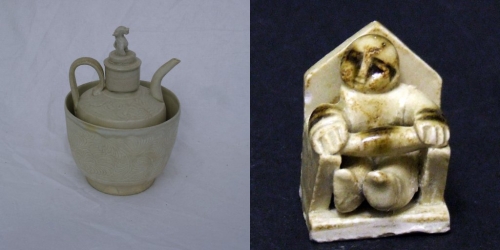
Earlier Northern Sung Qingbai porcelain,
drink warmer and baby in chair - courtesy
Glade Antiques and R&G McPherson
Antiques
The main problem facing the potters was the lack of plasticity of kaolin-based porcelain compared with earthenware or stoneware. This meant they either had to throw small, very thinly potted pieces on the wheel, or if larger pieces were needed, put up with them being rather thicker. Initially they made small, simple, very thinly potted bowls that required the minimum of subsequent shaving and finishing. As the skill in shaving the outside wall improved, bowls and vases became larger and were joined by ewers, multi–lobed gourds, lamps, incense burners and very elegant vases. At first the bowls were entirely undecorated or with an almost imperceptibly incised or carved relief work. Some examples also had decoration applied in raised slip or as beading under the glaze and others used a combing instrument giving lines and dots. Again, beauty of form was preferred to colour as a decorative effect.
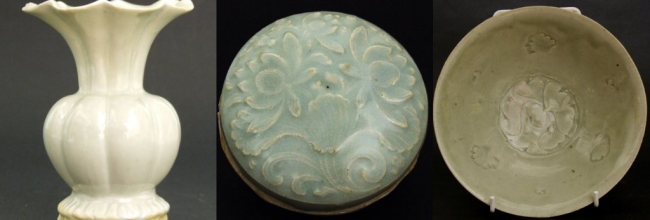
Southern Sung Qingbai porcelain fluted
vase, moulded lotus decorated box and bowl
with carved decoration - courtesy R&G
McPherson Antiques
About the middle of the 12th century, moulding was added, primarily for bowls and saucer shapes. The use of moulds was particularly useful for porcelain, as the clay’s tendency to crumble was considerably reduced and shaving could be carried out on the mould. This way the thinnest pieces could be made more easily and quickly without breaking up. The decorative style used bears little resemblance to the nearest comparable Northern white ware, Ding. In the South the treatment of the surfaces was less free, so flowing lotus scrolls and ducks swimming in a reeded pond are not found in the South. Firing was always on the foot or base until moulding was introduced, when items were fired on their mouth rims as was Ding Ware, but in Ch’ing-pai there was a tendency to sag in the middle. The rough rim was covered with a wide band of silver rather than the copper commonly used with Ding. The glaze was prepared by fritting ground petuntse with brushwood and leaves. The fritted material was then ground to a suitable particle size, mixed with water to a thin creamy consistency then applied to the unfired body. The slightly bluish tinge was due to reduction of traces of iron. Occasionally it came out pure white by accident, but it was not until the 18th century that this could be controlled.
| Page: 118 of 418 Go To Page: | |
◁◁ First | ◁ Previous | Next ▷ | Last ▷▷ |
Author: Dr. Stan Jones © Copyright 2010 -