

8. Ceramic Development in China
| 784 Page: 125 of 418 Go To Page: |  |
◁◁ First | ◁ Previous | Next ▷ | Last ▷▷ |
When the Ming Empire started it had about the same area as in the Three Kingdoms. The Ming consolidated their hold on China, and throughout their Dynasty rebuilt the Great Wall along the lines of previous fortifications on their northern border, and extended it. However, the Hongwu and Yongle Emperors were warriors and also introduced an expansionist policy. They looked for land expansion, annexing Korea in 1392 and expanding into Central Asia, gaining influence as far as Turkestan. The Yongle Emperor built up an army of a million men by giving them land, often near their posts, in lieu of pay. Many were full or part time farmers in quieter times, contributing greatly to the economy. They invaded the Mongols in the north and Annam (present Vietnam) in the south. The first campaign in the north ended in 1424 with the death of the Yongle Emperor. After his death the Chinese army was not so well supported and matters started to go downhill. The army was expelled from Annam in 1427. The Yongle Emperor had permitted his eunuch bureaucrats to assume great power, as he was powerful enough to control them, but the weaker Emperors who followed him suffered badly from the bureaucrat’s self-interest. When the young Emperor Zhengtong assumed the throne in 1435, he was advised by them to get personally involved quelling a Mongol rebellion in the north. Making matters worse, in the 1440’s there were agrarian uprisings in the southeast, due to crop failures and floods, and a rebellion in 1448 led to one million deaths. China’s expansionist policy had to be put on indefinite hold. The Chinese army was defeated by the Mongols in 1449 and the Emperor captured. His brother Jingtai was declared Emperor, so the Mongols freed the now worthless previous Emperor! Zhentong lived in exile in rural China until his brother died in 1457 when he resumed the throne – to everyone’s annoyance. When he died in 1464, he was succeeded by Cheng-hua, and a more stable period followed.
Through all this, many areas progressed well during the Ming period. New agricultural methods and crops were introduced (including yams, maize, peanuts and potatoes by Europeans). This contributed to the doubling of the population to 150 million by 1600 (The population had fallen dramatically from 115 million in 1200 to 70 million in 1400 due mainly to the plague). Industry and trade flourished and China became a major trading partner with South West Asia, Japan and the Middle East. The Grand Canal was built to significantly improve transportation between Peking and Hangzhou, a distance of 1,000 miles. With increased commerce, particularly under the Wanli Emperor (1572-1620), Chinese pottery exports increased greatly and Europe also joined the queue of willing traders sending ships to China to buy expensive luxury items which could not be manufactured in Europe, particularly the porcelain or “White Gold from Cathay”. From the mid-16th century much of this porcelain was paid for with silver from Japan and the New World.
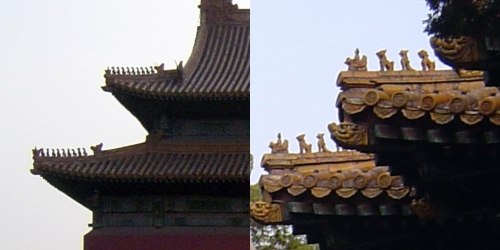
Forbidden Palace roof ridge figures
The third Emperor’s Palace, the Forbidden City, is the foremost surviving Chinese palace compound – maintained and rebuilt over the centuries. Only the vast Imperial burial ground, North of Beijing, not far from the Great Wall, which now houses 13 mausoleums, matches the grandeur of the Palace. The Palace complex, which is on a colossal scale, is an amazing range of huge wooden buildings – Chinese architectural culture meant that fired bricks and stone were only used as building materials where it was considered to be essential such as for bridges, fortifications and underground tombs. The last rebuilding of the Hall of Prayer for Good Harvests in the 1890’s required such tall timbers that they had to be imported from the US. The glazed pottery figures decorating the roof ridges are very noticeable on these buildings.
| Page: 125 of 418 Go To Page: | |
◁◁ First | ◁ Previous | Next ▷ | Last ▷▷ |
Author: Dr. Stan Jones © Copyright 2010 -