

8. Ceramic Development in China
| 786 Page: 131 of 418 Go To Page: |  |
◁◁ First | ◁ Previous | Next ▷ | Last ▷▷ |
Another colourful painting style called “wu ts’ai” or “wucai”, meaning five colours, developed in the Jiajing period. It comprised three overglaze enamels – red, green and yellow, underglaze blue and the white of the body.
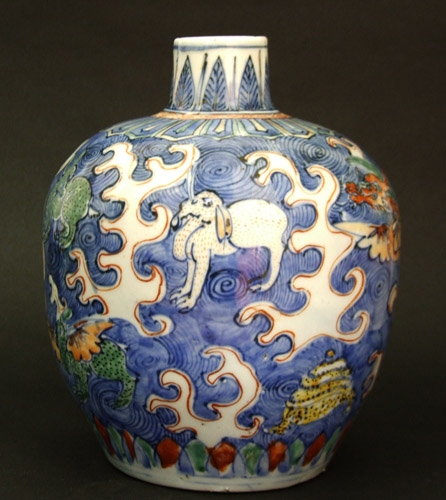
Ming Wanli porcelain jar with wucai
decoration - courtesy R&G McPherson
Antiques
Scholars were often amateur artists, and in their workrooms they would have 4 “treasures”, namely a paintbrush, ink, grinding stone (for ink) and paper. All these were frequently used in a stylised way in decoration on porcelain.
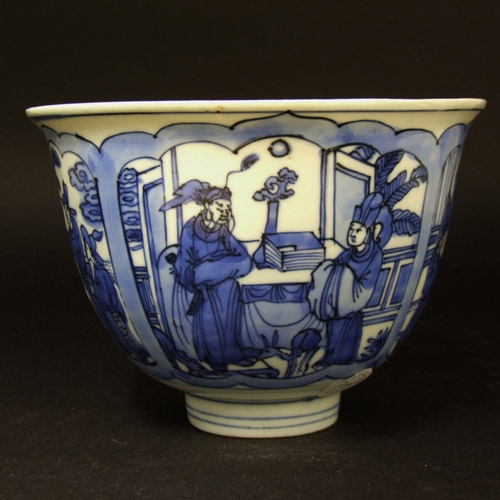
Ming Jiajing blue and white bowl, scholars
and officials - courtesy R&G McPherson
Antiques
In the Jiajing and Wanli periods the Imperial kilns were not well managed and products were sometimes of poor quality, although private factories were able to turn out lively wares until the end of the Dynasty. Emperor Wanli was notorious for his irresponsible attitude to finances. Orders for porcelain from Jingdezhen would be cut back for lack of funds half way through their execution, leaving the factory financially strapped with unwanted orders left on their hands. He squandered money on luxuries and his funeral arrangements were as extravagant as his life had been.
The impact of Chinese porcelain on Europe was significant. This can be judged by the huge volume of blue and white porcelain recovered from cargo ships that sank in the 17th and 18th centuries.
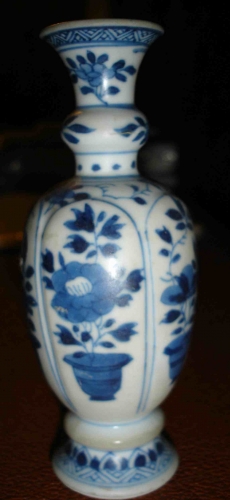
Vung Tau cargo small blue
and white vase
Interestingly, in 17th century paintings by Rembrandt and other Dutch still-life artists, the pottery is presumed to be Delft earthenware but in fact it is Chinese porcelain. Europeans commissioned porcelain by sending patterns of their desired shapes and decoration, for example using wooden models, and the earliest such model was received in Jingdezhen in 1635. There are some extremely amusing decorations on some of this commissioned porcelain where Chinese decorators have attempted to depict things they have never seen before, such as strange lions or tigers, and weird clothing.
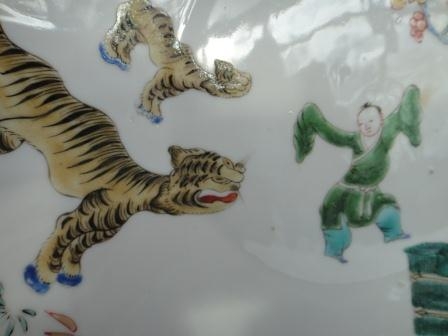
Later Kangxi period plate with strange
tigers - courtesy Glade Antiques
A class of blue and white porcelain “mass produced” for export to Europe was called Kraak. It was the Dutch translation of the type of Portuguese cargo ships called carracks often used to transport porcelain from China to Indonesia. The Dutch captured one loaded with porcelain in 1603 and the name stuck. After their early, less-than-successful naval expeditions, the Chinese Emperors prohibited the building of large ships, so global trade relied on European transport. Kraak items were mainly plates, wine-jars, bottles, bowls and drinking bottles (kendis). The porcelain was fine, the glaze transparent and thin, but tends to flake off curved edges, referred to as “insect nibbled” or by the Japanese as “moth eaten”.
| Page: 131 of 418 Go To Page: | |
◁◁ First | ◁ Previous | Next ▷ | Last ▷▷ |
Author: Dr. Stan Jones © Copyright 2010 -