

8. Ceramic Development in China
| 790 Page: 130 of 418 Go To Page: |  |
◁◁ First | ◁ Previous | Next ▷ | Last ▷▷ |
Whether great care was taken in the making of monochrome pieces, or mass production techniques were used for porcelain with underglaze colour, the items were ideally suited to their basic purpose, even though the shape may have been based on one 1,000 years old. In a prosperous household you may have found the guan, with its small opening, useful for storing wine, the lei with its sweeping broad opening and round body which was established as a spittoon, high round containers used to keep toy fish (with decoration of water plants, fish and ducks to match).
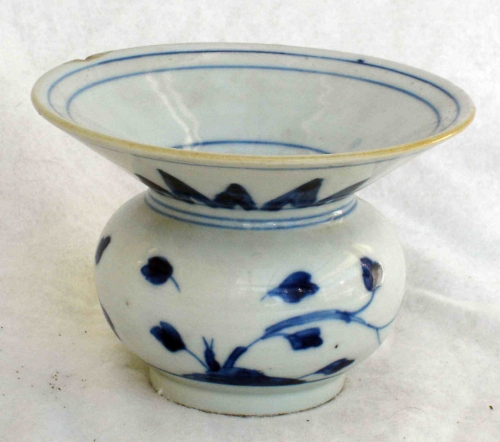
Later Qing spittoon from Nanking cargo -
courtesy Glade Antiques
Little round boxes with grooved tops were for crickets and what in Europe was considered in the 18th-20th centuries to be an appropriate shape for a tea caddy (a bulbous tall container with a small circular lid) was already being used by the Chinese in the Ming period. Along with these were plates, cups, pots and little bowls – some of which were the caged bird feeders. Flower vases were also very important in the Ming period and books appeared on flower arranging – one by Yuan Hongdao became a classic in Japan. As an example of the fashion of the times, a manual on the use of craft products for house decoration by Wen Zhenheng in 1620 instructed that bronze vases should be used in winter and porcelain ones in summer.
Often Chinese artists liked to copy artists of previous Dynasties so the Ming painters copied those from the Tang and Sung periods. Celebrated Master painters such as Qui Ying (1494-1560) advanced the painting of garden scenes. These paintings together with paintings of houses and figures could have had a great influence on Europe’s image of China. They would have been seen by Europeans active in China at Court and in business. In the 15th century many designs on ceramics were of a standard form. Now these new decorations were also used on ceramics, with flower patterns being the most prevalent. Densely woven branches and blossoms in extremely stylised forms were used, and by the Wanli period (1572-1620) it was as if gardens were spread out over the porcelain. In fact gardens were a rapidly growing phenomenon and a popular book appeared in 1634 describing their design.
Decoration usually had a meaning rather than only an attractive appearance, for example emblems of good luck and happiness such as flowers, ornaments, animals, figure schemes and symbols and pictures of proverbial idioms. Porcelain ordered by the Emperor used such traditional decoration, but alongside this was decoration such as Taoist symbols and Japanese-style painting for Japanese customers, and floral patterns and Koran inscriptions for the Middle East. So at this time Chinese potters at Jingdezhen had to be capable of producing anything a merchant may demand, only occasionally coming unstuck when faced with some inscriptions in Arabic or Latin. In the reign of Zhengde (1505-1521) the all-powerful eunuchs, who were mainly Muslim at this time, sent orders to Jingdezhen for an unusual group of blue and white ware with inscriptions in Arabic and Persian – many were items used by scholars such as writing boxes and brush rests. One example, a table screen, has an inscription from the Koran, which is easy to read even though made by artists unfamiliar with Arabic script.
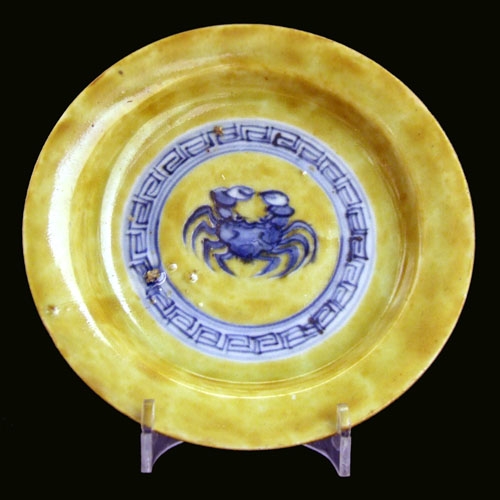
Late Ming Jiajing mottled yellow ground,
blue and white, crab centre for Japanese
market - courtesy R&G McPherson
Antiques
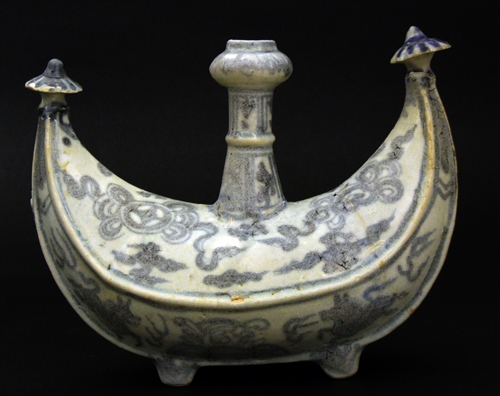
Ming Hongzhi crescent shaped ewer for
Islamic market - courtesy R&G
McPherson Antiques
From the Jiajing period (1521-1566) the designs had a much more popular appeal, containing children, animals and birds in naturalistic surroundings such as gardens or open landscapes. Often inspiration came from illustrations in contemporary books or from familiar objects.
| Page: 130 of 418 Go To Page: | |
◁◁ First | ◁ Previous | Next ▷ | Last ▷▷ |
Author: Dr. Stan Jones © Copyright 2010 -