

8. Ceramic Development in China
| 794 Page: 135 of 418 Go To Page: |  |
◁◁ First | ◁ Previous | Next ▷ | Last ▷▷ |
Blue and white wares in the Kangxi period are particularly noted for the precision of the drawing and the use of cobalt washes of vivid intensity. As before, the decoration included floral motifs, well known scenes from literature or mythology and depictions of the life of the literati.
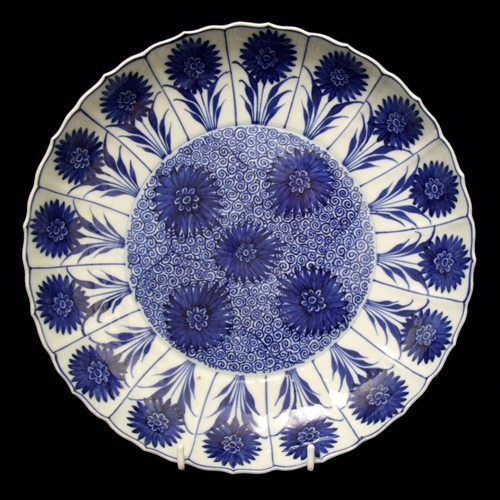
Kangxi blue and white Aster Pattern dish,
a popular export design - courtesy R&G
McPherson Antiques
There was significant exporting, making to order and copying of European style ceramics.
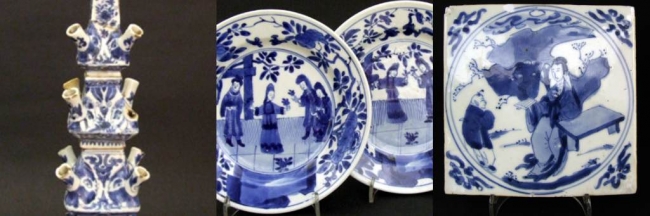
Kangxi export porcelain, Delft style flower pyramid,
European design plates – from a French engraving,
and tile imitating Delft ordered by Dutch East
India Co - courtesy R&G McPherson Antiques
Towards the end of the 17th century the use of underglaze blue declined in favour of overglaze blue. However, blue and white declined in popularity especially after the mid-18th century, as interest grew in the newer decorative techniques.
The ceramics in ascendancy were without exception colourful and the glazes were perfect, having great purity and fine sheen. Monochrome glazing was the most notable achievement in the late 17th century under Tsang Ying-hsuan. He carried out deliberate experiments to produce new glaze colours and transmutations and revive old glaze effects. There was a creative return to a wide range of classical forms. The finest pieces include small monochromes recapturing the form and glaze of classic Sung wares. One of the best and most popular revivals was Kuan-type glaze. The colour and crackle were remarkably deceptive in really good pieces.
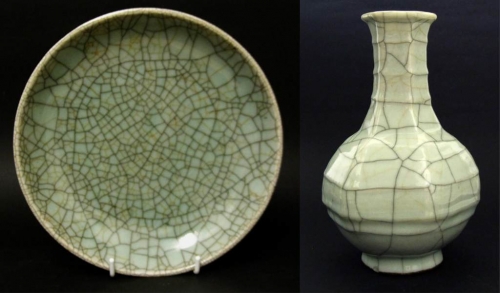
Yongzheng or Qianlong Kuan style crackle
ware, stoneware dish and vase with
“iron wire and golden thread”
pattern - courtesy R&G McPherson
Antiques
This significantly adds to the confusion over dating, as it has been suggested that during the Kangxi Dynasty more porcelain had Ming marks than Kangxi ones! They tried to imitate Ding ware, but were unable to achieve the quality of the originals. New colours and glaze effects were produced such as very pale cobalt blue called “Claire de Lune”, very pale celadon green, lustrous brown “Café-au-Lait”, turquoise blue, speckled “Robin’s egg glaze, eel-skin yellow, and snakeskin green, all on white porcelain.
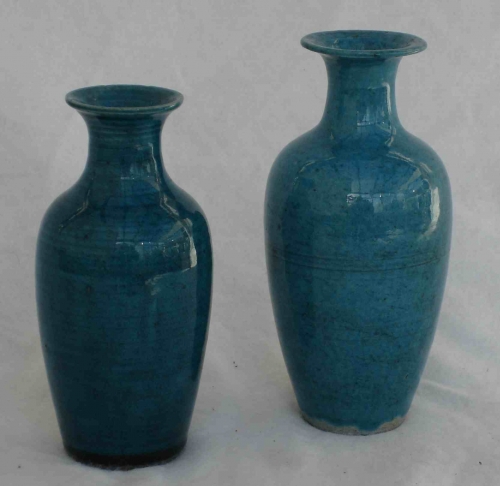
Kangxi, pair of blue vases - courtesy
Glade Antiques
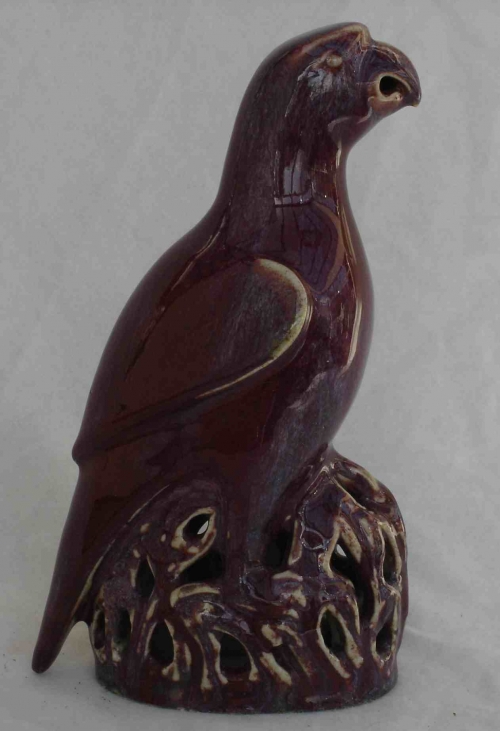
Qing sang de boeuf bird - courtesy
Glade Antiques
Later colours were rose pink, acid yellow and a green that combined with black was used to imitate ancient bronze. Mottled effects were achieved by blowing powdered coloured oxides onto the unglazed body with a bamboo tube spray then glazing in the usual way. Edges of vases and dishes often showed vivid contrast – snow white above the glaze colour. One of the most striking achievements was the reintroduction of copper red and the development from this of an exquisite soft red glaze known as “peach bloom”, together with other transmutations using copper in a reducing atmosphere. Peach bloom was difficult and expensive to produce, so was often used for small vessels made for scholars’ desks. Sometimes excess copper could break through the glaze and oxidise green on the surface. This effect was controlled and used to good effect on vases with underglaze copper red dragons with consistently bright moss green faces. Also perfected was lang-yao (Sang-de-Boeuf or ox blood) ware, covered with a rich copper-red glaze.
This was produced by firing the biscuit body, putting on the first copper charged glaze then a base glaze added in the usual way. After this it was fired a second time at a temperature much higher than the first firing – 1350-1400 degrees Celsius, which fused the porcelain body. Such high temperature accounts for the fine crackle of these pieces.
| Page: 135 of 418 Go To Page: | |
◁◁ First | ◁ Previous | Next ▷ | Last ▷▷ |
Author: Dr. Stan Jones © Copyright 2010 -