

8. Ceramic Development in China
| 795 Page: 136 of 418 Go To Page: |  |
◁◁ First | ◁ Previous | Next ▷ | Last ▷▷ |
There was also a popular, reddish, very fine-grained stoneware called Yi-hsing (Yixing) used extensively in China at this time as it was considered to improve the taste of tea, and it held its own alongside porcelain. Best-known products are unglazed but incised or low-relief decorated teapots, but some items had a bluish-grey glaze.
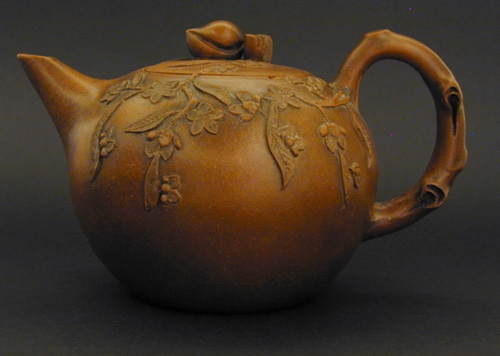
Kangxi or Yongzheng Yixing teapot with
applied cherry branches - courtesy R&G
McPherson Antiques
Polychrome wares became immensely popular in the Qing Dynasty not only in the home market but also in 18th century Europe, as they perfectly matched the prevailing Rococo taste. They became known in Europe as “famille verte” from the predominant green colour in their floral decoration. There were two types, ordinary overglaze enamel decoration - the wucai five-colour painted wares, and the other enamel on biscuit (which generally had much less white areas). Shapes popular for enamel on biscuit were teapot stands, panels for furniture and small models and figures.
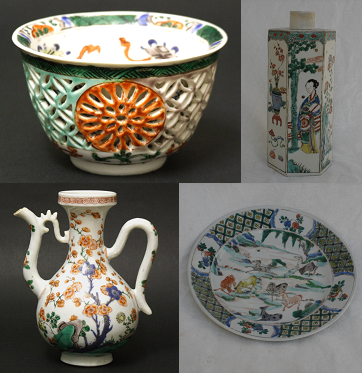
Kangxi famille verte porcelain,
double-layer tea bowl with outer
reticulated, hexagonal jar, plate with
eight horses of Mu Wang and Islamic style
ewer - courtesy R&G McPherson Antiques
and Glade Antiques
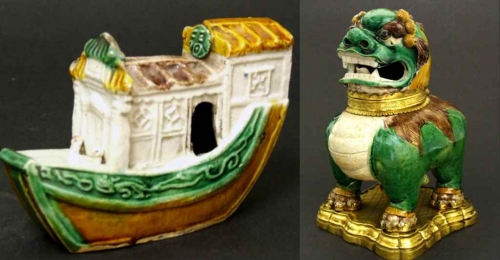
Kangxi biscuit moulded boat with dragon on
sides, and guardian lion - courtesy
R&G McPherson Antiques
These wares also included expert imitation of the overglaze painting from the Yuan Emperor Cheng-hua’s reign. Another variety, called “famille noir” used the same palette, but the black was applied to the biscuit and then translucent green enamel covered the dull black surface resulting in an extremely dense black background over which the coloured decoration was painted.
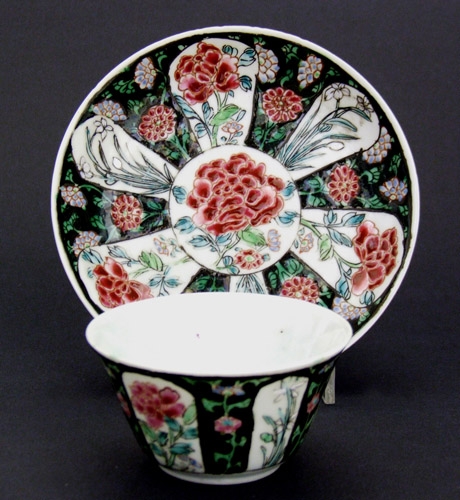
Yongzheng export famille noir tea bowl and
saucer - courtesy R&G McPherson
Antiques
“Famille rose” was introduced to China in about 1720, towards the end of Kangxi’s reign, and the following emperor Yongzheng took a personal interest in it. This new pink overglaze colour was introduced from Europe by Jesuits at the Imperial court and named yangcai, “foreign colour”. It was Europe’s major technical contribution to Chinese ceramics, and the Jesuits arranged help from Europe to teach the Chinese craftsmen. Its origins were in Limoges, France, where it was initially used as enamelling on metal and later on ceramics. Famille rose is based on colloidal gold in a high-lead enamel glaze, and it took the Chinese craftsmen 10 years to master its firing, but when they had, its quality surpassed European. Chinese ceramic craftsmen were creating goods using the wealth of classical tradition together with new ideas, so the new rose pink colour made their palettes even richer. Court artists were commissioned to design the decoration to fit desired shapes with much more attention to detail than with famille verte. The technology had improved so that enamel pastes were very stable, permitting delicate shading of tones and a wide variety of colour combinations. Minute details achieved rivalled European miniaturists. The porcelain used was of the finest quality, extremely white, thin and very translucent – faultless. Particularly good examples were birthday plates made for Kangxi’s 60th birthday in 1713 inscribed with the standard Imperial birthday greeting “long life without limit”.
| Page: 136 of 418 Go To Page: | |
◁◁ First | ◁ Previous | Next ▷ | Last ▷▷ |
Author: Dr. Stan Jones © Copyright 2010 -